Key Takeaways
- There are various types of ATSs based on the mode of deployment, business size, functionalities, and hiring needs.
- Cloud-based, on-premise, and hybrid deployment modes are offered by ATSs.
- There are independent, integrated, and artificial intelligence-based hiring processes.
- The selection of the ATS will be dependent on volume and budget.
Introduction
All organizations have different needs when it comes to recruitment. Whereas a small start-up recruiting just a few people would need a simplistic candidate management system, a large organization recruiting hundreds of candidates will need complex recruitment capabilities.
This is why different types of applicant tracking systems are available. These vary from hosting to suitability for a business, recruiting capability, and approach to recruitment. Understanding various types of ATS would allow comparison between different software and selection according to business requirements.
Read our guide on What Is an Applicant Tracking System? to understand its basics
What Are the Different Types of Applicants Tracking Systems?
Classification of ATS systems is feasible based on the following four factors: deployment, company size, software functionalities and recruitment method. Here are eight common categories.
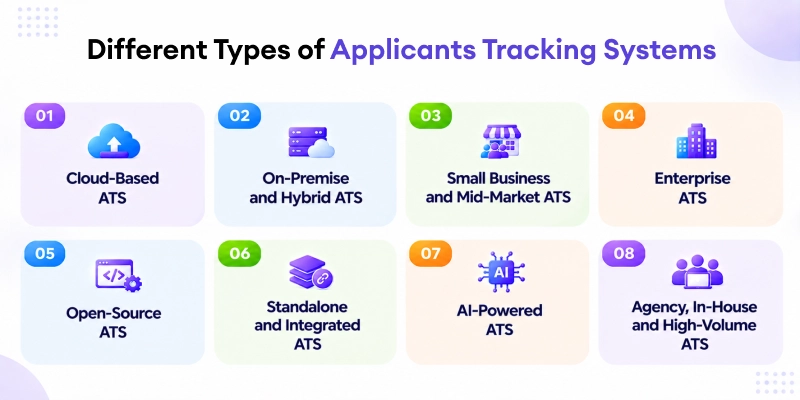
1. Cloud-Based ATS
This type of applicant tracking system is delivered to users through the Internet by the software vendor. Recruiters will be able to conduct the recruiting process remotely. Usually, the vendor takes care of maintaining and updating the system.
Best for: Startups and growing businesses seeking easy access and reduced IT maintenance.
2. On-Premise and Hybrid ATS
On-Premise ATS will be installed on the organization’s servers and, therefore, gives more control of the infrastructure and data storage. The organization is, however, responsible for hosting and maintenance costs. Hybrid ATS combines cloud services with on-premise infrastructure.
Best for: Organizations that have specific security, infrastructure, or data control needs.
3. Small Business and Mid-Market ATS
Small business-friendly ATS software supports posting jobs, managing applications, and scheduling interviews. Some even offer free systems with limited functionalities. Mid-range ATS software provides growing recruitment teams with workflow support, reporting, and collaboration.
Best for: Start-ups, SMEs, and growing businesses.
4. Enterprise ATS
Enterprise-level ATS systems are suited to companies managing multiple departments, locations, and recruitment teams. Some features can include workflow approvals, user permissions, extensive reports, and integration with other HR software systems.
Best for: Large organisations with complex recruitment operations.
5. Open-Source ATS
The source code is available to the open-source ATS and hence allows firms to customize the software according to their requirements. Technical skills would be needed for the hosting and maintenance of the software.
Best for: Businesses with development capabilities and certain customization requirements.
6. Standalone and Integrated ATS
A standalone ATS will only focus on recruiting and nothing more. On the other hand, an integrated ATS will integrate recruiting with data about employees, onboarding, payroll, and job boards.
Best for: Organizations that must choose whether to go for a standalone recruiting solution or HR solution.
Explore ATS Integration and our guide on ATS vs HRMS
7. AI-Powered ATS
The AI-based ATS uses artificial intelligence technology to filter out CVs and hire candidates through automation. This is an intrinsic system that performs such activities automatically as part of its hiring process. However, the recruitment managers need to evaluate the AI recommendation prior to hiring.
Best for: Recruitment teams handling large application volumes.
8. Agency, In-House and High-Volume ATS
These platforms support different recruitment models:
- Agency ATS: Manages multiple clients, job orders, candidate submissions, and placement. The agency ATS comes equipped with recruiting CRM capabilities to manage clients and candidates.
- In-House ATS: Manages the recruitment process of its own employees.
- High-Volume ATS: Manages the high-volume recruitment process of retail, manufacturing, hospitality, and campus recruitment.
- Industry-Specific ATS: Manages the recruitment process of health care and executive search industries, among others.
Best for: Agencies and organisations with specialised or large-scale hiring requirements.
How Do Different ATS Types Compare?
| ATS Type | Main Focus | Best Suited For |
| Cloud-Based | Online access and hosting | Startups and growing businesses |
| On-Premise / Hybrid | Infrastructure and data control | Organisations with specific IT requirements |
| Small Business / Mid-Market | Recruitment by business size | SMEs and growing recruitment teams |
| Enterprise | Complex hiring operations | Large organisations |
| Open-Source | Customisation | Businesses with technical resources |
| Standalone / Integrated | Dedicated or connected HR workflows | Businesses choosing between separate and unified HR solutions |
| AI-Powered | AI-assisted recruitment | Teams handling large application volumes |
| Agency / In-House / High-Volume | Different hiring models | Recruitment agencies and organisations with specialised hiring needs |
How to Choose the Right Type of ATS?
Consider the following when choosing software:
- Hiring volume: Quantity of positions and applications to be filled.
- Size of company: Current recruitment needs and future growth.
- Features: Job posting, resume screening, candidate management and reporting.
- Compatibility: Ability to integrate with HRMS, payroll systems and job boards.
- Cost: Annual subscription, implementation and maintenance costs.
- Data security: Data protection and vendor support services.
Also read How to Choose the Right Applicant Tracking System and Best Applicant Tracking Systems before deciding.
Conclusion
The type of ATS will vary based on the requirements of recruitment. The organization must consider issues such as hosting, functionality, volume of hiring, and integration. A small business may be able to use cloud or standalone Applicant Tracking Systems, while large businesses may choose to go for enterprise or integrated applicant tracking systems.
Companies that receive many applications may also choose artificial intelligence applicant tracking systems. Before settling for a type of ATS, it is advisable to conduct a needs assessment.
Frequently Asked Questions
What is the difference between cloud-based and on-premise ATS?
Cloud-based ATS is hosted by a provider and accessed online, while on-premise ATS is installed on company servers.
What is the difference between standalone ATS and HRMS-based ATS?
A standalone ATS focuses on recruitment, while an HRMS-based ATS connects hiring with other HR functions.
Is an open-source ATS free?
The software may have no licence fee, but hosting, customisation, security and maintenance can involve costs.
What is an AI-powered ATS?
It uses artificial intelligence to support resume screening, candidate matching and recruitment activities.
Which ATS is best for recruitment agencies?
An agency ATS supports multiple clients, job orders, candidate submissions and placement management.
Can an ATS be integrated with HRMS?
Yes. Integration can transfer candidate information into employee records and support onboarding.
Author