Key Takeaways
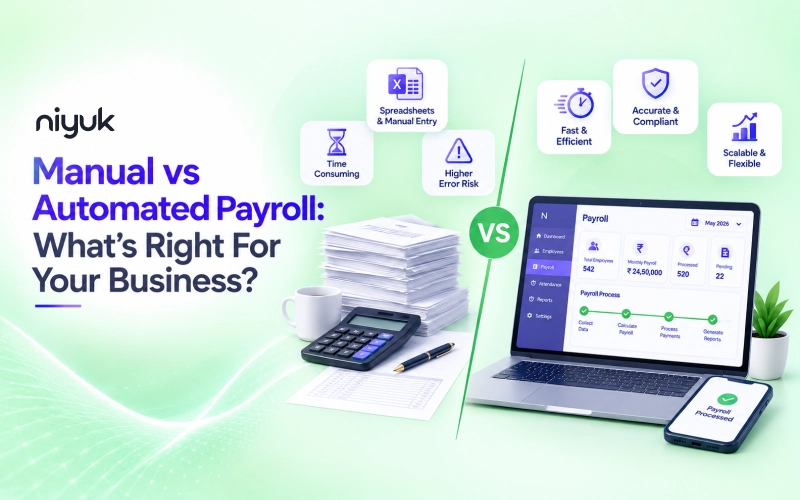
- The manual payroll requires that the salary calculations and confirmation of the employee’s details be done in spreadsheets. This process is time-consuming, especially when the business grows.
- Payroll automation simplifies salary calculations, payroll slips creation, and payroll reporting due to reduction of the repetitiveness of the tasks.
- Costs of payroll processing include the time spent on correcting the mistakes and compliance of the payroll processing rules.
- The automatic payroll system maintains consistency in payroll processes and needs accurate data and proper HR management.
- The selection of the payroll management system depends on the size of the employees, payroll requirements, budget, and compliance.
Introduction
It is critical to have a timely payroll process for all companies; however, it might be more complex depending on the size of the organization. Calculation of salaries, deduction checks, attendance controls, and payroll processing might take a lot of time.
There are two types of payroll processing. The first one is manual payroll, and the second one is automated payroll. Understanding the difference between these methods will help companies save time, reduce errors, lower expenses, and choose appropriate payroll
How the Payroll Management Process Works?
The payroll management process involves collecting attendance records, calculating salaries, checking deductions, preparing payslips, and processing salary payments. The process helps keep everything organized.
The payroll management process may be suitable for companies that have only a few employees and simple pay structures.
- Collect employee attendance and working-hours records.
- Calculate basic salary, allowances, overtime, and bonuses.
- Calculate applicable taxes and other deductions.
- Verify employee information and payroll calculations.
- Prepare payslips and payment records.
- Process salary payments.
- Maintain payroll records and compliance records.
The two types of payroll management process that is followed in different organizations of different sizes are:
| Manual Payroll | Automated Payroll |
| A manual payroll is the method in which the HR department or the finance department computes the salary and deduction of the employees using the calculations in the excel sheets or manually. | This is a procedure in which the payroll software calculates the wages, deductions, tax and employee’s net pay from the information known about them. |
Based on the current scenario, as the HR automations are in demand, manual processes are getting replaced with automated payroll, that makes a huge difference in saving time and money of the organisations. As there are several challenges in practising manual payroll, let’s get to know how it can cost more to the business.
How Is Manual Payroll Costing Your Business More?
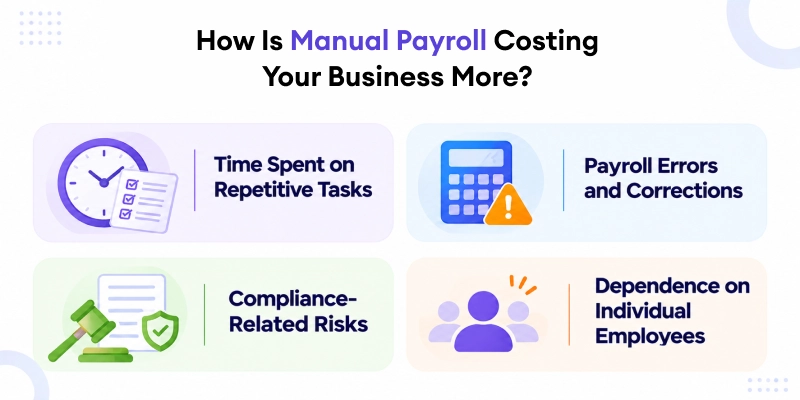
Manual payroll may appear cheaper because teams can use current spreadsheets and workplace tools. However, the payroll processing costs include the time employees spend processing payroll and correcting mistakes.
Time Spent on Repetitive Tasks
The HR team often spends many hours gathering data related to attendance, verifying leave balances, calculating overtime payments, managing payroll data, and creating payslips. This takes time which could be better used in other aspects of HR. By using payroll software in business, it will save time on such repetitive tasks.
Payroll Errors and Corrections
An incorrect spreadsheet formula, a data-entry error, or outdated payroll data can cause incorrect payments. Fixing those errors requires recalculations, approvals, and communication with employees.
Compliance-Related Risks
Manual monitoring could make it tough to track requirements and time limits. Businesses in India must account for PF, Employees’ State Insurance (ESI), Tax Deducted at Source (TDS), professional tax, and other applicable obligations.
Errors or missed deadlines can result in penalties or additional costs, depending on the applicable regulations and circumstances.
Dependence on Individual Employees
If only one person is aware of the process of preparing the payroll spreadsheet, that person’s absence might delay payroll preparation each month. Having clear guidelines is beneficial in this situation.
What Is Payroll Automation?
Payroll automation is when the use of software simplifies payroll processes. Payroll automation makes it easy to compute salary and deductions, prepare payslips, and prepare payroll reports. Payroll management system assists organizations in processing such payroll activities efficiently.
How an Automated Payroll System Works?
Dependent on the particular software application, the HR department can combine payroll processing with attendance management and leave management, employees records and accounting.
For example, the automated payroll process may use the approved attendance records for computing the payable number of days using the configured salary structure. HR professionals can then review exceptions and approve the final payroll.
Key Features of Payroll Automation
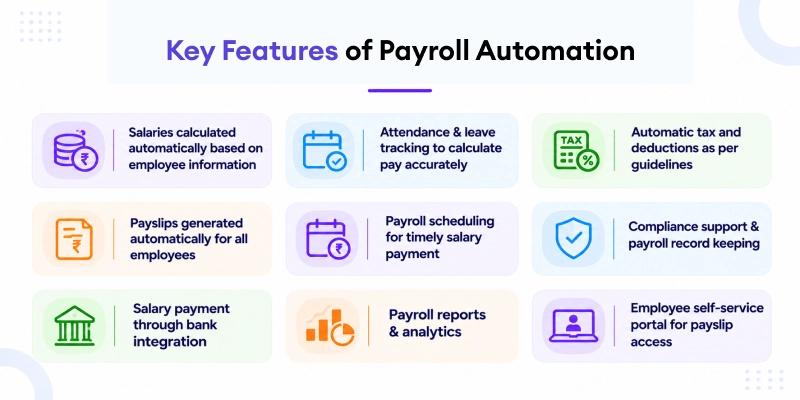
- Salaries calculated automatically based on employee information
- Attendance & leave tracking to calculate pay accurately
- Automatic tax and deductions as per guidelines
- Payslips generated automatically for all employees
- Payroll scheduling for timely salary payment
- Compliance support & payroll record keeping
- Salary payment through bank integration
- Payroll reports & analytics
- Employee self-service portal for payslip access
How Does Payroll Management Automation Save Time and Money?
Payroll management automation saves time and money by helping organizations to reduce effort by standardizing routine activities.
Faster Payroll Processing
All this is done automatically, which reduces the amount of manual input that goes into the creation of spreadsheets. The HR department can now focus on the verification of payroll data and salaries.
Improved Calculation Consistency
Payroll software applies configured rules consistently. It may flag missing information or unusual values. This helps reduce calculation errors, although incorrect source data or outdated settings can still affect results.
Payslip Generation
Most payroll systems produce payslips in batch mode and enable the employees to view their payslips using self-service facilities. This ensures time is saved in delivering the documentation and answering any questions relating to this documentation. This functionality is normally available in payroll management systems that streamline payroll processing.
Better Payroll Cost Visibility
The automated report will be useful for HR and finance departments for evaluating salaries expenses, payroll deduction and payroll adjustment. The data may be useful for planning and financial forecasting. Increased availability of payroll data will help businesses to better understand payroll processing costs.
A Practical Cost Example
Let us consider a firm that takes 24 hours per month for manual payroll processing. If the total cost of the employees per hour is ₹400, the administrative cost incurred per month is ₹9,600.
Suppose automation reduces the workload to eight hours per month.
| Calculation | Amount |
| Manual payroll cost | ₹9,600/month |
| Automated payroll cost | ₹3,200/month |
| Potential monthly difference | ₹6,400 |
| Potential annual difference | ₹76,800 |
Payroll Management: Manual vs Automated Payroll – Key Differences
The following table explains how the payroll management process compares with an automated payroll system.
| Factor | Manual Payroll | Payroll Automation |
| Processing time | More manual work | Faster recurring tasks |
| Accuracy | Depends on manual checks | Validation reduces common errors |
| Cost | Lower initial software costs | Subscription and setup costs |
| Compliance | Manual monitoring | Configured rules and reminders |
| Payslips | Prepared manually | Can be generated in batches |
| Reporting | Often compiled manually | Automated reports |
| Scalability | Work increases with complexity | Supports growing workflows |
The best option depends on the business’s payroll requirements, data quality, and the capabilities of the system.
When Should a Business Switch from Manual Payroll to Automated Payroll?
Companies are not required to automate their payroll right away. There are certain indications that the company’s payroll system needs to be improved.
- Payroll takes too long: A large amount of time is invested by the HR team in checking the payroll calculations each month.
- Payroll errors occur frequently: Issues that arise with salary deductions, attendance, or salary payments need to be corrected.
- The number of employees is increasing Payroll management becomes increasingly difficult as the number of employees increases, as well as the complexity of their payment structures.
- Tracking compliance is hard: The HR teams will often fail to meet deadlines using spreadsheets and reminders.
- Employees keep requesting adjustments: Many questions on payslips and deductions display that employees need to look their pay records clearly.
- Employee information is scattered: Data approximately attendance time without work and pay needs to be entered into system one by one that is time-consuming.
Conclusion
Manual payroll might be a reasonable option for organizations that have small teams and simple payroll processes. But as an organization expands, there is no doubt that manual payroll calculations, data entry, and corrections can take a lot of time and effort.
Payroll automation will contribute to the process of payroll processing, its accuracy, and ease of report creation. While using payroll systems does not come without any costs, it still might be considered an efficient investment comparing to the amount of time and effort spent on manual payroll management.
Proper payroll management entails analysing how difficult payroll processing is and determining whether there is a possibility of return on investment.
Your HR department spends most of its time processing payroll rather than helping employees’ manual payroll might be the reason.
Frequently Asked Questions
What Is the Difference Between Manual Payroll and Automated Payroll?
The difference between manual payroll and automated payroll is manual payroll involves the use of spreadsheets, calculators, and manual checks to compute salaries, while automated payroll uses software that does the calculation, deduction, creation of payslips, and reporting.
Is Automated Payroll Better Than Manual Payroll?
Automated payroll is frequently extra appropriate for companies which have growing workforces, complicated salary systems or habitual payroll mistakes. Manual payroll might also additionally nonetheless be sufficient for teams which have honest necessities.
How Does Payroll Automation Save Money?
Automated payroll saves time and money since manual data entry is eliminated, faster computation of salaries is done, and bulk payslips can be printed. How much money one will save really depends on the time savings and the cost of implementing payroll system.
Can Small Businesses Benefit from Payroll Automation?
Small businesses may gain by automating their payrolls if the payroll process is taking up too much time or there are constant changes in employee information, or when calculations become challenging.
Does Payroll Automation Eliminate Payroll Errors?
Despite the reduction in manual errors by automating the process, some of the factors that may cause errors include wrong employee information, outdated laws, and wrong system configurations.
Is Payroll Automation Suitable for Businesses?
The right payroll software can help with payroll requirements like PF, ESI, TDS, and professional tax. This depends on configuration, current legislation, and the duties of the employer.
When Should a Company Automate Payroll?
An organization have to take into account automation whilst payroll processing will become time-consuming mistakes recur compliance monitoring will become hard, or enterprise increase will increase payroll complexity.
Author