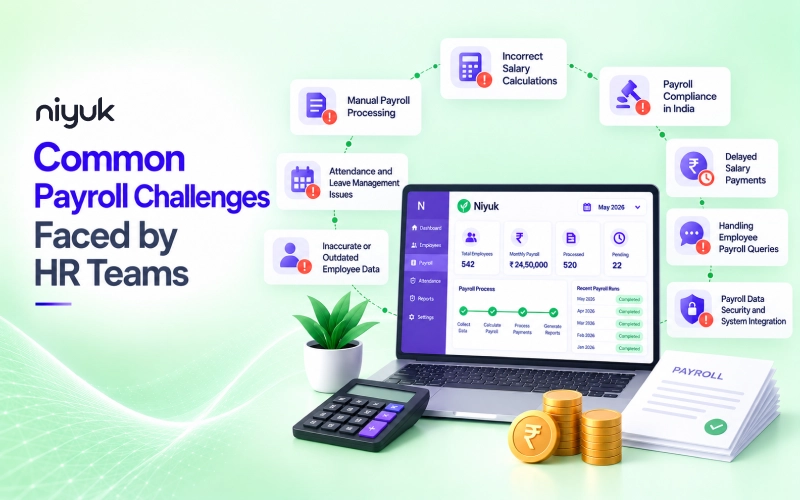
Payroll control is a duty that each corporation ought to take seriously. HR groups ought to ensure that personnel obtain salaries on time. They additionally need to cope with attendance, leave, deductions, tax computations, and felony requirements. These capabilities can be easy in the beginning glance, however the manner can come to be extraordinarily bulky whilst a agency is growing, and the payroll must be processed on a ordinary basis.
Companies that rely upon spreadsheets and disconnected software program for payroll may also face calculation errors, delays, and compliance risks. Recognising the payroll troubles confronted with the aid of using HR enables in figuring out the loopholes and enhancing the payroll with the aid of using the use of the important workflow, accurate worker facts and suitable payroll software program.
This manual explains not unusual place payroll control challenges, their impact on businesses, and sensible approaches hr groups can cope with them.
What Is Payroll Management?
Payroll Management is the manner of figuring out how a good deal every worker have to be paid, deducting the sums due for taxes and different deductions, making the charge of required contributions to authorities schemes, sending out the cash and retaining correct facts of the entire thing.
This consists of calculating earnings, making use of taxes and different deductions, making required contributions, disbursing salaries, and retaining correct facts.
It involves activities, including:
- Calculating the simple salary, the allowances, the overtime, the bonuses and the incentives.
- Keeping statistics of attendance, running hours and any go-away taken, whether or not paid or unpaid.
- Working out the taxes and different deductions. Handling contributions and payroll compliance.
- Handing out salary. Paying salary.
- Keeping records of employees and payroll.
A good payroll procedure makes certain that employees are paid correctly and enables companies to fulfil their legal obligations.
Why Is Payroll Management Important?
Payroll processing directly affects employee satisfaction, record-keeping, and legal compliance. Employees must receive the correct salary on time. Repeated mistakes can reduce trust in the hr department.
In addition, efficient payroll management allows an organisation to keep accurate financial records. It helps control labour costs and get ready for audits.
In India, payroll teams must consider applicable income tax, employees’ provident fund, employees’ state insurance, professional tax and other employment-related obligations depending on the organisation and employee eligibility.
The payroll system is well managed, the amount of administrative work is reduced, and this enables HR professionals to concentrate on employee engagement, talent management, and other strategic duties.
Common Payroll Challenges Faced by HR Teams
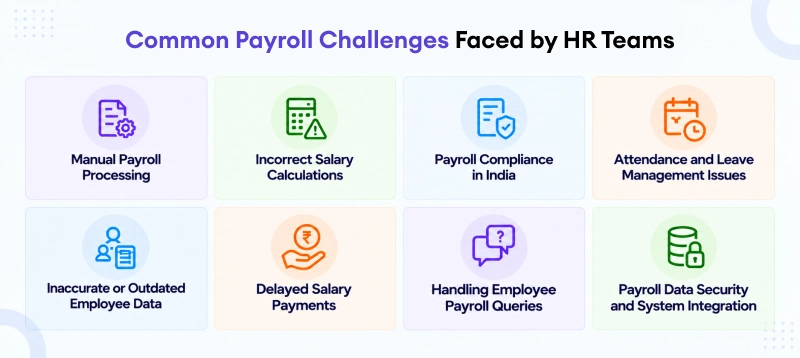
Manual Payroll Processing
One of the most common payroll management problems is manual payroll processing. Before calculating salaries, HR departments that use spreadsheets and laborious data entry have to collect information from multiple resources.
Just one wrong entry in any of these areas can affect salary, deductions, and payroll. In addition, manual processes are harder to manage with an increase in employees.
How to overcome it:
- Standardise the approval and payroll workflow.
- To automate the monotonous calculations, use payroll software.
- Make certain to hold a database of your personnel in a single place.
- Double-take a look at the payroll inputs before finalising the bills to personnel.
While automating allows you to save time and standardise the processes, you ought to nonetheless have manual auditing of your payrolls.
Incorrect Salary Calculations
These can appear when HR miscalculates overtime, incentives, bonuses, unpaid leaves, deductions, and arrears.
For example, incomplete attendance records may cause the payroll team to calculate the wrong number of payable days for an employee.
Common payroll errors can lead to faulty financial records, more correction work, and disgruntled employees.
How to overcome it:
- Verify salary structures and employee compensation details.
- Before the payroll run, verify the attendance and leave records.
- Using Automated Formulas and validations
- Review any unusual salary fluctuations before final approval.
- Provide employees with detailed payslips indicating their earnings and the deductions made.
Periodic reviews of payroll can help detect errors before processing the payroll.
Payroll Compliance in India
Payroll compliance can be hard because businesses have to understand the various employment and tax laws that are relevant to their employees.
Depending on the scenario, payroll teams might have to process provident fund contributions, employee state insurance, income tax deductions, professional tax, and other legal obligations. The needs will be based on the state, establishment, salary, and the employees.
Missed filing dates, wrong deductions or insufficient record-keeping are just some of the problems that can be faced in the process.
How to overcome it:
- keep track of likely dates for payments and filings,
- keep up to date with late-breaking legislation and notices,
- check employee eligibility and contribution calculations,
- retain supporting documentation and payroll records.
- When unsure, seek professional advice from a qualified payroll or tax expert.
HR teams should verify current requirements through relevant official government websites and keep their compliance checklist updated.
For India-specific compliance, check the relevant official portals, including the Income Tax Department, EPFO, and ESIC, as applicable.
Attendance and Leave Management Issues
Time Records they are directly impact payroll calculations. Late In/Out punch, IMT, approved/not approved leaves, differences in overtime, shifts record mismatch between timesheet & other logs can lead to wrong salary payments.
The situation gets even trickier if employees are working in different locations, different shifts, or in a remote environment.
For example, if the employee’s leave has not been granted prior to processing payroll. If it is not granted and it is processed, he may be paid for those days.
How to overcome it:
- Merge attendance and leave records into payroll so that all hours worked automatically become visible.
- Fix cut‑off dates each month for payroll data to ensure that you always meet deadlines.
- Verify that attendance corrections and leave slips are approved by a manager before processing.
- Verify that all attendance entries are completed before calculating wages.
- Maintain instructions in writing for calculating and recording operations for overtime or shift allowances.
When attendance records are accurate, HR teams can compute salaries with fewer mistakes and faster turnaround.
Inaccurate or Outdated Employee Data
Payroll is primarily based on worker information. That consists of earnings, financial institution account information, tax filings, employment status, and dates of becoming a member of and leaving a position.
If employee information is stored in spreadsheets or systems that HR may pull in, they could be using old or incorrect data. Wrong bank details can hold up salary transfers. Missing tax declarations can mess up the deductions.
When an employee changes role, receives a promotion, gets an earnings review, moves to a region or resigns, the ones modifications have to be processed in the right payroll cycle.
How to overcome it:
- Keep an employee information system.
- Update employee records when changes are approved.
- Validate employee bank details and essential payroll information.
- Restrict editing access to authorised personnel.
- Conduct reviews of employee data and perform reconciliations.
Accurate employee data is the foundation of reliable payroll processing.
Delayed Salary Payments
Delayed income can adversely have an impact on employee morale and cause economic hardships for employees who depend upon the pay for their everyday needs.
Delays in income may be because of past-due statistics submission, incomplete approval of the price request, incorrect monetary group details, lack of coordination amongst HR and finance departments, or last-minute changes in payroll.
How to overcome it:
- Create a fixed payroll calendar.
- Set deadlines for attendance, leave and variable-pay inputs.
- Define responsibilities for HR, finance and managers.
- Complete payroll reviews before the payment date.
- Maintain a documented process for handling corrections.
Planning payroll steps reduces last-minute strain and enables establishments to meet their charge schedules.
Handling Employee Payroll Queries
I see that employees are frequently consulting the human resource (HR) teams concerning salary differences, tax deductions, payslips, reimbursements, bonuses, and leave deductions. I observe that in the case of ambiguous payroll information and inaccessible salary records, the HR teams waste much time responding to employees’ queries.
I realise that the delayed response to such inquiries may cause employees to develop a negative perception of the organisation.
How to overcome it:
- Give detailed payslips that anyone can read.
- Create ready‑made answers for the common payroll questions.
- Let employees safely view their payroll details.
- Set up a plan for submitting and fixing payroll questions.
- Track repeated problems to find the root causes.
Payroll Data Security and System Integration
See that payroll records hold information such as salary details, bank information, tax records and other employee data. When payroll records are accessed without permission. Are accidentally revealed, employees and organisations face financial and privacy risks.
Using systems for attendance, HR records, accounting and payroll creates extra problems. Teams often have to enter the information many times, which raises the chance of inconsistencies.
How to overcome it:
- We apply role-based access controls and strong authentication to protect our data.
- We use structures with suitable statistical safety measures to maintain statistics safe.
- Audit logs and get admission to permissions want to be reviewed regularly just so we are able to see who accessed what.
- Payroll needs to be integrated with HR and attendance systems wherein sensible to reduce mistakes.
- Records need to be backed up. Incident-response strategies need to be established to get higher response times if a component goes wrong.
Secure, integrated systems help reduce duplication whilst improving data consistency and control.
How Payroll Challenges Affect Businesses
Unresolved payroll problems can affect more than the HR department. Payroll problems can spread throughout the organisation.
- Employee dissatisfaction: When payroll offers salaries or delays bills, more personnel lose trust and experience low morale.
- Compliance risks: Payroll that makes deductions, misses deadlines, or leaves information incomplete can convey consequences or different criminal troubles.
- Reduced productivity: HR and finance staff waste time fixing payroll errors or doing critical work that adds value.
- Financial reporting: Payroll mistakes disturb rate calculations, make reconciliations tough and throw budgeting into doubt.
- Higher administrative costs: Repeated payroll corrections, manual data get right of entry to, and unnecessary approvals enhance effort.
Addressing payroll troubles early helps an organisation preserve worker confidence, improve payroll accuracy and run efficiently.
How to Overcome Payroll Management Challenges
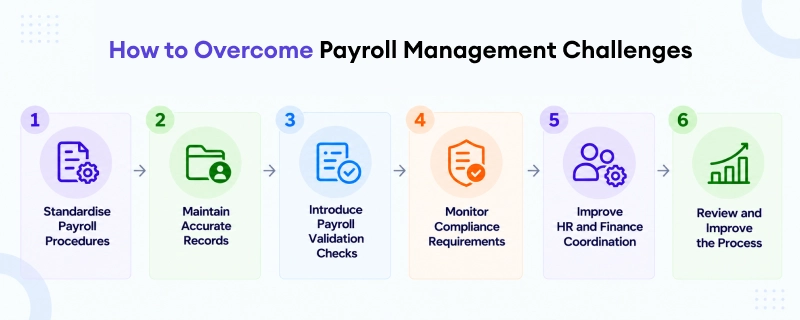
HR teams can improve payroll accuracy by establishing a structured, repeatable process.
Step 1: Standardise Payroll Procedures
I actually have documented each aspect of payroll, from accumulating and verifying statistics to calculating and approving payments, from disbursing finances to documenting the fee trail. Payroll procedures that are properly described leave little room for mistakes and omissions.
Step 2: Maintain Accurate Records
Maintain accurate employee details, salary structures, attendance records, leave records and any other approvals which impact payroll. Verify all numbers before every payroll.
Step 3: Introduce Payroll Validation Checks
Review of Payroll’s figures should be compared to those of the previous Payroll to check for inconsistencies. Deductions, variable compensation, new recruitment, and turnover should be evaluated and approved before finalising payments.
Step 4: Monitor Compliance Requirements
Keep a calendar of all the rules that Payroll must follow. Tell someone who will double‑check that every deadline and rule change is on track.
Step 5: Improve HR and Finance Coordination
It is vital to set up time limits for HR approvals of Payrolls and Finance clearance of coins advances. Documenting these records will save you delays in case some information is missed.
Step 6: Review and Improve the Process
Watch what number of Payroll mistakes happen, what number of correction requests come, and what number of worker questions. How long Payroll takes. Use those records to identify patterns and make Payroll better.
How Payroll Automation Simplifies Payroll Processing
Payroll automation can assist to cope with many common payroll demanding situations with the aid of using lowering the number of manual procedures and permitting the integration of data among unique structures.
Depending on the software program and its configuration, computerised payroll management systems can cope with the following issues:
- Salary calculations and deduction policies are programmed into payroll solutions to keep away from mistakes and save time.
- Attendance and leave statistics integration ensures all worker hours and days off are well recorded.
- Payslip generation lets personnel access their payslips easily, whilst worker self-service offers them control over their information.
- Payroll reviews and reconciliation assist in maintaining track of the whole lot and ensure the numbers match.
- Reminders for payroll responsibilities and time limits prevent overlooked entries or overdue submissions.
- Centralised worker data and approval workflows streamline processes. Improve transparency.
Automation could make paintings extra constant and save time for groups which have many personnel or complex payroll systems.
Payroll software program does now no longer get rid of all risks. Wrong worker records, settings and moving policies can nevertheless cause mistakes. HR groups need to take a look at the system settings, confirm the results, and make certain that the correct deductions comply with the laws.
When searching for payroll software, organisations must consider what number of employees they have, how well the software can connect to other tools, what reporting they need, how secure the data is, how well the software program keeps up with policies and what sort of it costs to set up.
Payroll Management Checklist for HR Teams
Use this checklist to review your payroll process:
- Check each employee’s details and any recent salary changes.
- Make sure attendance records, overtime hours and approved leaves are correct.
- Look over bonuses, incentives, reimbursements and any unpaid salary amounts.
- Double-check all deductions and required government contributions.
- Look into any changes in employee pay.
- Get the payroll approvals from the right people.
- Pay salaries on time following the set payroll schedule.
- Send payslips to employees in a secure way.
- File all required documents. Make payments before deadlines.
- Match payroll. Fix any employee questions or issues.
Following a checklist helps HR teams catch missing information before payroll is finalised.
Conclusion
There is more to payroll control than simply identifying salaries. While keeping exclusive records, HR groups are answerable for coordinating worker information, attendance, deductions, compliance, payments, and worker communications. HR groups often address payroll problems that could result in useless administrative work, decrease worker trust, and place groups at pointless risk. These problems may be resolved with the use of standardised procedures, particular documentation, common validation, and unambiguous coordination among HR and finance.
Payroll automation can similarly reduce down on repetitive responsibilities and improve consistency for increasing businesses. Businesses can create a payroll system that is more specific, safe, compliant, and powerful by combining suitable technology with common human supervision.
Frequently Asked Questions
What are the common payroll challenges faced by HR teams?
The common challenges include manual processing, incorrect salary calculations, compliance requirements, inaccurate employee data, attendance discrepancies, delayed salary payments, employee queries and payroll data security.
How can HR teams reduce payroll errors?
HR groups can reduce payroll mistakes with the aid of using keeping records, integrating attendance with payroll, automating calculations, introducing validation assessments and reviewing payroll outputs earlier than approving payments.
Why is payroll compliance important in India?
Payroll compliance enables corporations to meet tax, contribution, payment, filing, and recordkeeping obligations. The precise necessities rely on the laws, worker eligibility and business circumstances.
Can payroll software eliminate payroll problems?
Payroll software program can lessen paintings and enhance calculation consistency, but it can not dispose of each error. Accurate worker data, suitable system configuration, regular reviews and compliance tracking continue to be essential.
How often should payroll processes be reviewed?
Payroll must be checked throughout each payroll cycle, while the general manner must be reviewed periodically. Compliance requirements, habitual errors, worker remarks and adjustments in business operations must inform those reviews.