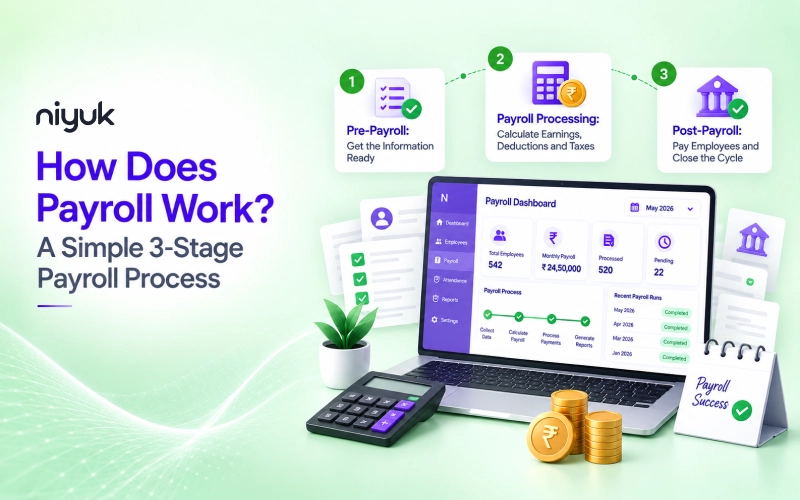
An employee sees only the final salary credited to their bank account in generic scenario. Behind that payment, however, several things have already happened. Employee details are checked, attendance and leave are reviewed, salary components are calculated, and applicable deductions and taxes are worked out.
So, what is payroll? Payroll is a calculation process for what employees are owned, making the salary payment, and maintaining the records connected with that payment.
How does payroll work in actual? Many organisations may break the work into three broad stages: pre-payroll, payroll processing, and post-payroll.
How Does the Payroll Process Work?
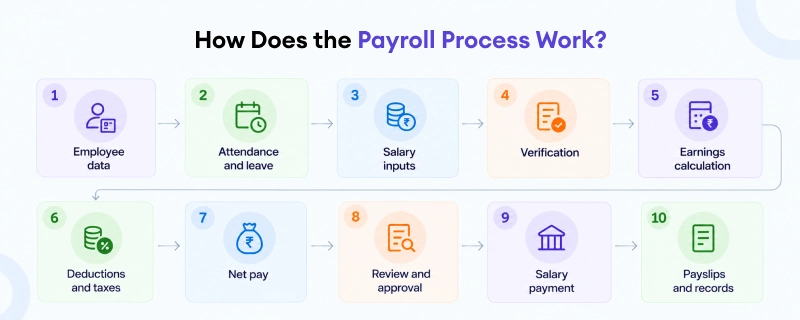
A payroll process follows this flow:
Employee data → Attendance and leave → Salary inputs → Verification → Earnings calculation → Deductions and taxes → Net pay → Review and approval → Salary payment → Payslips and records
The actual steps may vary by organisation, salary structure, payroll frequency, and country. A company with 20 employees may have very simple process than one with many thousand employees from different locations.
The basic idea, however, remains as it is. Information is collected and checked first. Pay is calculated next. The final stage includes payment, payslips, statutory requirements, and record-keeping.
This is also a very simple answer to how does payroll work step by step?
Pre-Payroll: Get the Information Ready
Pre-payroll is where the information for the current pay period is gathered and checked. It happens before the final salary calculation.
1. Check employee and salary details
Payroll starts with basic employee information. This can include salary details, bank information, employment status, tax information, and other details required to process the employee’s pay.
Changes made during the month also need to be captured. A new joiner, resignation, salary revision, promotion, or change in allowance can all affect the current payroll.
2. Review attendance, leave and overtime
Attendance and approved leave records are checked for the pay period.
Depending on company policy, unpaid leave or loss of pay may reduce an employee’s earnings. Overtime or other approved payments may increase them.
This is why payroll cannot simply copy the previous month’s figures. The inputs may be different every month.
3. Add variable pay and adjustments
Not every employee receives the same fixed amount each month. Bonuses, incentives, overtime, reimbursements, and other variable payments may need to be added.
The payroll team also checks deductions that need to be considered for the period.
4. Verify the inputs
This is an important point in how to do payroll. Before calculations begin, the available information needs to be checked for missing or incorrect entries.
For example, an incorrect leave record or missed salary revision can affect the final amount paid to an employee. Finding that error before processing is much easier than correcting it after salary has been released.
Payroll Processing: Calculate Earnings, Deductions and Taxes
Once the inputs are ready, the actual salary calculation begins.
Calculate gross pay
The salary of a worker before any deduction or tax is the gross pay.
The wage system might change by the employer however it essentially means that the basic pay and then the allowances for overtime, bonus, incentive or any other payment applicable.
You may also need to make adjustment for periods of unpaid leave, partial-year employment, etc.
Calculate Net Pay
Once earnings, deductions, and applicable taxes have been accounted for, the employee’s net pay can be calculated.
Net Pay = Gross Pay − Applicable Deductions and Taxes
For example:
- Gross pay: ₹50,000
- Deductions and taxes: ₹6,000
- Net pay: ₹44,000
This is a simplified example. Actual payroll calculations can involve several salary components and statutory rules.
If someone asks, what is the difference between gross pay and net pay? the simple answer is that gross pay is earnings before applicable deductions and taxes, while net pay is the amount left after those amounts have been accounted for.
Review and approve payroll
The calculation is normally reviewed before salaries are released.
HR or finance may check unusual salary changes, new employees, exits, large deductions, overtime, or attendance adjustments. Once the figures are reviewed and approved, payroll can move to the payment stage.
Post-Payroll: Pay Employees and Close the Cycle
The payroll process does not end when the salary calculation is complete. There are still payments, records, and statutory requirements to take care of.
Release employee salaries
After approval, salaries are released through the organisation’s chosen payment method.
The payment date usually follows the company’s payroll calendar. Some organisations release salaries on a fixed date every month, while others follow a different schedule.
Generate payslips
Employees receive payslips showing the relevant earnings, deductions, and net pay for the pay period.
A payslip gives the employee a record of how the final amount was calculated and part of the organisation’s payroll records.
Complete statutory payments and filings
Depending on the country and organisation, payroll may also involve statutory payments, returns, or filings.
These requirements have their own deadlines, so completing salary payments does not necessarily mean the entire payroll cycle is finished.
Maintain payroll records
Payroll records may include payslips, salary calculations, payment information, reports, and supporting documents.
If an error is found later, the organisation may need to correct the records and make an adjustment through the appropriate payroll process.
How Long Does Payroll Take to Process?
A small payroll with straightforward salary structures may take less time to prepare. Larger payrolls can require more checking when there are variable payments, multiple locations, attendance adjustments, new joiners, exits, or several approval stages.
This is why payroll teams generally work with cut-off dates. Employee inputs need to reach the team early enough to be checked before the scheduled payment date.
How Does Payroll Work for a Small Business?
The basic cycle is much the same:
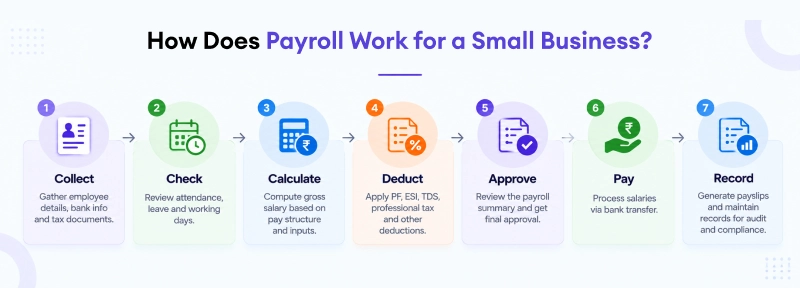
Collect → Check → Calculate → Deduct → Approve → Pay → Record
A small business may manage these activities internally, use a payroll system, or work with an external payroll provider.
The method may change, but the basic requirement does not. Employee information, salary details, attendance, leave, and applicable deductions need to be accurate before the final payment is approved.
Payroll System: Where Does It Fit into the Payroll Process?
A payroll system is involved in employee payouts, can be handled manually through spreadsheets or managed through dedicated payroll software.
A payroll management system is a software-based system used to manage activities such as employee payroll information, salary calculations, deductions, payslips, payments, and payroll records.
How Does Payroll Outsourcing Work?
An organisation gives agreed payroll activities to an external provider.
Depending on the arrangement, the provider may handle calculations, payments, reporting, or certain compliance-related activities. The organisation still needs to provide accurate employee information and review the payroll at the agreed stages.
Conclusion
Payroll is more than simply calculating a salary at the end of the month. It begins with employee details and goes on to attendance checks, salary calculations, deductions, approvals, payments, payslips and record-keeping.
Understanding the process from pre-payroll, payroll processing and post-payroll makes it much easy to see how daily HR information becomes an employee’s final take-home pay.
Frequently Asked Questions
1. What Is Payroll Tax and How Does It Work?
Payroll tax is linked to the money paid to employees and the statutory obligations that come with it. The rules differ across countries and can also vary based on the type of employment. Some amounts come out of an employee’s pay, while others are paid by the employer and reported to the authorities.
2. How Does Payroll Work Step by Step?
The process generally starts by checking employee information, attendance, leave, overtime, and other salary-related details. Earnings and deductions are then worked out, followed by a review of the figures before salaries are approved and paid. Payslips are issued, while the necessary payroll records and filings are completed for the period.
3. What Are Payroll Deductions?
Payroll deductions are amounts taken from an employee’s gross earnings before the final salary is paid. Some are required by law, while others may be based on employee benefits or authorised arrangements. Common examples include income tax, statutory contributions, insurance, retirement contributions, and approved repayments. The actual deductions depend on the situation.
4. What Is the Payroll Process in HR?
The payroll process in HR brings together several pieces of employee information before salary can be processed. HR may provide details such as attendance, leave, new joiners, salary changes, and employee records. Depending on the organisation, finance or a dedicated payroll team may then handle calculations, approvals, payments, and statutory requirements.
5. What Is the Difference Between Gross Pay and Net Pay?
Gross pay is the amount an employee earns before applicable taxes, and other deductions are taken out. Net pay is the amount that finally reaches the employee’s bank account. The difference between the two comes from the deductions applied during payroll, so net pay is usually lower than gross pay.