Key Takeaways
- A well-managed payroll system enables HR professionals to calculate salaries accurately and on time.
- Payroll automation reduces the amount of manual work and the risk of calculation errors.
- The HR team can match the attendance and leave data with payroll data to make accurate calculations for the salary of each employee.
- The HR team needs to constantly review the payroll process to ensure compliance with labour laws and legislation.
- The HR payroll management system assists the HR team in making calculations of salaries, creating pay slips and reports, and keeping track of employee records.
- The payroll review process will ensure that the employees understand how their salary is calculated and structured.
Introduction
Being an HR, have you ever found yourself spending hours on processing payroll, checking salary calculations and correcting errors while meeting your deadline? All these activities associated with payroll processing such as managing deductions, keeping attendance records and making sure that salary is paid on time can become quite difficult for HR teams without payroll management.
This is where payroll management becomes important. With efficient payroll management practices, automation and proper employee records, HR departments can make salary processing easier. This blog explains how HR teams can improve payroll management, reduce errors, and simplify salary processing.
How Can HR Teams Improve Payroll Management? Step-by-Step Process
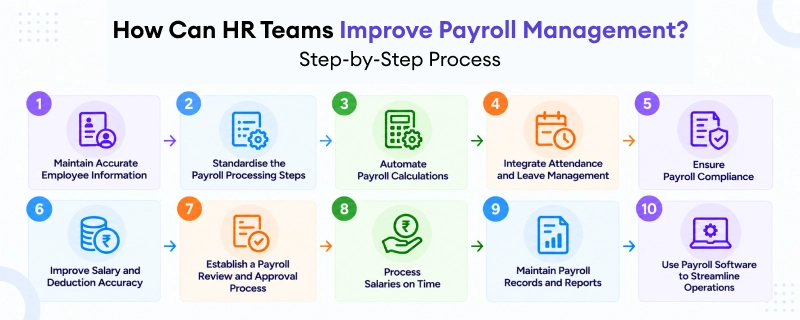
Payroll management for HR can be enhanced through processes such as management of employees’ information, calculation of wages, compliance, approvals, payments, and reporting. These processes help HR in managing payroll effectively.
Step 1: Maintain Accurate Employee Information
It is necessary to have accurate information of the employees for an effective payroll management because if the information is outdated, salary calculations may be wrong and bank transfers may fail.
HR departments should ensure that the below data is constantly updated.
- Employee name and identity information.
- Bank account and payment details.
- Employment start date and end date (if applicable)
- Salary structure and approved changes.
- Tax declarations and applicable employee tax details.
- PF and ESI details, where applicable.
- Attendance, Leave Balances and Employment Status
- Reimbursements, Bonuses and Other Income
It is just as crucial to have an effective process in which employees’ information can be updated whenever necessary.
For example, when an employee is given a salary increment, the HR department should ensure that the new salary is reflected in the payroll database before the next payroll period starts.
Full and Final Settlement
Payroll data must be updated by the HR team in case an employee leaves the company. Full and final settlement will involve unpaid salary, encashment of leaves, any reimbursements, allowable deductions, and other payables as per the policies of the organization and relevant laws.
It will become possible by having an employee database because duplicates can be avoided and manual data entry can be minimized.
Step 2: Standardise the Payroll Processing Steps
The proper documentation of payroll will help human resources staff to be able to fulfil their duties in a systematic manner.
It is necessary to develop a payroll calendar, which can provide deadlines for data collection, verification, approval, payroll processing, and the completion of all other legal requirements.
The usual payroll management process is:
- Keep information on attendance, leave, and overtime.
- Monitor newly hired employees, employee exits, and salary changes.
- Calculate gross salaries and make any necessary adjustments.
- Apply approved deductions and statutory contributions.
- Approve the payroll report.
- Process salary payments and create payslips.
- Complete all payments, reports, and final checks.
Roles should be clearly defined for the HR team when it comes to the payroll process, finance, and approval.
A standard payroll process will help each team member know what is expected of them.
Step 3: Automate Payroll Calculations
Manual calculations become more difficult as the organization grows. There could be mistakes in entering data into spreadsheet applications and in manipulating salary components manually.
With payroll software, salary calculations can be automated according to the selected salary structure and employee information. With payroll software, HR personnel will have more time to review the payroll rather than doing manual calculations
Depending on the software, automatic payroll processing can support:
- Gross and net salary calculations
- Salary changes for unpaid leave and partial months
- Overtime, incentives, and variable pay
- Employee deductions and employer contributions
- Tax calculations and TDS estimates
- Payslip generation and payroll reviews
For example, if there is any change in the salary of the employee based on an approval, then the salary data can be used by the software to do future calculations.
To have payroll automation done successfully, the HR department needs to ensure that the employee data and payroll rules are correct.
Step 4: Integrate Attendance and Leave Management
The information regarding attendance and leave will definitely affect the payment of salaries. This is particularly true when the employees take leave without pay, work extra hours, or join a payroll cycle.
Integrating attendance and leave management with payroll makes life easier for the HR team because:
- Import approved attendance records.
- Calculate unpaid leave deductions.
- Process approved overtime and shift-related payments.
- Account for employee joining and leaving dates.
- Reduce repeated data entry.
- Match attendance records with payroll data.
For instance, approved unpaid leaves have to be considered when calculating salaries.
HR has to confirm the attendance and leave records before processing the payroll.
Step 5: Ensure Payroll Compliance
The payrolls in India are managed through compliance to laws of employment and taxes for that organization and its employees.
Depending on eligibility and applicable law, these can also include:
- Employees Provident Fund (EPF)
- Employees State Insurance (ESI)
- Tax deducted at source (TDS)
- State-specific professional tax
- Applicable salary and minimum wage requirements
- Relevant statutory payments and filings
HR team must maintain a compliance calendar and review the eligibility criteria of employees, contribution rate, and deadlines for filing.
HR teams must follow the applicable income-tax provisions, rules, and transitional requirements for salary payments and tax compliance from 1 April 2026.
HR teams can visit the official websites of EPFO, ESIC, and Income Tax Department for any updated information.
The compliance obligations vary depending on various factors like the category of employees and geographical area. Companies should find out the applicable rules and compliance obligations.
Step 6: Improve Salary and Deduction Accuracy
In order to have an effective salary processing, the HR departments must confirm the earnings, salary adjustments, deductions, and employer contribution per employee.
A simplified formula is:
Net Salary = Total Earnings − Applicable Employee Deductions
The earnings could include basic salary, allowances, incentives, etc. The deductions could be PF, ESI, TDS, professional tax, etc.
HR teams must comply with these practices:
- Review salary structure before every payroll cycle.
- Verify applicable statutory contribution rates and tax information.
- Confirm that salary changes are approved.
- Check deductions against applicable requirements.
- Compare current payroll figures with preceding months.
- Investigate unusual modifications in gross or net salary.
These checks help HR to check errors before salaries are paid.
Step 7: Establish a Payroll Review and Approval Process
A review of each payroll cycle is necessary before paying the salaries. This ensures that HR managers will be able to spot any miscalculations, unauthorized alterations, duplicates, and missing employee data.
The following must be examined before payroll approval by HR and finance teams:
- New employees and employees leaving the company
- Approved salary changes and variable pay
- Attendance records and unpaid leave adjustments
- Applicable deductions and contributions
- Unusually high or low net salary amounts
- Employee bank details and total salary
HR departments should be able to keep payroll calculations and approval always separate. The calculations can be done by one authorized individual, who is then verified by another authorized individual before being approved.
Step 8: Process Salaries on Time
Salary processing on time is necessary to create trust among employees and comply with the payment procedures. Also, it allows employees to manage their monthly expenses in an effective way.
Preparation of the payroll schedule is necessary for the HR department based on the day on which salaries must be paid and the deadlines for the submission of attendance, payroll preparation, approval, and transfer to the bank. The payroll schedule will assist HR departments in conducting payroll operations in time.
To avoid payroll delays, firms must:
- Publish a monthly payroll calendar
- Set clear time limits for attendance and incentive approvals.
- Resolve missing employee information early.
- Coordinate payment approvals with finance.
- Verify bank details earlier than processing transfers.
- Investigate failed transactions promptly.
After processing salaries, HR or finance must reconcile actual payments with the approved payroll register.
Step 9: Maintain Payroll Records and Reports
Accurate payroll records help HR teams respond to employee queries, support audits, and demonstrate compliance
Important payroll records can also include:
- Employee salary details and authorised revisions
- Monthly payroll registers and payslips
- Attendance and leave records
- Deduction and contribution calculations
- Payment confirmations and reconciliation reviews
- Applicable statutory payment receipts and filings
Payroll data must be available to authorized personnel who comply with company policies regarding data security and document control.
The HR department needs to examine payroll records on a monthly basis to detect any errors.
The HR department needs to compare the approved payroll register after each payroll period with salaries paid and accounting documents. This is important to detect salary discrepancies and any remaining amounts to be paid.
Step 10: Use Payroll Software to Streamline Operations
Payroll software enables HR teams to organise employee information, calculate salaries, manage deductions, generate payslips, and prepare reports.
When comparing payroll management systems, businesses should consider:
- Support for applicable Indian payroll requirements
- Attendance and leave integrations
- Flexible salary structures and variable pay
- Payslip generation and payroll reporting
- Approval workflows and audit trails
- Data protection and access controls
- Integration with HR software and finance systems
Selecting the right payroll system depends on the number of people working in the company, payroll complexities, the budget, and the needs of the business.
Organizations can also use HR management software systems like Niyuk.ai, which include payroll among others like recruitment.
What Are the Common Payroll Management Challenges?
There are several problems that an HR team can experience while handling payroll manually.
| Challenge | How to Address It |
| Manual calculation errors | Calculate automatically and check payroll reports. |
| Inaccurate attendance data | Check attendance and leave before processing salaries. |
| Compliance changes | Be aware of relevant laws and dates. |
| Delayed salary processing | Have specific deadlines for approval processes. |
| Disconnected employee records | Maintain an updated and central database for employees. |
| Data security risks | Implement access control mechanisms and storage security techniques. |
This will allow the HR department to ensure accuracy of the payroll by applying standard solutions to the above-listed issues through automation.
There should be a set procedure within HR to address questions from employees regarding pay issues. It involves reviewing payroll information, making corrections where necessary, and letting employees know what has been done.
How Can Payroll Software Help HR Teams?
The HR payroll management software helps in the process of salary processing through data organization and payroll management.
| Feature | Benefit |
| Automated salary calculations | Reduces repetitive manual work. |
| Attendance integration | Helps calculate attendance-linked pay and deductions. |
| Payslip generation | Simplifies payslip preparation and distribution. |
| Payroll reports | Helps review salary expenses and identify discrepancies. |
| Employee record management | Keeps payroll information organized. |
| Compliance support | Helps HR teams track applicable payroll requirements and deadlines |
Payroll Management Checklist
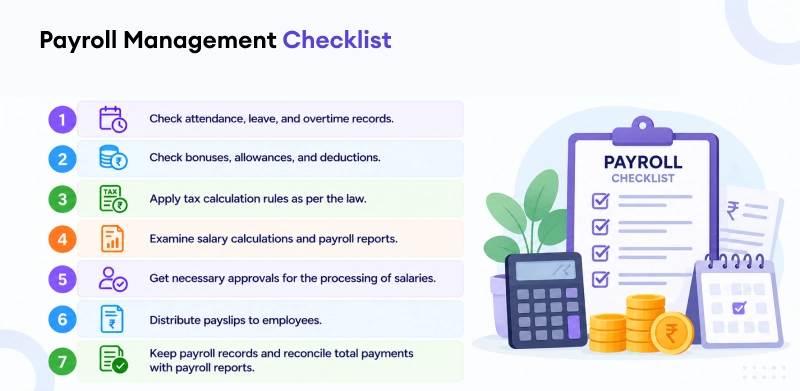
Use this checklist to check the payroll process monthly:
- Check attendance, leave, and overtime records.
- Check bonuses, allowances, and deductions.
- Apply tax calculation rules as per the law.
- Examine salary calculations and payroll reports.
- Get necessary approvals for the processing of salaries.
- Distribute payslips to employees.
- Keep payroll records and reconcile total payments with payroll reports.
Conclusion
When managing payroll, HR need to have correct data for employees, processes, compliance and correct payroll calculation. With payroll automation, HR can reduce time in payroll management, automating the tasks in the HR process, communicate with finance department, and review payroll reports.
Payroll systems make payroll management easier. Proper selection of payroll software and procedures could improve the efficiency of payroll management.
Frequently Asked Questions
1. How can HR teams improve payroll management?
The HR team could manage payroll better by automating salary computation, keeping accurate records of employees, monitoring attendance, streamlining processes and reviewing payroll reports prior to making any salary.
2. What are the common payroll management challenges?
Some of the common payroll problems faced are salary computation mistakes, incorrect attendance records, changes in compliance regulations, delayed approvals, lack of system integration, and payroll data security.
3. How does payroll automation help HR teams?
Automation of the payroll process makes the process simpler, decreases the requirement of repetitive data entry processes, helps maintain a constant calculation of income and facilitates preparation of payslips.
4. How is payroll compliance critical in India?
Payroll management in India allows employers to satisfy applicable legal and statutory obligations, hold accurate records, and reduce the chance of penalties or disputes.
5. What must HR teams look at before processing payroll?
HR personnel need to ensure that all such information like the employee’s details, attendance, leave, salary increment, bonus, deductions, taxes, etc., is validated.
Author