
Workplaces are place of work. Every person feels valued, confident, and respected for doing their best at their respective workplace. That said, you can’t construct the “hope and a prayer” workplace safety you’ve dreamt of without some real, actionable rules and employee training and let’s not forget, support from leadership. whether it’s your startup of 20 people or your enterprise of 20,000 people—everyone must understand professional office behaviour, the systems that can help support them, and have the confidence to treat extremely serious organizational concerns seriously and justly.
Today, businesses will be expected to not just meet regulations, but additionally cultivate a company that emphasizes dignity, fairness, and responsibility. It doesn’t matter if you have a 20-person startup or 20,000 employees – everybody really should know appropriate office conduct, the reporting procedures available to help them, and the confidence to look at the organization serious complaints in a fair.
As a result, POSH training is just not simply beneficial, it’s now really a core requirement regarding any organization’s HR and compliance initiatives.
For those people who have long questioned what POSH training can be, what is the POSH Act is, or even what a POSH policy may include, this blog helps you with a realistic, no-nonsense manual to get through most these issues. It covers what you might need to know about POSH to boost your office culture even though at the same time maintaining authorized compliance.
By finishing up this guide, you’ll know:
- What POSH training is and its importance.
- The purpose and scope of the POSH Act, 2013.
- What a POSH policy should include.
- Employer and employee responsibilities.
- Best practices for effective POSH compliance.
- How technology can simplify compliance management.
What is POSH Training?
POSH training, a well laid down awareness program at the workplace is intended to sensitise employees, managers, HR professionals and employers about sexual harassment prevention at work. It delineates the rights, duties and the entire reporting mechanism followed and legal implications in accordance with the POSH Act, 2013 thus providing a secured, respectful as well as a compliant working environment for an organisation.
Rather than being a one-time orientation program, POSH training is a continuous program which changes and adapts with the evolving work practices and societal norms at the workplace.
Primarily, it aims at sensitising the employees regarding the inappropriate behaviour, an approach toward undesirable situations and the correct procedure to approach it with an upright concern. For the employers it instils the necessity to be proactive, prompt while dealing with a report, and about the transparent complaints redressal system.
Why POSH Training Matters Today?
Not only this but can have detrimental impacts not only on individual health and wellbeing of employees but on overall team morale, team productivity and turnover as well as market value. Organizations investing into prevention and awareness for a positive workspace where the employees of an organization, from all its teams feel safe, respected and inspired. As per International Labour Organization survey report of July 2021shows that, workplace violence and workplace harassment cost a company on average productivity loss, but higher employee turn-over, also, absence and long-term psychological harm.
As per UN Women pointed, companies that put-in clear workplace policies and conduct regular employee training on work behaviour practices are best placed to deal with this at the earliest opportunity.
Hence this type of POSH training can’t be termed as solely compliance driven work it now has been part of key business practices.
Quick Insight – Any team that puts-in regular workplace conduct training for their employee’s team wants to inculcate trust, promote proactive reporting and minimise workplace compliance.
Why is POSH Training Important?
An ideal POSH training module will contribute to more than simple legal compliance. The modules are meant to Foster open dialogue. On similar ground, the refresher courses guarantee that HR departments and managers get back the managers to react in the consistent & prompt way, leaving no room for any type of deviations in their processes. Equip employees with enough courage to speak out with confidence that they’ll be heard and looked after.
Training helps employees know the policies clearly and Reporting procedures and consequently employees to approach in the early stage. Handling complaints on time helps organizations maintain well-being and pre-empt potential conflicts. Similarly, periodic training ensures that managers and the HR departments respond in a similar and timely manner, avoiding scope for procedural irregularities in their handling.
| Why POSH Training is Important | Supporting Statistic / Fact |
| Legal Compliance | Every organisation with 10 or more employees should constitute an Internal Committee (IC/ICC), conduct awareness and orientation programmes, also include POSH compliance details in the annual report. Non-compliance may attract penalties and, in repeated cases, business licences cancellations. |
| Employee Awareness | As per Deloitte India survey, 71% of respondents said availability of POSH information via company intranet/HR portals was the preferred awareness method, while 52% believed for regular POSH training helps employees to understand and detect workplace harassment. |
| Respectful Workplace | The POSH Act places the responsibility on employers to create a safe and harassment-free workplace, making prevention and awareness a legal obligation—not just an HR initiative. |
| Reduce Complaints / Encourage Reporting | India’s top 30 listed companies reported a 6.2% increase in POSH complaints in FY25. Experts interpret this as a sign of improved compliance and greater employee confidence in reporting, rather than simply more harassment incidents. |
| Employer Protection | Around 54% of surveyed organisations said all POSH complaints undergo a formal Internal Committee inquiry, but only 13% had a digital case-management system, highlighting the importance of structured compliance and documentation for legal protection. |
| Company Culture | Deloitte reports that organisations increasingly view regular POSH awareness programmes as an essential part of building an ethical workplace culture and improving compliance beyond simply having a written policy. |
Sources: (Indian School of Transport Management), (The Economic Times)
Key Objectives of POSH Training
Every POSH training program should focus on creating awareness while encouraging responsible workplace behaviour. Its primary objectives include:
- Educate employees about the POSH Act, 2013 and workplace rights.
- Help your employees on how to identify harassment and inappropriate behaviour.
- Empower them on how to securely file a complaint either orally or in writing in a confidential manner.
- Define roles and responsibilities for employers, Managers, HR staff and Internal Committee (IC) in their corresponding capacities.
- Configure out a framework for maintaining professionalism, courtesy and a positive work environment.
- Lower down the risks involved while strengthening legal requirements.
- Sustain and recreate strong trusting relations to inspire workplace ethics with consistent accountability of management and employees.
By enlightening awareness of as an ongoing process always over a one-time activity, organizations can create workplaces where employees feel respected and protected.
Quick Overview of POSH
| Topic | Details |
| POSH Full Form | Sexual Harassment Prevention |
| Law | Sexual Harassment of Women at Workplace (Prevention, Prohibition and Redressal) Act, 2013 |
| Primary Objective | Prevent workplace sexual harassment and provide a fair complaint redressal mechanism |
| Who should Arrange POSH Training? | Certified trainers, or Compliance experts, Employers, HR teams |
| Who must Attend? | Employees, Managers, HR professionals, Leadership teams, All Interns, Contract staff, and Internal Committee members |
| Why is it Important? | Inspires workplace safety, legal compliances, respectful behaviour and employee awareness |
What is the POSH Act?
For implementing a strong POSH training within any organization, we first need to understand the basics of the legal backdrop behind it.
The POSH Act, 2013 “Prevention of Sexual Harassment” which is officially known as Sexual Harassment of Women at Workplace (Prevention, Prohibition and Redressal) Act, 2013, is an Indian law made to protect/ safeguard women from sexual harassment at the workplace. It mandated an organization to prevent harassment and provide and an inhouse complaint redressal system along with working a space safe.
Under the POSH act all organizations, whether public or private, that are, companies, government sector organizations, startups, universities and colleges, hospitals and NGOs come under its ambit of regulation.
The law is applicable to many workplaces, including private enterprises, government institutions, startups, educational institutions, hospitals, non-governmental organizations, factories and other establishments.
All organizations with ten or more employees must have an Internal Committee (IC) which addresses and investigates complaints related to sexual harassment.
This Act was promulgated following the Vishaka Guidelines (1997) judgment issued by the Supreme Court, which gave rise to protection from sexual harassment at workplace before this Act came into effect.
At the end of the day, POSH Act is more than just a compliance procedure; it’s an approach towards building respectful, equitable and responsible work culture.
What Is POSH Policy?
When there is an efficient POSH Policy it can present security for the employee, integrity of the office and employee dignity in the premises. It confirms what behaviour the staff must not engage in and gives reassurance on how their complaints will be handled very confidentially and appropriately.
This is as per the provisions of the Sexual Harassment of Women at Workplace (Prevention, Prohibition and Redressal) Act, 2013 (also commonly known as the POSH Act).
A POSH Policy broadly defines what behaviour is to be recognized as ‘sexual harassment’, employee rights and duties, outlines a procedure for filing complaints, and state an organization’s commitment towards workplace safety and respect. It is not merely a compliance document placed in a shelf for legal requirements only. It can guide all the employees on what acceptable modes of conduct and assurance on how the complaints are filed will be appropriately and secretly taken care of.
The workplace security, employee’s dignity and the overall integrity of the office can be presented when a strong POSH policy is available.
Why Each Organisation Needs a POSH Policy?
At work it must be somewhere where you feel your people are respected and are not threatened or put at ease. Thus unwritten ‘rules’ can turn an irritating micro-behaviour into one that is destructive and you have no doubt what effect this is having to your people and to your culture and the self-esteem of your people.
A POSH policy helps organisations in many ways:
1. Assurance of Legal Compliance
The POSH Act mandates organizations to put in place machineries to prevent and prohibit workplace sexual harassment. Where employers are having at least 10 workers, the requirement is to setup an Internal Committee, sensitize employees, and implement stipulated complaint redressal process. A duly crafted and implemented POSH policy will assist in the regulatory and compliance efforts of the organisation.
This will enable compliance of prescribed standards of conduct and help reduce the chance of attracting any sort of penalty.
2. Creates Awareness Among Employees
Employees are not so sure about what behaviour qualifies as ‘sexual harassment’.
A POSH policy removes confusion by explaining:
- Kinds of inappropriate behaviour
- Sexual harassment examples
- Employee rights and awareness
- Complaint registering procedures
- Roles of the Internal Committee
This ensures employees to know where to seek help and how concerns will be addressed.
3. Builds a Safe Workplace Culture
When the processes of the organisation can be relied upon, it strengthens your organisation! Your POSH policy sends a clear message that sexual harassment, discrimination or untoward behaviours will not be tolerated and there is absolute zero-tolerance. The policy which is likely to encourage workers, in the same breath to affirm human respect and dignity among themselves.
4. Protects Employees and Organisations
A well-defined POSH policy protects both employees and employers. It provides formal communication for employees to file grievances. Organizations receive a framework to identify and resolve concerns with integrity and efficiency. This might mean things that might fall by the wayside and is not have in place a proper policy document leaving the company exposed to other risks and legal exposure.
What Should a Comprehensive POSH Policy Include?
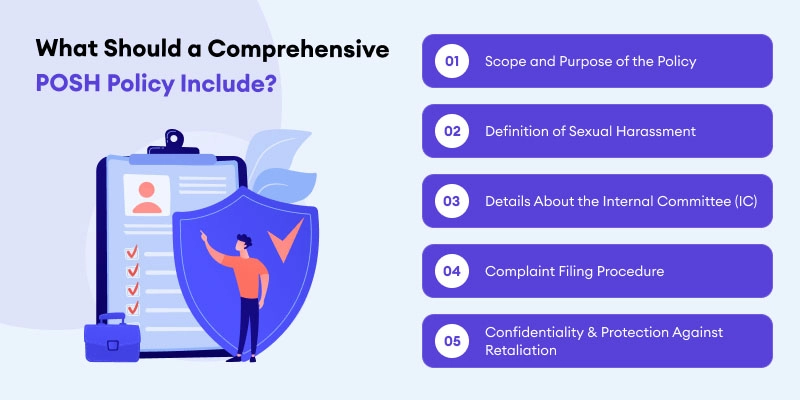
An entire or comprehensive POSH policy must cover all important aspects need to prevent and address workplace harassment.
The key elements are here. Refer them as below:
The policy should explain clearly, why it is there and to whom it applies to.
A good POSH policy should cover:
- Permanent employees
1. Scope and Purpose of the Policy
- Temporary employees
- Contract workers
- Interns
- Consultants
- Visitors and clients interacting with the workplace
The objective is to assure everyone associated with the organisation understands the expected standards of behaviour.
2. Definition of Sexual Harassment
The policy needs to specify or define clearly, what constitutes sexual harassment.
Examples to be included or covered:
- Unpleasant physical contact
- Request for sexual favours
- Inappropriate comments / jokes
- Sharing explicit content of sex
- Unrequired messages or communication
- Behaviour making a hostile work environment
A clear definition helps employees find unacceptable conduct.
3. Details About the Internal Committee (IC)
Each organisation covered under the POSH Act must setup an Internal Committee to handle complaints.
The POSH policy must mention:
- Names and contact details of IC members
- Roles and responsibilities of committee members
- Complaint submission process
- Confidentiality Guidelines
The Internal Committee has an important role to play in ensuring fair, bias free complaints handling.
4. Complaint Filing Procedure
Employees must clearly understand how to report an incident.
The policy must cover:
- Who can file a complaint
- How to submit a complaint
- Timeline for filing complaints
- Investigation process
- Resolution process
A simple, transparent complaint process motivates the employees to report issues without losing their comfort level.
5. Confidentiality and Protection Against Retaliation
A POSH policy should highlight confidentiality of the whole complaint process.
Information related to:
- The complainant
- The accused person
- Witnesses
- Investigation details
must be handled carefully.
The policy must protect employees from retaliation / unfair treatment after raising a genuine concern or issue.
Why POSH Training is Important?
POSH policy creation is not the final step. POSH awareness and training programs can equip the employees with better tools and methods to manage and deal with its different elements. A POSH training will assist the employee with better methods to spot offenses, understand their responsibilities, and become familiar with the established complaint procedures.
The POSH Act also mandates that employers conduct regular awareness program.
Effective POSH training supports organisations:
- Generate awareness about workplace harassment
- Educate all employees about an acceptable behaviour
- Explain complaint procedures
- Train Internal Committee members
- Inspire a respectful workplace environment
Training changes POSH compliance from a document-based activity into an active workplace practice.
Who Should Attend POSH Training?
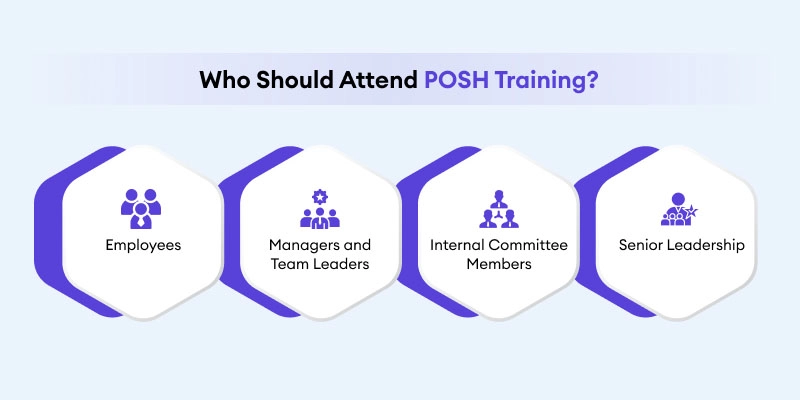
This is an important section to explain here. POSH training should not be limited to HR teams or managers. Every individual connected with the organisation must understand workplace safety guidelines.
1. Employees
All employees must attend POSH awareness sessions to get fully familiar with:
- What is harassment?
- How to prevent or restrict inappropriate behaviour?
- How to report concerns?
2. Managers and Team Leaders
Managers act as the first point of contact when employees face workplace issues across any team or department inside an organisation.
They should understand:
- How to reply to complaints?
- How to maintain confidentiality?
- How to support employees appropriately?
3. Internal Committee Members
Internal Committee members require specialised POSH training because they handle sensitive complaints.
They should learn:
- Investigation procedures
- Evidence handling
- Legal requirements
- Fair hearing practices
4. Senior Leadership
Leadership involvement is compulsory because workplace culture starts from the top level only.
When leaders proactively support POSH compliance, employees are likely to believe and follow the process.
Who Should Comply with the POSH Act?
The Act is applicable to the companies across the country including public companies, government and educational organisations, social welfare NGO’s, etc. For having 10 or more employees, in the organization, set-up Internal Committee and fulfil other compliance requirements.
Key Compliance Requirements are:
- Creating a POSH policy
- Forming an Internal Committee
- Conducting employee awareness programmes
- Displaying relevant information about the complaint mechanism
- Maintaining records and submitting required reports
POSH compliance is not a legal responsibility but an important step towards making a respectful workplace for employees to feel safe and secure.
What Does POSH Training Cover?
POSH training enables employees to comprehend sexual harassment at the workplace prevention and their rights & duties outlined in the POSH Act. It disseminates general awareness to employees regarding workplace conduct etiquette and processes for lodging a complaint including the functions of the IC. A POSH awareness program is efficient not just because it educates employees on compliance.
An appropriate POSH awareness training program assists an organisation in developing an inclusive workspace culture where every employee is well versed about the methods to deter misconduct & responds appropriately when a conflict arises.
A complete POSH training programme normally covers below mentioned important modules:
| Module | Description |
| Law | Employees know about the POSH Act, its end objectives, employer responsibilities, and the much importance of POSH compliance. This module briefs the legal framework made to prevent and address workplace sexual harassment. |
| Harassment Examples | Employees understand various examples of workplace sexual harassment, with unwanted behaviour, inappropriate comments, uneven communication, online misconduct, and actions creating an unsafe work environment. |
| Reporting | This module briefs how employees may report incidents, who they could approach, and the complaint filing process within the POSH policy. Employees learn about confidentiality and the Internal Committee (IC)’s role. |
| Investigation | Employees get a complete picture of the POSH enquiry process, with complaint review, evidence collection, investigation timelines and how the Internal Committee makes sure for a fair and unbiased process. |
| IC Role | This module covers the Internal Committee’s responsibilities, with receiving complaints, conducting investigations, sustaining confidentiality, and covering recommended appropriate actions. |
| Employee Rights | Employees aware for their rights under the POSH Act, with the right to a safe workplace, protection from retaliation, confidentiality, and access for a fair complaint resolving process. |
Sources:
- International Labour Organization (ILO) – Violence and Harassment at Work (Convention C190)
https://www.ilo.org/topics/violence-and-harassment-world-work
- Ministry of Women & Child Development – Handbook on Sexual Harassment of Women at Workplace
https://wcd.gov.in/sites/default/files/Sexual-Harassment-at-Workplace-Handbook.pdf
- UN Women – Ending Violence Against Women
https://www.unwomen.org/en/what-we-do/ending-violence-against-women
How to Conduct an Effective POSH Training?
To arrange a result-oriented POSH training, there must be adequate planning, employee involvement and consistent awareness. Trainings must be simple and to the point for all employees and in sync with your POSH policy.
These steps for POSH awareness training should help your organization conducting one effectively:
1. Boost up awareness related to workplace sexual harassment
It must begin with propelling a proper awareness of workplace sexual harassment and elaborating the need for its prevention.
Employees should know:
- What is sexual harassment as it is defined under the POSH Act
- Instances of improper conduct at workplace
- Importance of maintaining professional boundaries
- How employees can contribute towards workplace safety
Awareness supports employees to identify unacceptable behaviour and encourages early reporting for their concerns.
2. Explain the POSH Policy and Complaint Process
Employees should have complete clarity about the organisation’s POSH policy and complaint structure.
The training should explain:
- Purpose and scope of the POSH policy
- Complaint filing procedure
- Role of the Internal Committee
- Investigation process
- Guidelines for Confidentiality
A well explained policy gives employees that much confidence for raising their concerns, which will be addressed by a structured process.
3. Include Practical Case Studies
Case studies make POSH training more engaging and easier to understand.
Real workplace scenarios help employees understand:
- Different natures of workplace harassment
- How to respond to uncomfortable situations?
- How the complaint process works?
- Common misconceptions for workplace conduct
Practical examples really make legal concepts easier to remember and apply.
4. Do Assessments and Feedback
Assessments support organisations to measure if really employee understand the key concepts explained during POSH training.
Organisations can use:
- Short quizzes
- Scenario-based questions
- Feedback surveys
- Knowledge assessments
Regular feedback helps improve future POSH awareness training programmes.
5. Provide POSH Training Certificate
A POSH training certificate confirms that employees have completed workplace harassment prevention training.
Certification helps organisations:
- Maintain POSH compliance records
- Track employee participation
- Show commitment towards workplace safety
It also encourages employees to take POSH awareness programmes seriously.
6. Conduct Annual POSH Refresher Training
POSH compliance requires continuous awareness. A single training session is not enough to maintain a safer workplace culture.
Annual refresher training helps employees:
- Remember key POSH guidelines
- Understand policy updates
- Refresh knowledge about complaint procedures
- Stay informed or updated about workplace responsibilities
Regular training takes care for one thing: Sexual harassment prevention remains an ongoing organisational priority.
Conclusion:
POSH compliance not only covers the mandate to stay on the right side of the law according to the POSH Act; but it covers creating a workspace where you feel respected, secure and comfortable complaining if the need arises.
POSH Policy with Training and Internal Committee makes Workplace free from the fear of workplace sexual harassment. A workplace that is safe is achieved when the staff are educated about their roles and responsibilities towards maintaining workplace standards. POSH compliance equals equal dignity, respect, and equal opportunity.
For more information on this please follow our website – www.niyuk.ai and you can also drop an email on: info@niyuk.ai
FAQs
1. What are the 11 types of harassment?
The POSH Act mainly addresses workplace sexual harassment, which may include unwelcome physical contact, sexual remarks, demands for sexual favours, showing explicit content, inappropriate messages, stalking, gender-based comments, intimidation, hostile work environments, retaliation, and misuse of authority. Effective POSH training helps employees understand these examples and promotes workplace safety through better awareness.
2. What is the difference between POCSO and POSH?
POCSO (Protection of Children from Sexual Offences Act) protects children below 18 years from sexual abuse, while the POSH Act focuses on preventing and addressing sexual harassment at the workplace. POSH compliance applies to organisations and employees, whereas POCSO deals with offences against children. Both laws support safety, protection, and prevention of sexual misconduct.
3. What is Rule 7 of the POSH Rules?
Rule 7 of the POSH Rules, 2013 explains the procedure followed by the Internal Committee while conducting an enquiry into workplace sexual harassment complaints. It covers investigation steps, hearing opportunities, evidence review, and recommendations. Proper POSH training enables IC members to understand their responsibilities, maintain confidentiality, and follow a fair enquiry process.
4. Is POSH Training mandatory for startups and small businesses?
Yes, POSH training is essential for startups and small businesses to create awareness and support POSH compliance. Organisations with 10 or more employees must follow POSH Act requirements, including forming an Internal Committee. Regular POSH awareness training helps employees understand workplace sexual harassment prevention, complaint procedures, employee rights, and workplace safety responsibilities.
5. How often should an organization conduct POSH Training?
Organisations should conduct POSH training regularly, with annual refresher sessions recommended to maintain awareness and POSH compliance. New employees should receive POSH awareness training during onboarding, while Internal Committee members should receive specialised training. Continuous learning helps employees understand the POSH policy, reporting process, and their role in maintaining a respectful workplace.
6. What happens if a company does not comply with the POSH Act?
Failure to follow POSH compliance requirements can lead to penalties, legal issues, and reputational damage. Organisations may face fines, disciplinary action, and increased risks due to improper handling of workplace sexual harassment complaints. Maintaining a proper POSH policy, conducting employee training, and establishing an Internal Committee helps organisations fulfil their responsibilities under the POSH Act.
7. Can POSH Training be conducted online?
Yes, POSH training can be conducted online through virtual classrooms, digital learning platforms, and online awareness programmes. Online POSH awareness training allows organisations to train remote employees and maintain participation records efficiently. However, the programme should cover the POSH Act, reporting process, employee rights, Internal Committee responsibilities, and workplace sexual harassment prevention practices.