
POSH Full Form is Prevention of Sexual Harassment. It is normally applicable for workplaces. It applies to all businesses, including corporates, startups, SMEs, and remote workplaces, with certain compliance requirements based on employee strength.
Understanding the POSH simply means to know insights of the POSH Act 2013.
Knowing all about the POSH Act 2013 is important for both employers and employees. The law entirely explains what sexual harassment is, how complaints must be raised, and what responsibilities organisations should follow.
This blog helps as guide to understand the full form of POSH, the POSH Act, POSH policy, POSH committee, POSH training, complaint process, and compliance requirements in a realistic and easier way.
Initially, we will try to know Why POSH is essential in today’s workplace.
What is POSH Act 2013?
The POSH Act 2013 is a law implemented in India. This law is often called the law. It was made to keep away women from bad behaviour at work.
Every company must follow the law. It must be ensured that people are not behaving badly at work. There must be a system in place to handle the complaints. This means that the POSH Act 2013 is very vital for companies. The people in charge and the human resources team have to do things to follow the POSH law.
The POSH Act 2013 is a mandatory requirement, for companies.
Why POSH is Essential in Today’s Workplaces?
As we know in today’s fast changing workplaces, businesses from small enterprise to multinational corporate houses, placements are more business objective driven and gender equality is much followed.
At the same time, vital role of prevention of sexual harassment at these workplaces has become a matter of pride for every business house.
Here, we are helping them by offering below useful guidelines to make them a ‘safe place to work’.
Let us refer below important guidelines for this.
1. We must be able to offer a safe and secured workplace
Each person who works for us needs to be in a genuine place where they feel okay. Where we think they are important. We need to have a system in place to stop people from being mean to each other at work, which is called POSH.
This helps our company make sure everyone is nice, to each other and it helps us make a place where people can work without worrying about things happening to them so they can focus on their work and feel confident.
2. It must support compliance while protecting employees
POSH compliance is important. It is not something we have to do because of the law. It is all about assuring our employees are doing good. When we follow the steps, we know, we are obeying the law. We can also handle problems that come up in a way. We can make sure our employees have a safe place to work where they feel safe and trusted. POSH compliance is about keeping our employees safe and happy, at work.
3. Makes it easy for raising the concerns fearlessly
Employees are keen to talk about their experiences, problems when they know they will be treated fairly and things will be kept confidential. A good POSH process helps people talk openly makes them trust the organization and helps the organization act when it is needed.
4. Makes the workplace a better place
When people respect each other at work everyone is happy, they work well together. They get more work done. Upon serious implementation of POSH, organisations show that they really care about their employees. They make the workplace a ‘nice for work’. They show eachone that they are a good employer to work with.
Key Features of POSH (Purpose / Legal Framework / Obligations)
In this section, we are throwing a flashlight on the main features of purpose of POSH, the required legal framework as well as obligations needed. This gives a complete breakdown of what POSH is all about.
Let us refer them one by one here:
1.Secures Employees from Sexual Harassment
The POSH Act isa helpful law to keep women employees safe from harassment at workplace. This simply means they can work in a safe, secure place with respect, without fear of being treated unfairly or being made to feel uncomfortable.
2. Helps Create a Safe and Respectful Workplace
One of the POSH goals, is to help companies to make a workplace where eachone is treated with dignity and respect. This means employers can ensure that, their employees feel valued and heard and they can report any concerns without worrying about being treated badly.
3. Governed by the Act 2013
The POSH Act 2013 is a useful law to prevent and deal with sexual harassment in workplaces in India. It briefs what employers need to do, what rights employees have and how complaints must be handled.
4. Clearly Explains What is Sexual Harassment
The POSH Act clarifies what is considered harassment at work. This also includes things like physical contact, rude comments or showing inappropriate material.
5. Offers a Way to Resolve Complaints
POSH gives a clear and confidential process for reporting and dealing with complaints. This means every complaint is handled fairly and on time while keeping everyone rights and dignity safe.
6. Companies Must Have a Policy
Each employer should possess a written POSH policy explaining about- what is expected at work, how complaints are handled and what actions needed to be taken. A clear policy helps companies to show that, they care about creating a workplace.
7. Regular Awareness
The POSH Act inspires employers to hold training sessions and awareness programs for their employees. These help employees to understand what POSH means, to recognize behaviour and contribute to a more respectful workplace.
8. Internal Committee
Companies with 10 or more employees must set up an Internal Committee to handle complaints under the Act. Smaller companies can go to the Local Complaints Committee set up by the district administration.
9. Keeps Things Confidential
The Act emphasizes keeping things confidential during the complaint and inquiry process. This means information about the complainant, respondent, witnesses and proceedings is not shared publicly.
10. Holds Employers Accountable
The Act clearly indicates that employers are responsible, for implementing policies holding awareness programs and replying to complaints faster. This supports companies to create a workplace, that’s respectful, inclusive and following the law.
What Is Sexual Harassment Under POSH?
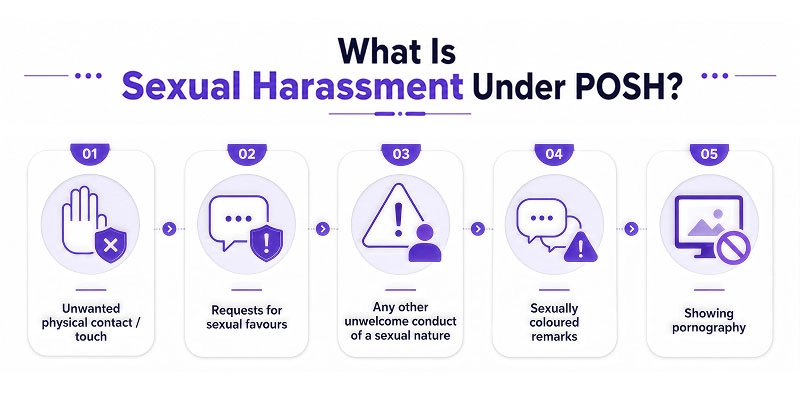
- Unwanted physical contact / touch
- Requests for sexual favours
- Any other rough conduct of a sexual nature
- Sexually coloured remarks
- Showing pornography
Where POSH can be applied?
POSH is applicable across a wide range of professional environments, not restricted to conventional workplaces. It includes both organized and unorganized sectors, as well as corporate workplaces, factories, educational institutes, hospitals, NGOs, and remote workplaces.
Whether the employee is permanent/ contractual/ remote, POSH also makes sure for the protection from harassment in all professional interactions. The scope of POSH also extends to any location connected to work, like meetings, client sites, or office-sponsored events.
Its objective is to make a regular standard of safety and respect, irrespective of place or quality of work.
What Is a POSH Committee?
A POSH committee is a group made inside an organisation to receive and handle POSH complaints. It is formally called the Internal Committee.
Mandatory Members of the POSH Committee-
As per Indian law, the committee must add:
- A senior lady employee as the Presiding Officer
- At least two internal members with HR, legal, or social work experience
- One external member from an NGO / legal expertise
Who is ICC and LCC?
The POSH committee setups the ICC and LCC to deal with sexual harassment in the workplace.
All companies with ten or more employees must be in an Internal Complaints Committee (ICC). The ICC is responsible for receiving complaints, investigation on them, and addressing any issues of sexual harassment within the organization. Every branch of the workplace should have an ICC. It must add at least one senior woman employee, two members familiar with the issues, and one NGO or external member with legal expertise.
District Officers establish the Local Complaints Committee (LCC) across their districts. It handles complaints from workplaces with less than 10 employees or involving the employer. The LCC makes sure for small workplace and informal sector workers to get help for workplace mistreatment.
Role & Responsibilities of POSH Committee Members
The Internal Committee is very important for our workplace. It helps make our workplace a safe and comfortable place for everyone who works here. Each person who is part of the Internal Committee has their jobs to do. When someone makes a complaint, the Internal Committee should handle it in a way. They must keep the complaint secret and follow the rules of the Act.
The Presiding Officer is like the person in charge. They investigate the complaints. Make sure the Internal Committee meetings go smoothly. The Presiding Officer should make sure that every complaint is dealt carefully.
The Internal Committee and the Presiding Officer must be fair and not take sides. The Internal Committee and the Presiding Officer must do their job so that the Internal Committee can do its job properly and help the workplace be a safe place for each one. The Internal Committee is important, for this.
Other committee members must receive complaints, conduct inquiries, document all findings, maintain strict confidentiality, recommend appropriate actions, and to prepare annual reports as per the requirements under the POSH Act.
Committee members serve for three years. This helps them do their jobs well and support the organisation’s goal of a workplace. The organisation wants to make sure everyone is safe and respected. The three-year term lets committee members carry out their duties properly. They work to create a workplace where no one faces harassment.
How to file a POSH complaint Step by Step?
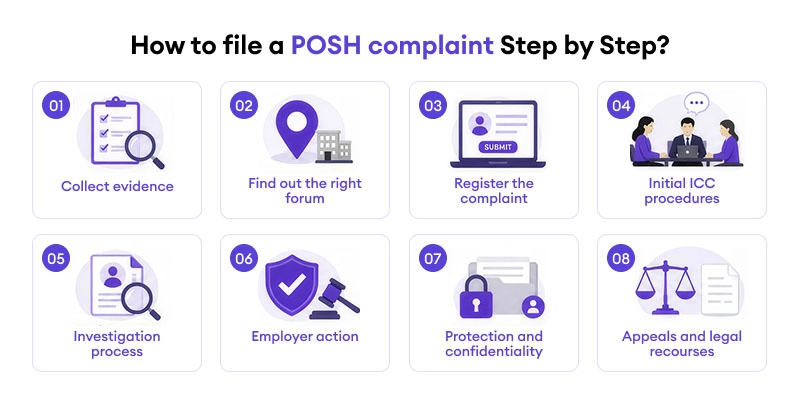
A POSH complaint should be submitted in writing to the POSH committee. The complaint must be filed within 3 months from the incident’s date.
In valid cases, the committee can allow extensions. Many organisations now use a digital POSH portal to manage complaints safely and confidentially.
1.Collect evidence:
The complainant must prepare all suitable evidence for the case, including proof of communication or names of witnesses.
2.Find out the right forum:
Employees can file complaints via the ICC or LCC, depending on the organization’s size.
3.Register the complaint:
You must register a written complaint within next three months of the incident, explaining details (dates, individuals involved) and offering any supporting proof’s / evidence.
4.Initial ICC procedures:
Once the ICC gets the complaint, it reviews it, notifies the parties involved, and proceeds with the redressal process under strict confidentiality.
5.Investigation process:
The committee will call a proper investigation, allowing the complainant and respondent to give statements and evaluate witnesses. It must complete the inquiry within thirty days.
6.Employer action:
The employer will act depending on the findings or observations written. The type of action will fully depend on the committee’s recommendations. Recommendations vary from warnings to termination or other disciplinary issues.
7.Protection and confidentiality:
The committee safeguards the identities of the complainant, respondent, and witnesses as confidential for all stages of the process.
8.Appeals and legal recourses:
If a party disagrees with the recommendations, it can appeal to the litigation system within three months of the recommendations.
How to write an email as an online POSH complaint?
In today’s fast working and digitised world of private / corporate sectors, lodging online complaint via writing a detailed email to the concerned committee for the expected action on the same is quite anticipated.
There is no government-prescribed email format under the POSH Act, 2013. The law specifies the entire complaint process and timelines, but not a standard email template.
The format below is based on best practices and aligning with the information typically required by an Internal Committee (IC) or Local Complaints Committee (LCC).
Sample Email Format for an Online POSH Complaint
Subject:
POSH Complaint Regarding Workplace Sexual Harassment
To:
The Presiding Officer / Internal Committee (IC)
[Company Name]
CC (Optional):
HR Department or Authorized POSH Contact
Email Body
Dear Presiding Officer / Internal Committee,
I am writing to formally submit a complaint under the Prevention of Sexual Harassment (POSH) Act, 2013 regarding an incident of workplace sexual harassment.
The incident occurred on [Date] at [Location/Department] and involved [Name/Designation of the Respondent, if known].
A brief description of the incident is provided below:
- Date and time of the incident:
- Location:
- What happened:
- Names of any witnesses (if applicable):
- Any supporting documents, emails, messages, or screenshots attached:
The incident has affected my ability to work comfortably and has caused emotional distress. I request the Internal Committee to acknowledge this complaint and initiate an inquiry in accordance with the POSH Act, 2013 while maintaining confidentiality throughout the process.
Please let me know, in case of requirement of any additional information or supporting documents.
Thank you for your attention and support.
Sincerely,
Name:
Employee ID:
Department:
Contact Number:
Email Address:
Attachments (if any):
- Screenshots
- Emails
- Chat messages
- Photographs
- Documents
- Witness statements
Tips to Write a POSH Complaint Email
- Use a fair, professional subject line.
- Mention required details like the date, location, and details of the incident.
- Explain the events fact wise and in chronological order.
- Attach any available supporting evidence.
- Do not use abusive / emotional language; stick to the facts.
- Request for confidentiality status and a genuine inquiry under the POSH Act, 2013.
- Maintain(retain) a copy of the email and any acknowledgements for your records.
POSH Enquiry Process and Timelines
Understanding what is POSH? is very important as knowing how a complaint is handled. The POSH Act, 2013 has got a well-structured process. It is having defined timelines to ensure each complaint is investigated fairly, confidentially, and without non-required delays.
From complaint filing to employer action, the entire process follows legal timelines to protect the rights of all parties involved.
| Step | Process | Timeline | Description |
| 1 | Complaint Filing | Within 3 months of the incident (extendable by another 3 months in exceptional cases) | The aggrieved woman submits a written complaint to the Internal Committee (IC). If there is a valid reason for delay, the committee may allow an extension as permitted under the POSH Act. |
| 2 | Conciliation (Optional) | Before the inquiry begins | At the complainant’s written request, the Internal Committee may offer a settlement through conciliation. Monetary compensation cannot be the base of the settlement under the POSH Act. |
| 3 | Inquiry Initiation | Within 7 days | If conciliation is not requested or is unsuccessful, the Internal Committee begins the formal inquiry by informing the respondent and initiating proceedings as per the prescribed process. |
| 4 | Inquiry Completion | Within 90 days | The Internal Committee investigates the complaint, records statements, reviews evidence, hears both parties, and submits its final report with recommendations to the employer within the statutory timeline. |
| 5 | Employer Action | Within 60 days of receiving the IC report | The employer must implement the recommendations of the Internal Committee, take appropriate disciplinary or corrective action, and ensure compliance with the provisions of the POSH Act, 2013. |
Why These Timelines are Vital?
One of the Act’s key objectives is to assure that complaints are resolved immediately, fairly, and confidentially. They will follow the prescribed timelines helping organizations to maintain legal compliance, secure employee rights, and promotes a safe, respectful, and accountable workplace culture.
The Complaint Process Timeline
The POSH Act, 2013 clearly defines timelines to handle sexual harassment complaints at the workplace, to assure a fair, confidential, and fast resolution. From complaint filing to employer action and appeals, each stage follows a prescribed process.
The table below summarizes the main POSH complaint timelines- every employer and employee must know.
| Step | Process | Timeline | Key Requirement |
| 1 | Complaint Filing | Within 3 months of the incident* | Aggrieved woman submits a written complaint to the Internal Committee (IC). |
| 2 | Conciliation (Optional) | Before inquiry begins | Conducted only if requested by the complainant. |
| 3 | Inquiry Initiation | Within 7 days | IC begins the inquiry after receiving the complaint or if conciliation fails. |
| 4 | Inquiry Completion | Within 90 days | IC completes the inquiry and submits its findings. |
| 5 | IC Report | Within 10 days | IC shares the inquiry report with the employer and both parties. |
| 6 | Employer Action | Within 60 days | Employer implements the recommendations of the IC. |
| 7 | Appeal | Within 90 days | Either party may appeal before the appropriate court or tribunal. |
Source: LKSLaw
Penalty for Non-Compliance of POSH Act
In case the employer of an organization attempts to violate or violates any provision under the POSH Act and Rules, a fine of maximum of Rs.50,000 will be imposed.
If the employer is convicted for a repeated offence of non-compliance to POSH Act, the penalty will be:
- Double the punishment that was awarded for the first time and/or
- Cancellation / non-renewal of the business license
The penalty may be more, if the case stands in the court.
Let’s check out for some real-world examples:
The Madras High Court instructed a company in Chennai to pay Rupees 1.68 crore as damages to an aggrieved woman.
Reference: Ms. G vs Isg Novasoft Technologies Ltd, 2014
In another case, Madhya Pradesh High Court levied a fine of Rs. 50,000 from a hospital for not setting up an Internal Complaints Committee in 2019.
The court also directed the hospital to pay an amount of Rupees 25 lakhs to the complainant for failing to redress her complaint.
Reference: Global Health Pvt. Ltd. vs District Panchayat on 16 September 2019
Penalties & Consequences
Have a look on the below given Penalties and their respective consequences in case of non-compliance with POSH Act by any employer, under various sections of the act.
| Offense | Penalty |
| Non-compliance with POSH Act provisions | Fine up to ₹50,000 under Sec. 26(1), POSH Act 2013 |
| Repeated non-compliance | Double the punishment and/or cancellation of license/registration under Sec. 26(2), POSH Act 2013 |
| Sexual harassment (criminal) | Imprisonment up to 3 years and/or fine under IPC Section 354ASec. 354A, IPC 1860 |
| False/malicious complaint | Action as per service rules (same as for sexual harassment) Sec. 14, POSH Act 2013 |
Source: LKSLaw
POSH Awareness Training
A safe workplace is built on awareness and trust and respect. The POSH awareness training helps employees to understand the behaviour standards at the workplace to recognise what is harassment and to learn the way to report their concerns about the workplace.
The POSH Act is all about the Sexual Harassment of Women at Workplace. It is also well known as the Prevention, Prohibition and Redressal Act, 2013.
The POSH Act gives us rules to prevent harassment at work. We learn how to solve complaints, so our workplace is safe for all. The POSH awareness training is, about stopping harassment. This training is crucial because it teaches us about the Act and how to prevent sexual harassment. The training focuses on the Act and preventing sexual harassment.
The POSH awareness training is not something, but we must do it is an important step towards making our workplace a place where everyone feels included and respected.
Why POSH Awareness Training is Important?
Understanding what POSH is, support employees to identify inappropriate behaviour and become aware of their rights and responsibilities.
Effective training allows organisations to:
- Make awareness about workplace harassment and acceptable behaviour
- Train employees about complaint processes and support systems
- Brief the role of the Internal Committee (IC)
- Inspire employees to report concerns without fear
- Develop a workplace culture based on dignity and equality
Key Areas Covered in POSH Training
1. Employee Awareness Training
Employees are aware (learned) about many forms of workplace harassment, reporting mechanisms, confidentiality rules, and their active role in establishing a safe professional environment.
2. Manager and Leadership Training
Managers (department heads) are trained to handle employee concerns responsibly, retain confidentiality, avoiding bias, and guide employees for the correct reporting channels.
3. Internal Committee (IC) Training
IC members get full guidance on complaint handling, investigating procedures, documentation, timelines, and maintaining fair approach across the inquiry process.
4. Training for All Workforce Groups
POSH awareness must include permanent employees, contractual workers, and support staff. Training in easy language with practical examples for assurance of the better understanding on the whole organisation level.
Best Practices for Efficient POSH Awareness Training
To make training really work organisations need to focus on making people aware getting them to participate and teaching them things. Here are some good ways to do this:
- Conduct Training: Organisations should have sessions when new people join and have regular POSH training to remind everyone.
- Use Examples: Explain what POSH is about by using real life stories, examples that happened at work and scenarios that people can understand.
- Train Everyone: POSH training should be for all employees, managers, the people in charge workers who are not time and Internal Committee members, so everyone knows what is going on with POSH.
- Inspire Open Communication: Organisations should make a place where people feel safe to talk about issues without being afraid of getting in trouble.
- Keep Sessions Interactive: Use talks, questions and answers and fun activities to help people understand POSH better.
- Review and Improve: Ask people what they think of the training. Make the POSH training programs better all the time.
If organisations do these things they can make a workplace where everyone’s safe, respected and treated with dignity, which is what POSH is all about. This way organisations can do more than just follow the rules they can make a culture for all employees and that is what POSH training is, for.
POSH Compliance Checklist for Employers
Getting assurance of workplace safety is not only about following the legal requirements; it is about setting up an environment where each employee feels respected, protected, and heard.
A clear POSH compliance process helps employers to stay aligned with the law while building the real trust employees. This checklist highlights the main responsibilities- organisations must follow to stop or avoid workplace harassment and maintain a safe, inclusive work culture.
- POSH Compliance Checklist
- IC constituted with proper composition
- IC members trained on inquiry procedures
- POSH policy drafted and communicated
- Penal consequences displayed at workplace
- Awareness programs conducted annually
- Annual report filed with District Officer
- Safe working environment maintained
- Complaint mechanism accessible to all
POSH for Startups & SME’s
POSH compliance is equally important for startups and small and medium-sized enterprises (SMEs), regardless of their team size. Many growing organisations assume that POSH requirements apply only to large companies, but each workplace has a responsibility to make sure for a safe and respectful environment.
Under the POSH Act, organisations with 10 or more employees must set up an Internal Committee (IC) to attain and resolve workplace harassment complaints. Anyhow, startups and businesses with less than 10 employees must follow the prescribed process through the Local Committee (LC) formed by the district administration.
For startups and SMEs, following of POSH policies at the earliest helps to make a culture of trust, transparency, and professional conduct. Sustaining of clear guidelines, employee awareness, and proper reporting mechanisms not only making sure for compliance but also empowers employee confidence.
Steps for Sexual Harassment Prevention in the Workplace
Organizations must prevent sexual harassment by initiating the awareness, accountability, and communication. Follow below mentioned steps to setup a safe, respectful workplace environment.
1.Build and share a well-defined policy on sexual harassment
This policy must list all behaviours those are not acceptable, how to make a complaint and what happens, if someone breaks the rules.
2.Conduct sessions to raise awareness
Manage training for all employees, with leaders and HR teams so they know- how to find, prevent or report harassment.
3.Set up a committee to handle complaints
Ensure that this committee is fully functional, trained and available to all employees.
4. Make a workplace where employees feel safe to speak up
Be ensured that employees feel comfortable in reporting behaviour without fear of consequences.
5.Handle complaints, with care and respect.
Deal with all complaints in a respectful, caring way so employees feel encouraged to report problems quickly.
Global Data on Workplace Safety
Setting up a safe workplace is not just about meeting compliances requirements only. Studies show that organizations with proper reporting processes and workplace safety policies build great employee trust, improve their retention, and empower their employer brand.
| Key Workplace Insight | Why It Matters |
| Among every 3 women one women experience physical and/or sexual violence during their lifetime on global level. | Indicates the importance of safe workplace policies and reporting mechanisms. |
| Various workplace harassment incidents are underreported because employees fear of retaliation or lack of confidence in reporting systems. | Organizations require confidential and fair complaint management processes to assure women’s overall safety in the long run. This is very crucial today. |
| Strong workplace ethics & compliance programs help for higher employee trust and organizational reputation. | Digital POSH workflows help standardize complaint handling and documentation. |
| Digital documentation upgrades record keeping, reporting, and compliance readiness as compared to paper processes. | Centralized HRMS Software simplify audits and annual report. |
- World Health Organization (Violence Against Women)
- International Labour Organization (Violence and Harassment Convention)
Conclusion:
Casual remarks or informal behaviour may mostly hide the serious issue of workplace sexual harassment. The POSH framework prevents overlooking such actions and offers a clear path for prevention and redressal. With proper awareness, strong internal processes, and the right training, orgs may build a safe and respectful work environment. Promoting an accountability culture and trust is not only a legal need. It’s a workplace responsibility.
For more upcoming information and details, you can ping us on: sales@niyuk.ai
FAQs
1. Who is eligible for the Posh Act?
The POSH Act applies to every woman employed in an organization, whether permanent, temporary, contractual, trainee, intern, apprentice, consultant, or volunteer. It also protects women visiting the workplace in connection with their work. The Act covers both organized and unorganized sectors, ensuring protection against sexual harassment and promoting a safe, respectful, and inclusive work environment.
2. Is POSH mandatory for all companies in India?
Yes. The POSH Act, 2013 requires every organization in India to provide a workplace free from sexual harassment. Companies employing ten or more people must constitute an Internal Committee (IC) to address complaints. Even small organizations are expected to comply with POSH provisions and follow applicable legal requirements to protect employees and maintain workplace safety.
3. Who can file a POSH complaint?
Any woman who believes she has experienced sexual harassment at the workplace can file a complaint under the POSH Act. This includes permanent employees, contractual staff, interns, trainees, consultants, apprentices, and visitors connected with the organization. The complaint should generally be submitted in writing to the Internal Committee within the prescribed timeline under the Act.
4. What is the time limit to file a POSH complaint?
Under the POSH Act, a complaint should generally be filed within three months from the date of the incident. If there are valid reasons for delay, the Internal Committee may allow additional time, ensuring employees still have an opportunity to seek redressal and support.
5. How long does a POSH inquiry take?
Once a complaint is accepted, the inquiry under the POSH Act should usually be completed within 90 days. If you are wondering what POSH is, it is a workplace mechanism designed to address sexual harassment complaints fairly and promptly. After the inquiry, the committee submits its recommendations to the employer for appropriate action.
6. What happens if a company doesn’t comply with POSH?
Non-compliance with the POSH Act can lead to financial penalties, cancellation of business licenses, and reputational damage. The full form of POSH is Prevention of Sexual Harassment. Companies are expected to constitute an Internal Committee, conduct awareness programs, and follow the law’s procedures to create a safe and respectful workplace for employees.
7. Is POSH applicable to companies with fewer than 10 employees?
Yes. The POSH Act applies to all workplaces, including organizations with fewer than 10 employees. Such companies may not need an Internal Committee, but complaints can be filed with the Local Complaints Committee established by the district administration. The POSH full form, Prevention of Sexual Harassment, ensures protection for employees regardless of company size.
8. What is the difference between ICC and LCC?
The Internal Committee (ICC) is formed within organizations that have 10 or more employees to handle complaints under the POSH Act. The Local Complaints Committee (LCC), set up by the district administration, handles complaints from workplaces with fewer than 10 employees or when the complaint is against the employer. Understanding what is POSH, and the POSH full form helps organizations ensure the right committee manages complaints fairly and in compliance with the law.