Most searches for hr software pricing return the same pattern: a vague “it depends,” a “contact us” button where a number should be, or a demo request form standing in for an actual answer. Some sources do publish real figures, but usually for a single market, either India or the US, rarely both. That gap makes it difficult to build an actual budget rather than a rough guess.
This guide takes a different approach. It covers real price ranges by company size, the factors that push cost up or down, the fees vendors typically leave off the pricing page, and a direct comparison of India versus US costs. The goal is to provide the figures needed for a budget conversation, not a sales pitch.
What Is HR Software?
HR Software, sometimes called HRMS or HRIS, depending on who you ask, handles the basics i.e. payroll, attendance, leave tracking, and keeping up with employee records. Think of it as one place for all the stuff you’d otherwise try to wrangle in spreadsheets. The thing is that prices swing wildly depending on just how much of the employee journey the system manages.
So, wrapping your head around what HRMS software is matters before you even start talking about cost.
HR Software Pricing Models
Numbers don’t mean much until you know how vendors set their prices. The answer to “how much does it cost” really depends on the pricing model.
- Per-employee, per-month (PEPM): This kind of approach is the go-to for most cloud HR platforms. They just charge a fixed amount for each active employee every month. So, if your headcount goes up, your bill follows right along. This model is straightforward to understand, though rates often increase once headcount crosses certain thresholds.
- Flat monthly fee (tiered): With fixed pricing, you pay a set rate for a certain number of employees, maybe 50, maybe 100. It’s a good fit if your team stays about the same size. Just keep in mind, those packages usually stick to the basics. Anything extra will cost more.
- Modular pricing: Modular pricing feels a bit different. You pay a basic fee for the core platform, then tack on features like recruiting tools or performance management if you want them. So, you’re paying for your usage.
- One-time license (on premises): Rare today, though many organisations are using it in present time with strict data-residency requirements. This includes a substantial upfront cost and ongoing maintenance fee.
How Much Does HR Software Cost? (Average Price Ranges)
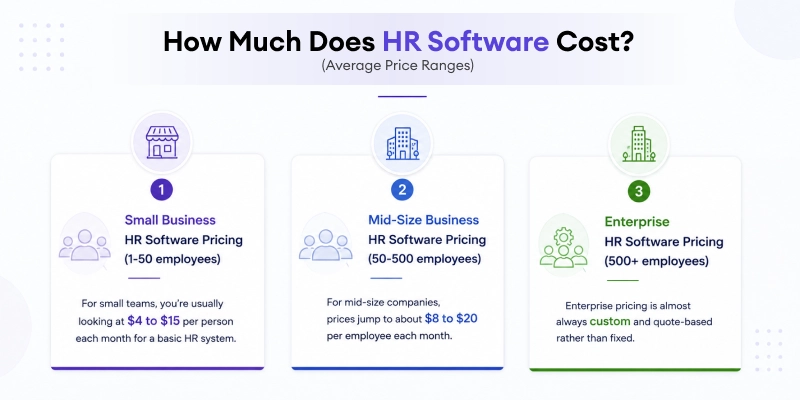
This is the section most pricing pages avoid. Below are the price ranges companies typically pay, broken down by size.
1.Small Business HR Software Pricing (1-50 employees)
For small teams, you’re usually looking at $4 to $15 per person each month for a basic HR system, something that handles attendance, leave tracking, and payroll. At this size, the cheapest plans cover what you need, but if you want things like advanced reports or performance management tools, you’ll usually have to pay extra.
For example, if you’ve got 20 people on your team and you’re paying $6 per person monthly, that adds up to $120 a month, or $1,440 a year. And that’s just the base price; add-ons cost more.
At this level, assessing best value hr software pricing typically matters more than selecting the lowest-priced plan. You’re better off spending a little more if it means you get built-in compliance and avoid headaches down the road.
2.Mid-Size Business HR Software Pricing (50-500 employees)
For mid-size companies, prices jump to about $8 to $20 per employee each month. That’s because you need more. Think about multi-department reports, performance management, tracking compliance for a bigger group, and making sure the system works with your finance or accounting software.
Here, you really need a proper HR software pricing guide. The price gap between basic and comprehensive plans gets much bigger, and the differences in features matter a lot more.
This is also where a genuine hr software pricing guide becomes most useful, since the gap between the lowest-cost and most complete plan widens considerably at this scale. Comparing hr management software pricing across vendors at this tier requires matching feature depth to actual need rather than selecting based on price alone.
3.Enterprise HR Software Pricing (500+ employees)
Enterprise pricing is almost always custom and quote-based rather than fixed. Factors that increase cost at this tier include the number of legal entities, countries of operation, integration complexity, and the depth of compliance support required across jurisdictions. A meaningful hr software cost comparison at this level typically requires a direct sales conversation, since publicly listed pricing rarely reflects what large organizations ultimately pay.
HRIS vs HRMS vs Payroll Software: Pricing Differences
Part of the difficulty in answering “how much does HR software cost” comes from inconsistent use of these three terms, which price differently in practice.
HRIS pricing tends to sit at the lower end, since it primarily involves storing and organizing employee data rather than running full HR processes. HRIS cost typically covers records management and basic reporting, without the automation depth of a full HRMS.
HRMS pricing runs higher, since it adds payroll processing, leave and attendance automation, and workflow management on top of the same underlying employee data.
Payroll software cost can vary in either direction. Standalone payroll tools are sometimes less expensive than a full HRMS if payroll is genuinely the only requirement, but they do not cover attendance, leave, or broader HR administration, which can result in the need for two separate tools instead of one.
Hidden Costs to Watch For
This is where a cost of hr software evaluation commonly goes wrong. Buyers tend to focus on the advertised monthly rate and overlook charges added afterward.
- Implementation and setup fees. A one-time charge that many vendors do not disclose until the contract stage.
- Data migration. Moving employee records, payroll history, and leave balances from spreadsheets or a legacy system is rarely included at no cost.
- Training. Free onboarding sessions typically cover the basics. More detailed, role-specific training or on-site sessions are often billed separately.
- Add-on modules. Recruitment, performance management, and advanced analytics are frequently priced apart from the core plan.
- Support tiers. Standard email support may be included, while priority phone support or dedicated account management usually is not.
- Renewal pricing. Introductory discounts are common in the first year. Confirm the year-two rate directly before signing.
Requesting an itemized breakdown covering each of these items before comparing vendors is advisable. The hidden costs of hr software are frequently what separate a predictable budget from a mid-contract surprise. Two plans that appear similar based on comparable hr software prices can differ by 50 percent or more once these factors are included.
Is Free HR Software Worth It?
Free hr software exists, but it rarely functions as a complete solution. Most free tiers cap employee count, commonly at five to ten users, and typically exclude payroll or statutory compliance features. This can be sufficient for a very early-stage team tracking basic records, but once payroll or compliance becomes necessary, most businesses require a paid plan.
Free tiers are best treated as a trial rather than a long-term solution for any business expecting to grow beyond a small headcount.
HR Software Pricing in India vs the US
Regional pricing differs substantially, and not solely due to currency conversion. Cost structures and compliance rules aren’t the same everywhere; they change a lot from one market to another. Take India, for example. Most cloud HRMS platforms there will charge you between ₹40 and ₹200 per employee each month. If you’ve only got a small team, you’ll usually see flat-rate plans that start at around ₹3,000 to ₹4,000 monthly for groups of 25 to 50 people.
Prices jump around quite a bit, mostly depending on whether core features like PF, ESI, TDS, or professional tax compliance are built into the software or just tacked on as extras. In the US, you’re looking at $4 to $20 per employee per month for similar HR platforms. The cost depends mostly on how many employees you have and how many features you want, pretty much, the same as what we’ve already seen for small and midsize firms.
But the real difference isn’t just about the numbers. It’s about what you get for the price. Indian HR software companies usually roll compliance features right into their basic packages, since that’s what local businesses expect and demand. In the US, you often end up paying more if you want all those extras.
US vendors more frequently position compliance and deeper reporting as premium-tier features. When evaluating hrms software cost in India against a US platform, it is important to confirm what is bundled rather than relying on the headline rate alone. A feature-by-feature comparison is covered in our guide to the best hrms software in India.
Regional pricing context informed by market research from EZHRM’s HR software cost analysis for the Indian market.
Is HR Software Worth the Cost? (ROI Breakdown)
The monthly fee represents only part of the total cost consideration. The remaining consideration is what manual HR processes are already costing the organization, even when that cost is less visible.
Suppose an HR team is spending 15 hours a month handling payroll manually. Those hours add up to a real business cost, mainly when much work could be automated. Then there are payroll mistakes, corrections, and possible compliance penalties to consider. Once these costs are included, payroll software can often prove more economical while giving HR more time for hiring, retention, and other important work.
Hr software ROI extends beyond time saved. Fewer compliance errors, faster reporting, and improved visibility into workforce data all carry real financial value, even when that value is difficult to express as a single figure.
How to Budget for HR Software: A Quick Checklist
Before you start collecting quotes, take a little time to work out exactly what you need from the software. This gives you a fair basis for comparing vendors and helps you avoid choosing a system simply because its starting price looks attractive.
- Determine headcount growth for the next 12 to 24 months, instead of basing your decision only on your present employee strength.
- List must-have modules separately from features that would be nice to have. Payroll and compliance are mainly required, while advanced analytics may not be needed from the very first day.
- Request an itemized quote describing the costs for setup, migration, training, and support. A single flat price doesn’t tell you what you’ll pay.
- Confirm the year-two renewal rate in addition to the introductory price.
- Verify compliance coverage specific to the relevant region and industry before signing any agreement.
A useful hr software pricing comparison means looking at the same features and the full cost across vendors. The number you see on a software provider’s homepage is only the starting point, not necessarily what you’ll pay in the long run.
Conclusion
There’s no single answer for what HR software costs. It really depends on your team’s size, where you’re based, and what you need the software to do. For a small team, you’ll probably pay somewhere between $4 and $15 per employee each month. Midsize companies usually see pricing in the $8 to $20 range. And if you’re buying for a big enterprise, you’ll have to talk to a sales rep, since published rates rarely cover all your needs.
Frequently Asked Questions
What pricing models do HR software vendors use?
There isn’t one standard approach to hr software pricing model. Some vendors charge employee wise each month. And others offer a flat fee for a certain number of employees or make different features-based plans. Large businesses will mostly receive a customised quote based on their needs.
Are there hidden costs with HR software?
They can be. The hidden costs of hr software will come with setup, implementation, data migration, more modules, training, premium support, or minimum contract commitments. These costs are not always obvious in the advertised price, so it is worth to ask for the full cost before planning, to your vendor.
Is free HR software actually free?
Not every time. Free hr software mostly puts limits on employees, features, integrations, or reporting. You may need to shift to a paid plan for payroll or other important functions. Before selecting a free option, check what is covered and what you’ll have to pay for your growing requirements.
What’s the difference between HRIS and HRMS pricing?
HRIS pricing is normally low when the system mainly handles employee records and basic HR administration. HRMS pricing may be high because it may bring together payroll, recruitment, performance management, attendance, and other required functions into the same system. The right option fully relies on your business needs.
Does HR software pricing include payroll?
It depends upon your selected plan and the service provider i.e. Vendor. Some include payroll in the main subscription, while others charge separately for it. This can make payroll software cost difficult to compare at first glance. Always check for payroll processing, compliance filing, and related services are included in the quoted price.
Is HR software worth the cost for a small business?
For various small businesses, the hr software ROI can make sense when the savings are really achieved. Reduced manual work, few mistakes in the payroll, and good control over daily HR tasks can justify the subscription. The real value is depending on how much time and effort your team spends, manually handling these processes at present.
How is enterprise HR software priced differently?
A reliable hr software cost comparison at the enterprise level begins with quote-based pricing rather than a fixed rate, since employee count, number of integrations, custom workflows, and dedicated support all factor into cost. A sales guidance is expected rather than a listed price.
What should I ask for when comparing HR software quotes?
While comparing various software quotes, you must ask for a fully itemized breakdown including licensing, implementation, ongoing support, and certain module costs to assure a realistic neck-to-neck comparison.