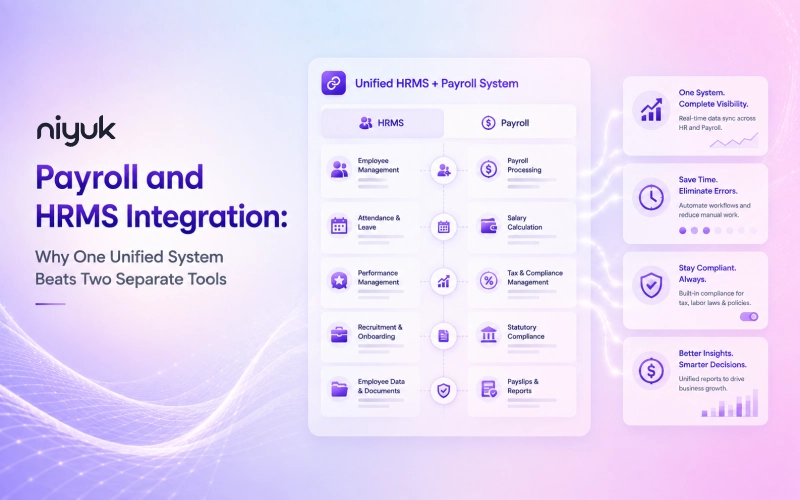
Payroll rarely starts with payroll. It starts with what happens in HR, a new employee joining, a salary revision, attendance being updated, leave being approved, or someone leaving the organisation. When all this information sits in different systems, even a routine payroll run can turn into a monthly exercise of checking, Fcopying, and correcting data.
This is the reason why businesses are keen for hr and payroll software that brings these processes together. Rather than asking HR and payroll teams to retain separate employee records, an integrated system enables suitable information to move between them, lowering repetitive work and making payroll processing more consistent.
This becomes increasingly important as a business grows. A process that works reasonably well for 30 or 40 employees can become frustrating when the workforce reaches several hundred. More employees mean more salary changes, attendance records, leave requests, deductions, reimbursements, new hires and exits to keep track of.
The question, then, is not simply whether a business needs Payroll Software and HRMS Software. It is whether these two critical functions should continue operating separately when they rely on so much of the same employee data.
Let’s look at why payroll and HRMS integration is becoming a more practical choice for modern businesses.
What Is Payroll Integration with HRMS?
Payroll integration is the connection between an HRMS and payroll system that allows relevant employee information to move between the two systems without repeated manual entry.
So, what is payroll integration in practical terms?
Suppose an employee receives a salary revision. HR updates the employee’s compensation details in the HRMS. With an integrated setup, the relevant information can be passed to payroll instead of someone having to manually update the same information again.
The same principle applies when a new employee joins, an employee leaves, attendance changes, leave is approved, or a variable payment needs to be added in payroll.
In a standalone setup, HR and payroll can each maintain their own version of the employee record. That creates a simple but important problem: the two records can eventually stop matching.
An integrated system creates a more connected flow:
Employee data → HR processes → attendance and leave → compensation changes → payroll → payslips and reporting
The actual setup relies on the software. Some hrms and payroll software solutions have payroll as a native module, while others connect an HRMS with an external payroll application through APIs or other methods of integration.
The objective is the same: make relevant employee data available for payroll without any duplication.
Why Do Modern Businesses Need an Integrated Payroll-HRMS System?
When a company has a smaller workforce, it’s easier to assume that separate HR and payroll tools are not a big issue. Somebody exports a spreadsheet, another person reviews it, payroll updates its records, and the monthly process is done.
But as the business grows, those small human steps start adding up.
Consider a typical month. HR may process new employees, attendance corrections, leave approvals, incentives, promotions, salary revisions, and employee exits. Payroll then needs the right information for each of those changes.
If HR and payroll work in separate systems, someone must ensure the right information reaches the right place.
That creates three recurring problems:
- More manual work: Teams spend time entering or transferring information that already exists.
- More opportunities for errors: A missed-out salary revision or wrong employee status will affect payroll.
- More reconciliation: HR and payroll should compare records to confirm that both systems are displaying the same information.
An integrated hr and payroll software setup addresses the underlying issue by connecting the workflows. It may be sensible for businesses to build a modern hr tech stack. Rather than adding another standalone application each time a business process requires automation, companies can go for systems working together as part of a broad employee-data environment.
Cloud technology simplifies this approach. With cloud-based hr and payroll software, authorised HR, payroll and management users can access suitable information without depending on a single desktop-located application or manually exchanging files.
The real benefit is not having “one more feature.” It is having fewer gaps between HR decisions and payroll processing.
Integrated Payroll-HRMS vs. Separate Payroll and HR Tools: A Comparative Study
The difference could sound technical, but employees and HR teams experience it in real ways.
| Business activity | Separate HR and payroll tools | Integrated HRMS and payroll |
| New employee joins | Employee information may need to be entered twice | Relevant employee data can flow into payroll |
| Salary revision | HR updates the change and payroll needs to be notified | Approved compensation information can move through the integration |
| Attendance and leave | Payroll may require a separate upload or reconciliation | Approved information can feed the payroll process |
| Employee exit | HR and payroll need to coordinate the change | Exit information can enter the relevant payroll workflow |
| Payroll reporting | Data may need to be collected from different systems | Connected information simplifies reporting |
| Error checking | Teams compare records manually | Validation can be built into the workflow |
| Employee queries | HR and payroll may refer to different records | Teams can work from more consistent information |
This does not mean an integrated system removes every payroll mistake. Poor data, incorrect configuration, missing approvals or outdated statutory rules may still cause problems.
What integration does is remove one major source of avoidable errors: re-entering the same information in multiple systems.
There is also a hidden cost to separate systems.
The subscription fees might not look very different from an integrated solution. But consider the hours employees spend downloading reports, checking spreadsheets, correcting mismatches, following up on changes and reconciling payroll information every month.
As headcount increases, that effort becomes harder to ignore.
How Does Payroll-HRMS Integration Work?
At a basic level, payroll-HRMS integration creates a controlled flow of information between the HRMS and payroll environment.
The HRMS generally holds core employee information, while payroll uses the relevant information required to calculate salaries, deductions, contributions and other pay components.
A typical workflow may look like this:
HR creates or updates employee information → approved changes are captured → relevant data is transferred to payroll → payroll processes calculations → payroll results are generated for employees and authorised teams.
The integration may happen within one platform or between two separate applications.
For businesses using an external payroll provider, APIs and connectors can allow the HRMS to exchange information with the payroll system. For example, Oracle documents payroll interfaces that can transmit employment events such as hires, terminations and salary changes to third-party payroll providers.
The important point is that integration should be designed around actual business processes, not simply around connecting two software products.
What Data Moves Between HRMS and Payroll?
Not every piece of HR information needs to be sent to payroll.
The exact data depends on the organisation and software, but commonly exchanged information can include:
- Employee name and identification details
- Joining and termination dates
- Department and designation
- Location
- Salary and compensation details
- Allowances and deductions
- Attendance and working hours
- Leave information
- Bonuses and incentives
- Benefits and contributions
- Tax-related information
- Statutory payroll inputs
- Bank or payment information
- Cost centre information
For example, if an employee’s approved salary changes in the HRMS, the payroll system should receive the relevant change. Similarly, if an employee exits, payroll needs accurate information to process the final settlement.
The aim is simple: the payroll team should not have to depend on multiple spreadsheets to find out what changed in the employee’s record.
What Are the Main Types of Payroll Integration?
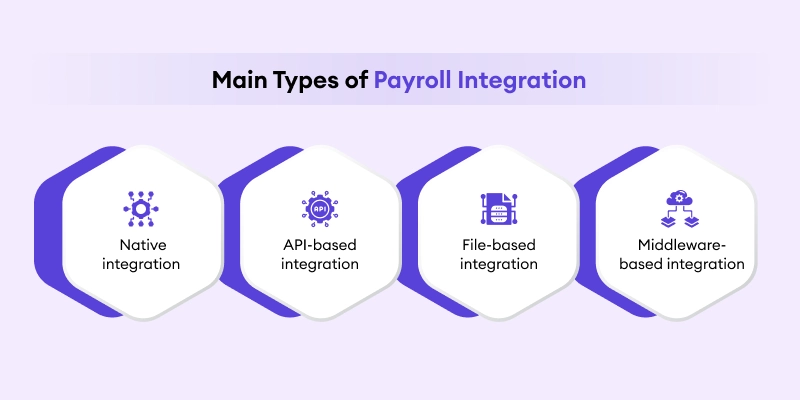
Businesses can approach integration in several ways depending on their existing systems and requirements.
1.Native integration
Payroll is built into the HRMS itself. Both functions operate within the same platform and may share a common employee database. This can be particularly convenient for businesses implementing a new HR and payroll platform from scratch.
2.API-based integration
An API connects the HRMS with a separate payroll application. This may be useful when a company wants to keep its current payroll provider but connect it with a new HR platform. With payroll api integration, systems can exchange information programmatically rather than relying fully on human file uploads.
3.File-based integration
Information is exported from one system and uploaded into another, often through CSV or similar files. This is relatively straightforward but still leaves some manual work in the process.
4.Middleware-based integration
Larger organisations with several applications can use middleware or an integration platform to join various systems. The right approach relies on the company’s size, current payroll software, technical setup, data requirements and expected level of automation.
What Are the Benefits of Payroll-HRMS Integration?
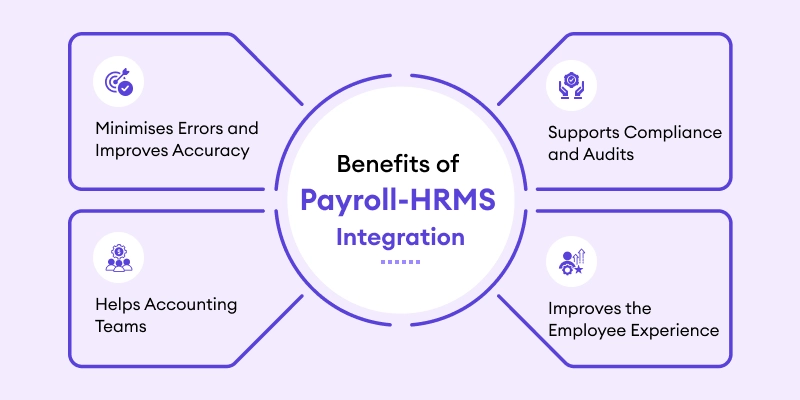
1. Minimises Errors and Improves Accuracy
Many payroll errors do not happen because someone intentionally entered incorrect information. Instead, they happen because information gets missed, entered twice, updated late or copied incorrectly.
A salary revision may be updated in HR but not payroll. An employee’s exit date may be recorded incorrectly. Attendance corrections may not reach payroll before processing begins.
These are ordinary administrative problems, but their consequences can be very real.
An integrated system lowers the number of manual handoffs. Rather than asking someone to copy the same information from one system to another, the suitable data can move through a defined workflow.
That gives HR and payroll teams more time to focus on exceptions and verification instead of regular data entry.
Modern payroll platforms are also moving towards automated validation and anomaly detection. This can help teams identify unusual payroll changes before final processing rather than discovering them after employees have been paid.
2. Supports Compliance and Audits
Payroll compliance depends on reliable employee information.
If HR and payroll are working with different salary figures, employee statuses or deduction information, compliance reporting becomes harder.
An integrated system helps by allowing payroll to work with current HR information.
For Indian organisations, this can be particularly useful because payroll may involve PF, ESI, TDS and other statutory requirements. Accurate employee and compensation information forms the basis for calculating and reporting these obligations correctly. This is really where the hr payroll software conversation matters most, since compliance accuracy depends entirely on the data sitting behind it.
Integration does not replace compliance expertise. Businesses still need the right rules, configurations, statutory updates and review processes.
But having connected data can reduce the risk of discrepancies caused simply by maintaining separate records.
It can also help during audits. Instead of piecing together information from multiple spreadsheets, teams can trace employee changes, approvals, payroll processing and adjustments more systematically.
3. Helps Accounting Teams
Even though accounting and HR payroll have different responsibilities, the two functions are closely connected. Once payroll is processed, organisations often need to allocate payroll costs, reconcile payments, prepare reports and pass relevant information into financial workflows.
This is where integrated hr and payroll software can also help accounting teams.
Instead of repeatedly asking HR or payroll for spreadsheets, finance teams can work with structured payroll information such as:
- Department-wise payroll costs
- Employee-related expenses
- Employer contributions
- Salary components
- Cost centre allocations
- Payroll liabilities
- Payroll-period summaries
For example, a company may want to find how much a particular department has spent on its employees. If payroll data is already structured around departments or cost centres, generating that information becomes easier.
The important point is that accounting teams benefit from cleaner and more accessible payroll data. This does not necessarily mean businesses need another standalone accounting platform simply to make payroll reporting work.
4. Improves the Employee Experience
Employees usually do not think about which department owns their data. They simply expect their attendance, leave balance and salary to be correct.
When HR and payroll systems are not connected, employees may sometimes find themselves stuck between the two. HR may say one thing while payroll has another record. A correction may then require multiple follow-ups.
An integrated system may create a smooth experience by connecting employee self-service with HR and payroll information.
Depending on the platform, employees would be able to access:
- Payslips
- Attendance records
- Leave balances
- Tax information
- Salary details
- Reimbursement information
- Employee records
This lowers frequent queries for HR teams while giving employees more visibility into their own information.
Which Features Should You Look for in an Integrated Payroll-HRMS Solution?
Not every hrms software offers the same integration level. When comparing solutions, one must think beyond the features list and check how the system handles the employee data.
Important capabilities are:
- Centralised employee records: There should be a clear source of truth for employee information.
- Automated payroll inputs: Attendance, leave, salary changes and other relevant information must be flowing into payroll with minimal manual intervention.
- Compliance support: The platform must support applicable payroll and statutory requirements.
- API and integration capabilities: APIs or standard connectors are useful when external applications must be connected.
- Workflow and approvals: Salary revisions and other sensitive changes must follow appropriate approval processes.
- Employee self-service: Employees should be able to access payslips and suitable HR information themselves.
- Reporting and analytics: HR, payroll and management should be able to generate useful reports from connected information.
- Audit trails: Changes to important employee and payroll information should be traceable.
- Scalability: The system should continue to work as headcount, locations and payroll complexity increase.
- Cloud accessibility: Cloud access can be valuable for organisations with distributed HR and payroll teams.
The right solution is not necessarily the one packed with the maximum features. It’s the one that fits naturally into your organisation’s daily processes and makes work easy for the people using it.
Security and Data Privacy Considerations
Payroll information is sensitive. It includes salaries, tax information, employee identifiers, bank details, and other personal data.
So, integration should never mean unrestricted access.
Before selecting an hr and payroll software platform, businesses should look at:
- Role-based access controls
- Data encryption
- Authentication
- API security
- Audit logs
- Backup and recovery
- Data retention policies
- Vendor security practices
- Third-party access controls
- Applicable data protection requirements
For example, an employee should not automatically have access to another employee’s salary information simply because both records exist in the same platform.
A well-designed system should make data sharing controlled, purposeful and traceable.
What Challenges Can Businesses Face During Payroll-HRMS Integration?
Integrating hr and payroll software can simplify daily work, but businesses should plan for a few practical challenges:
- Data cleanup: Old HR and payroll software records can contain duplicate or outdated information that needs to be corrected before migration. Skip this step, and that mess just follows you straight into the new system, dressed up as if it’s clean.
- System compatibility: Different hrms and payroll software platforms could use different data formats, requiring careful mapping or API configuration. Get the mapping wrong even slightly, and small mismatches have a way of turning into much bigger headaches later.
- Legacy systems: Old payroll applications may not support modern APIs, making connectors or file-based integration essential. Sometimes the workaround itself becomes the long-term solution, whether that was the original plan or not.
- Compliance: The system must support applicable tax and statutory requirements and stay up to date when rules change. Rules shift more often than most teams expect, and a platform that can’t keep pace quietly turns into a liability.
- Team adoption: HR and payroll teams may need training to adjust to new workflows and responsibilities. People don’t usually resist new tools out of stubbornness.
- Testing: New joiners, salary changes, attendance, leave and exits should be tested before the system goes live. It’s tempting to skip this when timelines get tight, but that’s exactly when a missed edge case turns into a live payroll error.
- Downtime during cutover: Nobody talks about this part enough, honestly. The moment you flip the switch from two systems to one; there’s usually a window where payroll can stumble a little. Do it in the middle of an active payroll run, though, and that small window turns into an actual delay, the kind people notice. Schedule it outside that run instead, and most employees never even know it happened. Same switch, wildly different outcome, depending entirely on timing.
Sound planning can address these issues early and make the transition to an integrated payroll-HRMS setup much smoother.
What Should Businesses Consider Before Integrating Payroll and HRMS?
Start by looking at the current process.
Ask:
- Which system is the main source of employee information?
- Where is data entered more than once?
- Which payroll errors occur most often?
- Which employee changes need to reach payroll?
- Which information should move automatically?
- How frequently should systems synchronise?
- Which compliance requirements need to be supported?
- Who approves salary and employee changes?
- What reports do HR, payroll and finance need?
- What security controls are necessary?
It is also worth asking whether you need two systems.
If the present payroll solution works well and there is no reason to replace it, API or connector-based payroll integration may be the actual answer.
If you are replacing both HR and payroll systems, anyway, selecting a unified platform may cut down the complexity of maintaining two separate applications.
When Should a Business Upgrade Its Payroll and HR System?
There is no universal employee count that tells a company when it must upgrade.
Rather, look at the amount of effort needed to keep the current system running.
An upgrade may make sense when:
- HR and payroll maintain duplicate employee records.
- Payroll requires frequent manual corrections.
- Salary revisions are communicated through spreadsheets or email.
- Payroll processing takes too long each month.
- Employees regularly report discrepancies.
- Compliance reporting involves substantial manual reconciliation.
- HR and payroll systems cannot communicate effectively.
- Finance teams spend too much time validating payroll information.
- The organisation is expanding into new locations.
- Existing payroll software India processes are becoming difficult to manage.
- Current hrms software India cannot keep pace with business growth.
For many growing organisations, the warning sign is not one major payroll failure.
It is the accumulation of small problems every month.
If your team spends several days every payroll cycle checking whether two systems contain the same information, that is a strong indication that the process needs a reconsideration.
What Does the Future of Payroll-HRMS Integration Look Like?
Payroll integration is moving beyond data transfer from one system to another.
The next stage is about using connected information to automate more decisions, identify problems faster and give employees great visibility.
For example, instead of waiting until payroll is almost complete to discover an unusual salary change or missing information, systems can increasingly flag exceptions during the process.
AI is also beginning to appear in payroll workflows. Modern payroll platforms are introducing capabilities such as anomaly detection, automated assistance and employee-facing explanations of payroll information. This could gradually change the role of payroll teams.
Instead of spending most of their time moving spreadsheets and checking routine records, payroll professionals can focus more on exceptions, compliance, analysis and employee support. The broader hr tech stack is also becoming more connected.
HR, attendance, leave, payroll, benefits, recruitment and employee self-service no longer must operate as isolated applications. For businesses comparing the best hrms software, integration must be considered alongside pricing, features, usability and scalability.
The best question is not:
“Does this HRMS have payroll?”
It is:
“Can this system connect HR and payroll data accurately, securely and with as little manual intervention as possible?”
That distinction can make a remarkable difference as the organisation grows.
Conclusion
HR and payroll processes are highly interconnected, requiring similar employee data. Managing them separately through different systems often leads to double-handling of information, manual data entry, and error-prone operations, especially at larger scales. This is why hr and payroll software featuring integrated payroll solutions could be a smart choice. Such tools will help you to manage and control all the information about your employees and payrolls correctly and efficiently, reducing errors, saving time and effort, minimizing costs. In addition, consider several factors when choosing the most suitable platform for your business, such as the tool’s performance, security, scalability, and compliance. Thus, in the future, the most effective solution that will help you manage and control your company’s payroll will be of great importance.
FAQs
1.Is HRMS the same as HRIS?
No. HRIS sticks mostly to core employee records and data. HRMS stretches further, payroll, attendance, Performance Management, the whole set. This is the classic HRIS vs HRMS question, and vendors blur the line constantly though, so don’t get hung up on labels. Look at what the platform does instead.
2.Why shouldn’t a business use separate payroll and HR software?
Because you end up entering the same employee information twice, sometimes three times, across different systems. Exporting, reconciling, double-checking. It’s real work, and it’s the kind of work where records quietly drift out of sync without anyone noticing right away. This is exactly the gap hr and payroll software platforms are built to close.
Raise the headcount, and that reconciliation job grows with it, along with the odds of a payroll mistake.
3.What is API-based payroll integration, and how is it different from manual imports?
API-based payroll integration allows the direct data exchange between an HRMS and payroll application by a coded connection, removing the need for manual entry. In contrast, a manual import requires an individual to export the information from one program to another, creating a period in which the data in both systems may be out of sync.
4.Does an integrated HR and payroll platform help with compliance?
Mostly, yes. An integrated HR and payroll software setup, or platform, whichever term you use, payroll works off cleaner, more current employee data when the two systems are connected, fewer mismatches on salary, status, deductions, the stuff that feeds statutory calculations. That said, an integrated platform isn’t a compliance autopilot. Still, you need to configure it correctly and kept current with regulatory changes.
5.Which is better for a growing business in India, standalone payroll software or an integrated HRMS?
For most growing businesses, an integrated HRMS wins out over time, mainly because payroll and employee data never drift apart in the first place. This is a common question for teams comparing payroll software India options specifically, since local compliance adds another layer to get right. Still worth comparing statutory support, security, scalability, integrations, and cost across options though, don’t just default to the “integrated” label.
6.How much does it cost a business to run payroll and HRMS as two separate systems?
The costs of software subscriptions for systems that require API-based integration are relatively simple to estimate. The primary challenge lies in understanding and budgeting for the operational costs associated with manual integration, including the duplication of efforts, time spent reconciling differences, creating spreadsheets for audit control, and correcting payroll errors. In addition, the addition of new employees and payroll processes increases the costs of manual processes at a rate that is often challenging to predict.