Key Takeaways
- Cost per hire measures the average expense involved in hiring one employee.
- Cost per hire = (Internal + External recruiting costs) / Number of hires.
- Recruitment expenses vary depending on the job role, hiring channel, company size and recruitment process.
- Tracking hiring costs helps HR teams identify expensive recruitment channels and improve budget planning.
- Using an ATS, employee referrals and a talent pipeline can help reduce hiring expenses without compromising candidate quality.
Introduction
Recruitment can be a costly process as well, as advertisement of vacancy, selection of applicants, interview process, and onboarding all requires both time and money.
In the context of HR recruitment, these expenses can increase quickly. If several positions are being filled, it can be hard to understand where the money goes without costing the process out.
Cost per hire is an essential KPI of recruiting. It helps HR to measure the cost of filling one position and find ways of decreasing those costs while ensuring high-quality applicants.
In this blog, we will discuss how to calculate cost per hire, what average numbers are, what influences the recruitment cost and how to reduce expenses.
What Is Cost per Hire?
The overall cost of hiring an employee includes expenses such as hiring fees for recruitment staff, marketing positions, employing recruitment agents, interviewing candidates, background checking, and recruitment software costs.
By knowing what it costs to fill positions, HR can understand how much it costs to hire individuals and manage budgets well.
Why Is Cost per Hire Important?
Cost per hire will enable you to determine how much your recruitment costs.
| Benefit | How It Helps |
| Budget planning | Helps estimate and manage recruitment expenses. |
| Cost control | Identifies expensive hiring channels. |
| Better efficiency | Highlights unnecessary recruitment expenses. |
| Decision-making | Helps compare hiring costs across roles and departments. |
It provides a clearer view of the recruitment process when contrasted with other recruitment metrics such as time to hire and quality of hire.
Cost per Hire Formula and Calculation
Cost per hire formula involves dividing the total amount spent by the number of hires in a certain time frame.
Cost per Hire Formula:
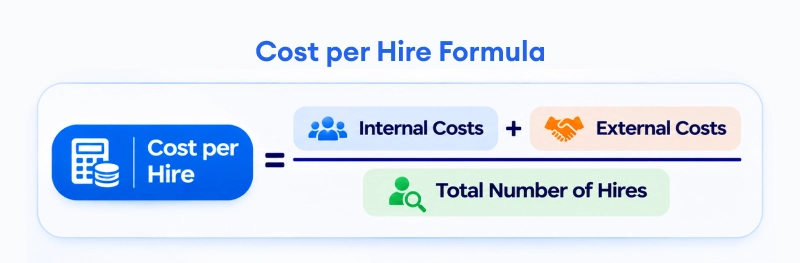
Cost per hire= Internal Costs+ External Costs/ Total Number of Hires

Businesses should include both internal and external recruitment expenses.
| Internal Recruitment Costs | External Recruitment Costs |
| Recruiter salaries | Job advertisements |
| Interview expenses | Agency fees |
| Referral bonuses | Background verification |
| Recruitment software | Job fair expenses |
Example:
A business hires 10 people in one quarter. The costs incurred are:
| Expense | Amount |
| Internal recruitment costs | ₹1,00,000 |
| External recruitment costs | ₹50,000 |
| Total recruitment costs | ₹1,50,000 |
| Total hires | 10 |
Calculation:
Cost per Hire = ₹1,50,000 ÷ 10
Cost per Hire = ₹15,000
This means the company spends an average of ₹15,000 to hire each employee.
Cost per Hire by Recruitment Channel: Example
| Recruitment channel | Total cost | Hires | Cost per hire |
| Job portals | ₹30,000 | 3 | ₹10,000 |
| Employee referrals | ₹12,000 | 3 | ₹4,000 |
| Recruitment agency | ₹40,000 | 2 | ₹20,000 |
This will enable HR to know which recruitment process is the most cost-effective. businesses should also consider candidate quality and employee retention before choosing a hiring channel.
Cost per Hire Benchmarks
Cost per hire varies depending on the industry, position, company size, and method of recruiting. Recruitment costs for entry-level positions will tend to be less than those for senior management or technical positions.
SHRM benchmarks reveal that the cost per recruit is $4,700 for a standard position. However, this information has been gathered exclusively in respect of recruitment in the US and therefore cannot be used as a benchmark for Indian businesses.
| Hiring Category | General Cost Pattern |
| Entry-level roles | Generally lower |
| Mid-level roles | Moderate |
| Senior-level roles | Generally higher |
| Technical roles | Can be higher |
These are general patterns, not fixed industry averages. Businesses should compare their recruitment expenses with previous hiring cycles and relevant industry benchmarks.
What Does a High or Low Cost per Hire Indicate?
Expensive recruitment might be because of costly recruitment sources or time taken for recruiting suitable candidates. On the other hand, cheap recruitment can be an indicator of effective recruitment sources. But cheap recruitment does not necessarily mean that recruitment is effective. Besides cost per hire, there are other things that need to be considered.
What are the Factors That Affect Hiring Costs?
Several factors influence the overall cost of recruitment.
| Factor | Impact on Hiring Costs |
| Job role and experience | Specialised and senior roles require more sourcing and assessment. |
| Hiring channel | Job portals, agencies and referrals have different costs. |
| Time to hire | Longer hiring cycles increase recruiter workload and administrative expenses. |
| Recruitment technology | Disconnected tools can increase software and operational costs. |
| Employee turnover | Frequent replacements require businesses to repeat recruitment activities. |
The longer time to hire can increase the cost of filling a position because recruiter need to spend more time and resources sourcing potential employees.
6 Ways to Reduce Cost per Hire
Costs can be minimised without affecting the quality of candidates. Processes can be made more efficient.
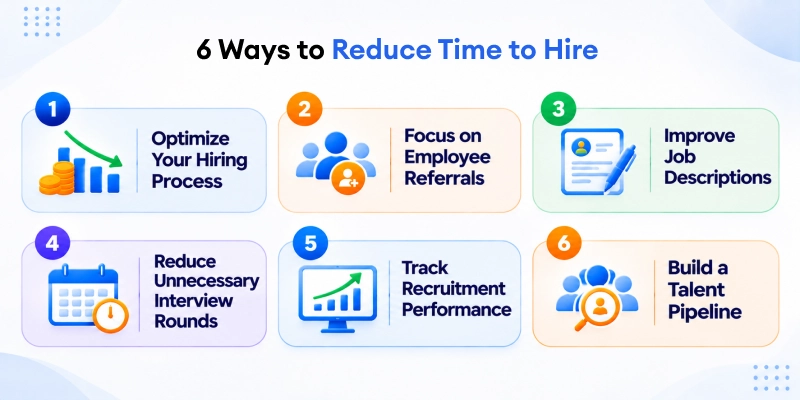
1. Use an Applicant Tracking System (ATS)
ATS software helps in streamlining the application process for HR. This means that you can sort out CVs, follow up on applicants, and schedule interviews, saving you time during the hiring process. Check out what they offer and how much they charge to choose the right one for your company.
Read our blog on ATS (https://niyuk.ai/blog/applicant-tracking-system/)
2. Focus on Employee Referrals
Get referrals from your existing staff for a suitable candidate. This may assist in reducing the cost of advertising and recruitment agencies.
3. Improve Job Descriptions
Describe clearly what you are looking for in the job description i.e. skills and experience. This will make sure you get the right candidates and reduce time spent on screening applications.
4. Reduce Unnecessary Interview Rounds
Think carefully about the stages of the interview and select the right decision makers. This will avoid unnecessary delays and minimize the workload of recruiters.
5. Track Recruitment Performance
Monitor important recruitment metrics to evaluate hiring performance. This can be helpful for you in determining areas where you might be incurring unnecessary expenses in the hiring process.
6. Build a Talent Pipeline
Create a pool of eligible candidates that helps you recruit people faster in the future. Using the right candidates from your pool of candidates can save you the trouble of finding new candidates.
Common Mistakes to Avoid
HR teams should avoid these common mistakes when calculating and managing recruitment expenses.
| Mistake | Why It Matters |
| Ignoring internal costs | Leads to inaccurate cost calculations. |
| Focusing only on lower costs | May compromise candidate quality. |
| Not tracking hiring channels | Makes cost comparisons difficult. |
| Ignoring employee turnover | Increases repeated recruitment expenses. |
Conclusion
If you manage the recruitment costs, you will be able to recruit good people effectively. By managing cost per hire, you will be able to measure how much cost is being spent on recruitment and how the situation can be improved.
Reducing recruitment costs by controlling recruitment expenses, choosing the right recruitment channels, using the Applicant Tracking System, and improving the recruitment process will help you reduce costs while recruiting quality people.
In general, by reducing the cost per hire, you would be able to make better recruitment decisions, which would eventually lead to more efficient recruiting.
Frequently Asked Questions
Does cost per hire include the new employee’s salary?
No, this does not include the salary or benefits of new employees. Such expenses belong to the employee cost category and are measured separately.
Does cost per hire include onboarding costs?
No, recruitment cost for the candidate is normally estimated based on the cost incurred in attracting and recruiting the candidate. Recruitment cost after recruitment (onboarding/training) is normally measured separately.
What is the difference between cost per hire and cost per applicant?
Cost per hire measures the average recruitment expense for each employee hired, whereas cost per applicant measures the expense incurred to attract each job application.
How do you calculate cost per hire for different recruitment channels?
Dividing it by the total number of hires that are made through the process will give the average cost of a hire. This will help you determine how well each process helped you get hires at low cost.
Can cost per hire be different for different departments?
Yes, the various departments require different kinds of employees. For example, recruiting for technical positions could be much more costly than recruiting junior positions.
Author