
Key Takeaways
- Time to hire refers to the amount of time it takes to recruit candidates through the entire recruiting process until they accept an offer of employment.
- This metric is used by HR to know how fast they are at recruiting candidates and find out possible bottlenecks.
- Time to hire and time to fill measure different stages of the recruitment process.
- The use of structured interviews, faster decision making, and automation of recruiting processes will help overcome any bottlenecks.
- Tracking this metric regularly helps to improve the process of recruitment and candidate experience.
Introduction
Have you ever found the right candidate, only to lose them because your hiring process took too long? Whether it’s due to the interview process being delayed or feedback not having been received yet, it may cause some difficulty for HR teams to close vacancies on time. Understanding the time to hire will help recruiters understand how fast they move candidates through the recruiting process.
In this blog, we’ll be discussing what time to hire is, how you can calculate it, what the difference between time to hire and time to fill is, and how you can reduce it without compromising on quality.
What Is Time to Hire?
Time to hire is the amount of time a candidate takes to accept your job offer after being entered into the recruitment process It will allow you to assess how well you identify, screen, interview, and select quality candidates for your vacancies.
For example: Suppose a candidate had applied for a job on 1st March, and they accepted the offer on 19th March; the time to hire will be 18 days.
A low time to hire could indicate efficiency in recruitment but you should never compromise on quality hiring.
How to Calculate Time to Hire
A simple calculation can be used to determine time to hire formula.

Time to Hire Formula: Time to Hire = Offer Acceptance Date − Candidate Entry Date
To calculate the average time to hire across multiple hires:
Average Time to Hire = Total Time to Hire for All Hires ÷ Number of Hires
Example:
Suppose a company hires three employees with the following timelines:
| Candidate | Entry Date | Offer Acceptance Date | Time to Hire |
| Candidate A | 1 March | 19 March | 18 days |
| Candidate B | 3 March | 25 March | 22 days |
| Candidate C | 5 March | 25 March | 20 days |
Total time to hire = 18 + 22 + 20 = 60 days
Average time to hire = 60 ÷ 3 = 20 days
Therefore, the company’s average time to hire is 20 days.
Time to Hire vs Time to Fill
The time to hire and time to fill are similar metrics that are employed to assess various aspects of the recruitment process.
| Basis | Time to Hire | Time to Fill |
| Meaning | Measures how long it takes to hire a candidate after they enter the recruitment process | Measures how long it takes to fill an open position |
| Starting Point | Candidate enters the recruitment pipeline | Job requisition is approved or the vacancy is opened |
| Ending Point | Candidate accepts the job offer | Candidate accepts the job offer |
| Focus | Candidate selection speed | Overall vacancy-filling speed |
| Helps Measure | Efficiency of candidate evaluation and selection | Efficiency of the complete hiring process |
For example: If a job vacancy is approved on 1 March, a candidate enters the recruitment process on 8 March and accepts the offer on 26 March, the time to fill is 25 days, while the time to hire is 18 days.
They both offer you insights on your recruiting procedures. The time to fill indicates the period for which the position remained open. Time to hire, on the other hand, is an indicator of how much time a candidate takes in the hiring process.
Why Is Time to Hire Important?
The time to hire statistics will assist you in identifying any problems in your recruiting process.
- Improves candidate experience: Faster the process of hiring and enhances the transparency of the process to minimize candidate loss.
- Decreases hiring delays: Helps you to identify slow interview rounds, and time spent waiting for feedback and approval bottlenecks.
- Planning your staffing: Hiring quicker will help your business fill key positions.
- Improves recruitment decisions: Shows where improvement is required in your recruiting process comparing the time taken by each department/position.
6 Ways to Reduce Time to Hire
To decrease your time to hire, there are several measures you must take to improve coordination, have proper recruitment criteria, and efficient recruitment process. Below are 6 methods to improve them:
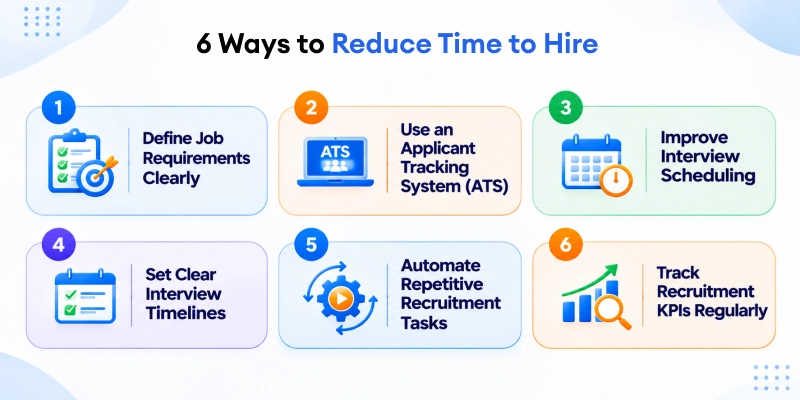
1. Define Job Requirements Clearly
Have a well-prepared job description, skill set, experience, and selection criteria before you start the recruiting process. It will help you find the best candidates.
2. Use an Applicant Tracking System (ATS)
With an ATS system, you can manage your applications, create candidate profiles and manage your recruiting process. It helps you to automate your processes and find candidates who are ready for the next stage.
3. Improve Interview Scheduling
This will assist in reducing the time to hire by using interview scheduling systems that can assist your recruiters in planning interview timings and sending out interview invitations, thus minimizing any communication between the candidates.
4. Set Clear Interview Timelines
Plan how many interview stages you need and set timings for each stage. Communicate these with hiring managers and interviewers. This will reduce any delays.
5. Automate Repetitive Recruitment Tasks
Automate candidate follow-up processes like informing candidates about their applications, scheduling reminders, and communicating with them. This will make it easier for recruiters to spend more time selecting candidates.
6. Track Recruitment KPIs Regularly
Keep track of time to hire metrics and other metrics such as time to fill, acceptance rate, and drop-off rate. This way, HR departments will be able to identify what is wrong in their hiring process and determine whether they have improved the hiring process.
Common Mistakes to Avoid
When measuring and reducing time to hire, HR teams must avoid the following mistakes:
- Using inconsistent starting points: The calculation will be hard to compare because you will be using a different starting date.
- Focusing only on speed: The quality of candidates hired will depend on the time spent on interviews and assessments.
- Ignoring candidate experience: Candidates might leave due to delays in the process of hiring.
- Not analysing individual hiring stages: It is hard to identify where the delays have been caused as you will only be measuring the total one.
Conclusion
Hiring time is a very important aspect of recruitment and may help the HR department get an idea about how efficient they are at hiring. By always calculating hiring times, recognizing bottlenecks and improving your interviewing schedule, you will make sure you decrease delays in your hiring process and provide a good candidate experience.
By using an ATS, scheduling software and automating your recruiting, you can make your hiring processes even more convenient. You want to create an efficient hiring process to ensure you are finding the right candidates for your business without unnecessary delays.
Frequently Asked Questions
What Is a Good Time to Hire?
Hiring can be different based on the role, industry, and level that you are trying to hire for. Hiring for entry-level positions will take less time, whereas hiring for specialized or senior positions can take more time.
How Is Time to Hire Calculated?
Time to hire refers to the duration taken by a candidate to accept an employment offer from the moment they come into your recruiting process. The calculation of the average time to hire is achieved by dividing the total time to hire for all your selected candidates by their total number.
How Can HR Teams Reduce Time to Hire?
The HR team will be able to decrease the time to hire by providing clarity in roles, the use of an applicant tracking system, efficient interview slots, decision-making within time frames and automation of repetitive tasks.
Is Time to Hire a Recruitment KPI?
Yes. Time to hire is one of the most important recruitment KPIs to measure. This KPI measures how fast your company can get candidates through the selection process. An insight for the HR team on how effective they are at recruitment and where they are wasting time.
What is the benchmark for time to hire?
The average time to hire benchmark is normally between 20 to 30 days, depending on the industry, job level, and complexity of hiring process. Technical jobs and executive positions can take longer than entry-level jobs.
How to decrease time to hire?
Time to hire could be decrease through resume screening automation, simplifying interview stages, adopting an applicant tracking system, and effective communication with candidates. Maintaining a talent pool and scheduling interviews promptly can also speed up the hiring process.
Author