Key takeaways
- A recruitment management system helps organizations control applications, applicants, and the recruitment process.
- There are several characteristics of such programs that guarantee their effectiveness, namely resume parsing, candidate tracking, interview scheduling, recruitment automation software, and recruitment analytics.
- There is also a need to select programs according to requirements like the needs of the company, the number of candidates, budget, and existing software at the company.
- It is very important to compare different vendors and ask for a demo of the product.
- Recruitment management metrics include time-to-fill, cost-per-hire, and acceptance ratio and can be used by businesses to determine how well the recruitment management system works for their purposes.
Introduction
Are you spending hours going through resumes, working with excel spreadsheets, and scheduling meetings with candidates? Manual recruitment operations are time-consuming and prone to errors. A recruitment management system is a helpful solution that helps companies keep track of their candidates. But what features should you look for in such a product? This blog includes the basic features, advantages, cost considerations, and useful tips to guide you in selecting the perfect recruitment management system.
What is recruitment management system?
A recruitment management system is a software solution used by organizations to manage the entire process of recruiting. This involves various stages including job posting, finding the applicants, screening their resumes, conducting interviews, and making the final decision from among them.
For example, in the case of a company that uses a recruitment management system, it can manage hundreds of applications for various vacancies.
Why do businesses need hiring software?
As organizations grow, they often need to fill more vacancies and manage an increasing number of applicants. This is where recruitment management system can assist HR professionals.
- Manual effort is reduced: the system will become automated in terms of application recognition, reminders, and candidates’ status.
- Helps in managing candidates: candidates’ resumes, personal data, interview notes, and their application status can be systematically stored.
- Helps in collaboration: there will be collaboration between recruiters and managers in terms of decision-making.
- Helps in transparency: helps in monitoring vacancies, pending interviews, and the progress of the hiring process.
- Helps in decision-making: provides reviews to assist in assessing recruitment trends.
- Helps in creating a good candidate experience: ensures smooth communication and a systematic hiring process.
The advantages will depend on the options chosen and the way the program is utilized.
Essential hiring software features
Before comparing vendors, identify hiring software features that address your biggest recruitment challenges.
Resume parsing & candidate management
Parsing tools collect information about the candidates from their resumes, such as the skills, qualifications, contact details, work experience, etc. On the other hand, candidate management software assists in organizing this information and making it searchable.
Thus, first, you need to consider the efficiency of parsing, i.e., the program’s ability to analyze resumes. The ideal software allows recruiters to edit collected data and provides an opportunity to sort and search candidates according to requirements.
Candidate screening & matching
Hiring software allows sorting dozens or hundreds of resumes according to the requirements set up by the employer regarding the job vacancy. Most of these programs include an algorithm that analyses candidates’ resumes and answers to screening questions.
Moreover, some of them use advanced algorithms based on artificial intelligence that suggest the most relevant candidates. It is important to note that to achieve the best results, one should use the suggestions as the initial base for human checking.
Recruiting workflow automation
These systems use recruitment automation software to help organizations in the form of automation software for repetitive and time-consuming tasks, which include identification of the applicants, informing applicants about the latest changes, and monitoring the progress of applicants.
It becomes highly essential that before buying any recruitment management system, you must confirm that the software can be customized according to the needs of your organization and that it also resolves the issue of recruiting.
Interview scheduling and feedback
The tools for interview scheduling will aid in coordinating the calendar, invitations, and reminders for interviews.
Feedback tools allow hiring managers to share feedback all in one place. They could be very helpful in case of multiple interviewers’ involvement in the process.
Vacancy postings and candidate sourcing
There is some hiring software that allows companies to post job advertisements on certain job boards. Some are capable of referral management, candidate database management, and contacting previous candidates.
Make sure that you know the various sources from which the hiring software can recruit candidates in the market you have selected.
Recruitment analytics and reporting
Analytics in recruitment can be useful to recognize how correctly agencies recruit, evaluate, and pick applicants.
Some metrics that can be used are:
- Time-to-hire
- Cost-per-hire
- Interviews from applications ratio
- Acceptance of offers ratio
- Performance of recruiting sources
- Hiring stages metrics
Select software that produces helpful reports where your team can take action from the data rather than just showing lots of figures.
Integrations, security, and scalability
The hiring software may need to interface with emails, calendar apps, HR software, job sites, and background check software. See what integrations may be made and if any extra value will accrue for the same. In addition, don’t forget to get entry to controls, security, retention, and privacy laws. The recruiting software program must be capable of adapting to your converting necessities even as your company grows.
What features should a recruitment management system have?
An effective recruitment management software should possess important features that make the recruitment process easy, and these include a resume parser, candidate management, candidate screening, recruitment automation, interview scheduling, job postings, recruitment analytics, and integration with HRMS. You should always try software with intuitive interfaces.
How to select the suitable recruitment management system
Selecting the best hiring software based only on features that do not add value can lead to poor decisions. To avoid this, follow the steps mentioned below.
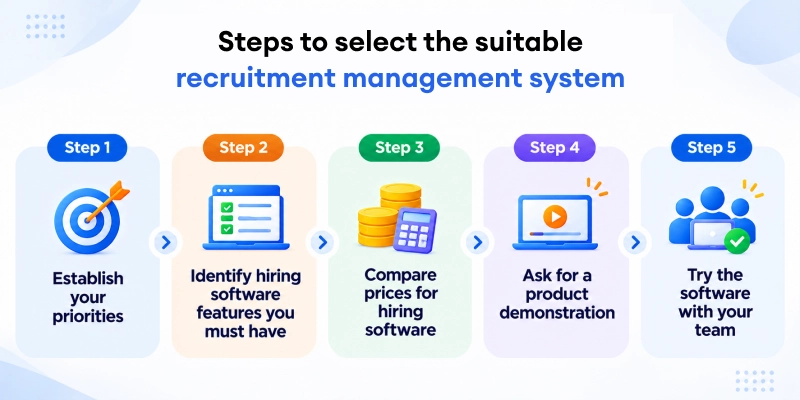
Step 1: Establish your priorities
Establish a list of major recruitment problems that you face. Are your recruiters spending a lot of time in resume screening? Is your interviewing process unorganized? Is information about candidates missing?
Step 2: Identify hiring software features you must have
It is essential to distinguish between key and non-key factors. Since all kinds of organisations have their own requirements, it is vital to know which category your company falls into. Every organisation has different requirements, so it is important to identify what suits your needs. Smaller companies may need only basic candidate management tools, whereas larger organisations may require advanced integrations.
Pay attention to the hiring software features your team will use and disregard the rest.
Step 3: Compare prices for hiring software
Hiring software pricing varies depending on the features, number of users, and pricing model. There are solutions that are provided for free but with a limited set of features and more costly advanced ones. Subscription models based on the number of users, hires, and available features are also quite common in this industry.
Here is what should be considered when comparing prices for hiring software:
- Subscription or licence fees
- Setup and implementation costs
- Training and onboarding charges
- Integration or add-on fees
- Costs for additional users or vacancies
- Contract length and renewal conditions
Ask for a full cost summary so that you can make comparisons based on the total cost and not just the starting price quoted.
Step 4: Ask for a product demonstration
Ask each vendor to go through the process of setting up a vacancy, working through the candidate through the process, and gathering feedback on an interview using the software. This is a great way to highlight the positives of your potential solution as well as the dealbreakers.
Step 5: Try the software with your team
If there is a trial period, ask your recruiters and hiring managers to perform their usual duties and gather information and make decisions based on it.
How much does a recruitment management system cost?
The cost of a recruitment management system is determined by its features, number of users, hiring process volume, and its customization. The basic version may cost nothing or low cost, but the advanced one might be more expensive. In addition, you should consider some other expenses.
Hiring software comparison checklist
Use this checklist when comparing different vendors.
| Evaluation area | What to check |
| Core features | Candidate tracking, resume parsing, interview scheduling |
| Automation | Custom workflows, reminders, candidate updates |
| Ease of use | Simple interface and manageable learning curve |
| Reporting | Relevant hiring metrics and custom reports |
| Integrations | Compatibility with existing business tools |
| Security | Access controls and data protection |
| Pricing | Subscription, setup, training, and extra fees |
| Support | Onboarding and ongoing assistance |
| Scalability | Ability to support future hiring needs |
Evaluate each of the providers of the services based on these requirements and prioritize them according to your organization’s priorities.
Common mistakes to avoid
Even the best recruitment software may not suit your team. Avoid these common buying mistakes:
- Choosing a tool based on price alone: A less costly solution might not have some of hiring software features and would require other costly modules to accomplish the necessary result.
- Ignoring ease of use: A complicated system that is not easily accessible to employees will demotivate them from using it.
- Lack of compatibility: the information exchange between incompatible systems is more difficult.
- Only automatic screening of candidates and no human interaction: recruiters must have enough control over the system.
- Insufficient protection of applicants’ personal data: security of the personal information of the candidates must be guaranteed to a corresponding degree.
- No training of the recruiters: employees who will use the system need to learn how to use it properly.
- Lack of definite goals: it is impossible to measure the effectiveness of the software without having definite requirements.
How to measure hiring software ROI
Hiring software is an investment, so it is important to consider how it will bring value to the business.
Record the figures from the current performance of the team before employing the use of the software and then compare the results to how the team is performing after they begin using it.
Keep track of these numbers:
- Time to hire: whether the vacancies are being filled faster.
- Cost per hire: whether recruitment costs are fluctuating.
- Recruiter efficiency: whether recruiters can handle the hiring process efficiently.
- Candidate conversion ratios: whether good candidates are moving on in the hiring process.
- Acceptance ratio: whether the candidates are accepting the job offers.
- Satisfaction of hiring managers: whether communication has been improved.
For example, if the use of hiring software helps to cut down the amount of time spent working with spreadsheets, recruiters will have more time to evaluate the candidates. It is crucial to measure these benefits and not just assume that a new software purchase will necessarily result in better hires.
Conclusion
Choosing the proper recruitment management system is not an easy task because, besides price comparison, it requires considering several other factors.
A recruitment management system can help to address your hiring issues, make the process easier for you, facilitate communication, and even evaluate how successful your recruiting campaign is.
There are certain aspects that you need to pay attention to when selecting a recruitment management system, such as features, cost, user-friendliness, automation, compatibility, security, and outstanding customer service.
Frequently asked questions
What is the difference between recruitment management software and recruitment CRM?
Recruitment management software includes everything regarding the recruitment process such as advertisements, applications, selections, etc. On the other hand, recruitment CRM involves only managing relationships with potential employees and candidates. It also helps recruiters maintain a database of potential candidates for future job openings.
Can a recruitment management system integrate with HRMS software?
Yes, there are multiple recruiting management systems that can interact with the HRMS software to supply data of selected candidates in the employees’ database. This reduces manual data entry and makes employee onboarding easier.
Is recruitment management software suitable for remote hiring?
Yes, because it provides a facility to hire people in remote locations using an online application form, conducting interviews, providing feedback, and communicating with them. It also allows hiring teams to coordinate recruitment activities from different locations.
How does a recruitment management system work?
It manages the activities of recruiting via different levels like job posting, candidate searching, resume screening, conducting interviews, selecting the best, and ultimately onboarding them. Recruiters can also track the progress of candidates throughout the hiring process.
How long does it take to implement a recruitment management system in an organization?
The duration of time required for implementation would depend on the type of software to be implemented, size of the organization, degree of customization and level of integration required. The simpler the software, the lesser the time it would take to implement. Proper planning and employee training can also help make the implementation process smoother
What should you consider before switching to a new recruitment management system?
Consider the aspects of data transfer, compatibility with your current HR software, costs, user training, security, and support. Apart from all of these, ensure that the software meets the requirements of recruitment as well. Also, check whether the system can support your organisation’s future hiring needs.
Author