Key Takeaways
- An applicant tracking system will help your HR team manage applications and candidates.
- The application process is going to be faster with the help of ATS software because it enables you to select candidates by their resumes and conduct interviews with them.
- This would be helpful in helping you get rid of administrative tasks and make the whole recruiting process transparent.
- There are some important factors that need to be considered when selecting an ATS for your company.
Introduction
Have you ever been in such a situation where you have got many CVs for one vacant job position? The condition can be worst when you have multiple positions, it becomes job to find a needle in the husk.
By using a manual process to recruit you can miss out on applications, delay communication and have inconsistent decision making. However, an Applicant Tracking System will help avoid this. Knowing how an applicant tracking system works will allow you to improve your recruitment process and improve your recruitment resources.
What Is an Applicant Tracking System?
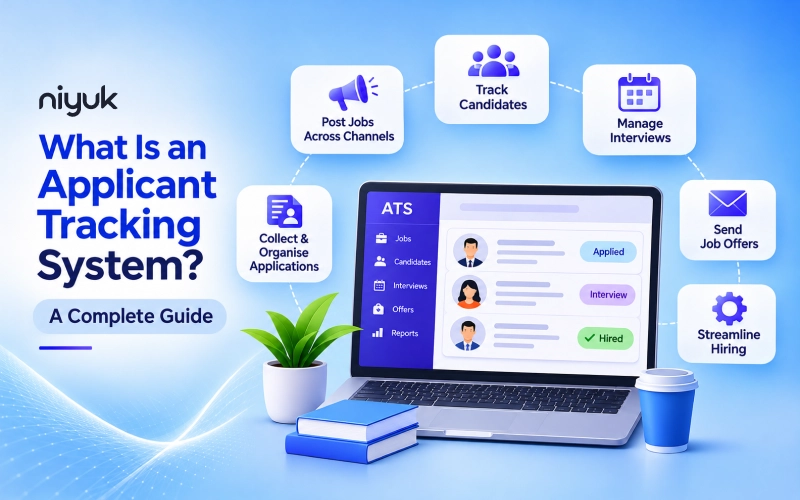
Applicant Tracking System or ATS is a software tool used by recruiters and HR departments. These tools help to gather and store the applications of candidates, manage CVs, shortlist candidates, schedule interviews and track the progress of applicants at different stages of their recruitment process.
Recruiters do not have to maintain multiple spreadsheets and send emails but use only one system for storing candidate data. There are many automation capabilities in modern ATSs that make it easier for recruiters to screen resumes, find proper candidates, and generate reports.
Candidates who want to apply for a position posted by the company may go to its career page or submit their application via job boards, and their information will be collected by the ATS.
The ATS assists recruiters in moving candidates through all stages of the recruiting process. An ATS supports every hiring stage, but the final evaluation and hiring decisions still rest with recruiters and hiring managers.
A Brief Evolution of the ATS
There have been many developments in Applicant Tracking Systems over the years. In the old days, the recruitment process was manual and included placing advertisements for jobs in the newspapers, storing resumes physically and managing them manually. Recruiters would find it difficult to manage a high volume of applications.
However, once the internet became common and job portals emerged on the internet, there were some changes to the way companies hired people. The first ATSs came into existence in the late 1990s. With ATS, companies were able to store large volumes of resumes and manage them efficiently. Resumes could be parsed, automatic alerts issued, candidates could be filtered and reports generated.
These days there have been many developments in ATS. ATS are available in the cloud, automate many processes and use artificial intelligence for matching candidates. This has made the whole process of recruitment much easier since recruitment can be managed through ATS.
Why Is an Applicant Tracking System Important?
Applicant Tracking Systems is critical for the following reason; it enables the HR department to coordinate its hiring process. This becomes hard for big companies to handle many applications manually.
Some key reasons businesses use an ATS include:
- Centralized Candidate Data: Keeps all the candidate information in one place.
- Improved Collaboration: Recruiters and hiring managers can share candidate information and interview feedback.
- Improved Visibility: Helps the recruiters keep track of applicants.
- Improved Communication: Keeps communication with the candidate during each phase of the recruiting process.
Using an ATS, HR departments will be able to reduce the amount of time spent on paperwork and concentrate more on candidate assessment.
Who Uses an Applicant Tracking System?
The Applicant Tracking System is used by many people in the process of hiring. This includes managing applications, looking at applicants, giving feedback, and tracking your recruiting process. What you can access and what you can do depends on your position and your hiring process.
| Role | How they use an ATS |
| Recruiters | Post job openings, review resumes, shortlist candidates, schedule interviews, and track applications. |
| Hiring Managers | Review shortlisted candidates, share feedback, and participate in hiring decisions. |
| Interviewers | Access candidate profiles, review interview details, and submit feedback after interviews. |
| HR Teams | Manage recruitment records, coordinate hiring activities, and support the transition from recruitment to onboarding. |
| Business Owners and Leadership | Monitor recruitment reports, hiring progress, and workforce requirements. |
| Candidates | Apply for job openings, submit resumes, receive updates, and sometimes schedule interviews through the company’s application portal. |
Types of Applicant Tracking Systems
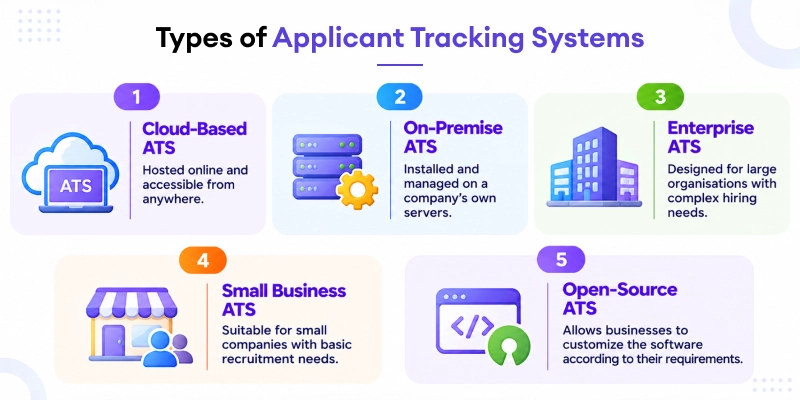
The common types of Applicant Tracking Systems include:
- Cloud-Based ATS: Hosted online and accessible from anywhere.
- On-Premise ATS: Installed and managed on a company’s own servers.
- Enterprise ATS: Designed for large organisations with complex hiring needs.
- Small Business ATS: Suitable for small companies with basic recruitment needs.
- Open-Source ATS: Allows businesses to customize the software according to their requirements.
How Does an Applicant Tracking System Work?
Applicant Tracking Systems is used for different stages of the recruitment process.
Step 1: Create and Publish Job Openings
Recruiters create the job description which includes information about the position’s duties, skills, experience, and other qualifications. The vacancy can be posted on the company’s career website.
Step 2: Collect Candidate Applications
Once the candidates submit their applications, the system will gather their CVs and application information. This helps create systematic records of applicants that recruiters can view when evaluating the applications.
Step 3: Conduct Resume Screening
The resume screening process helps recruiters to identify candidates who meet the job requirements in terms of their skills and experience. Some ATSs have keyword searching capability and screening questions to help recruiters filter resumes.
AI-assisted candidate matching is also available on some of the platforms. However, candidates’ relevant experience and transferable skills might not always show up in the keyword match.
Step 4: Schedule Interviews
The interviews will be scheduled with the help of the hiring managers. Utilizing scheduling services for the interviews including calendar syncs and email reminders can help to eliminate scheduling problems and emails.
Step 5: Track Candidate Progress
It can be identified that whether the applicants are at the stage of screening, short listing, interview, selection, or rejection stage. The HR can ask about the status and then proceed further.
Step 6: Review Hiring Results
Depending on the capabilities of the ATS, the tool can generate reports for hiring timeframes, source of candidates, and the progress of applications. This helps the HR department identify any lag in the recruitment process.
Key Features of an ATS
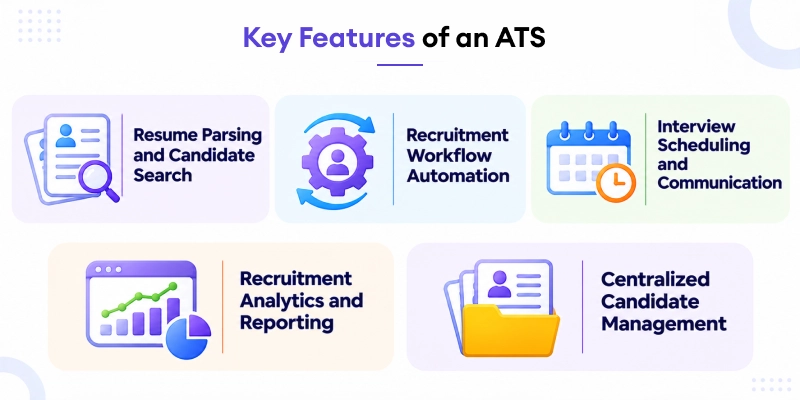
Resume Parsing and Candidate Search
The Applicant Tracking System is useful in the process of resume parsing and extracting the relevant data of the candidate, including their skills, education, work experience, and contact details.
Recruitment Workflow Automation
By automating, you can accomplish repetitive tasks like sending acknowledgments, updating the status of candidates, and scheduling reminders. This would help your recruiter handle applications.
Interview Scheduling and Communication
These tools make it easy for recruiters to schedule interviews, send invitations, and communicate with the candidates. The candidates will be kept informed of everything that is going on.
Recruitment Analytics and Reporting
Reporting allows the collection of data in terms of the number of applications received, recruitment source, and scheduling of recruitment. Human resource management can then identify any barriers within the recruitment process through such data.
Centralized Candidate Management
All candidates profiles, CVs, and interview feedback could be stored in one centralized system. It is more convenient for your team to access it when required, and it will allow recruiters to organize information about candidates in order to use it later when filling other positions in compliance with data protection requirements.
These tools can help to minimize the administrative load, facilitate team collaboration, and boost talent acquisition efficiency.
Benefits of ATS
• Saves Time: Automate tasks such as the screening process, schedule interviews, and communicating with candidates.
• Improves Hiring Efficiency: Manage large volumes of roles and keep track of your candidates.
• Enhances Candidate Experience: Keep your candidates engaged by sending them updates.
• Reduces Manual Errors: Store candidate data in an easy to access place to avoid any human error.
• Simplifies Collaboration: Easy for recruiters and hiring managers to give feedback and assess candidate.
• Provides Recruitment Insights: Provides reports to help you keep on top of your hiring, spot any delays and increase efficiency of recruitment.
How Much Does an ATS Cost?
Pricing for an applicant tracking system (ATS) depends on the pricing model, number of users, size of your team, volume of hiring, and feature set. Vendors often have free tiers or plans for small teams, while enterprise level tools often price on a customized basis.
ATS providers generally follow different pricing models:
- Per-User Pricing: Depending on the number of employees who use this software
- Per-Job Pricing: Depending on the number of available job openings.
- Flat-Rate Pricing: Businesses pay a fixed price monthly or annually.
- Custom Pricing: Enterprise ATS software providers will provide customized solutions which can be according to your requirements depending on how many candidates you want to hire and what kind of features you require from the software.
- Free or Open-Source ATS: Some systems offer a free version though additional charges may incur for hosting, customizing and maintaining the software.
Consider different pricing plans and features before selecting an ATS. Selecting an ATS solely based on the subscription plan may not be the correct decision. Consider the number of employees you will hire, the size of your workforce, and what your business will require in the future.
Choosing the Right ATS: What to Consider
Selecting the correct Applicant Tracking System involves knowing your business needs and existing hiring difficulties.
Identify Your Recruitment Needs
Consider the number of vacancies you have, the number of applications you have received, and the size of your recruitment team. Select an option that not only solves your present issue but also scales up in the future.
Compare Features and Pricing
Think about resume parsing, candidate search, interview scheduling, automation functionality, and reporting functionality. One can think about subscription charges, user licensing, implementation costs, and any additional charges.
Check Integrations
Check to see if the system supports integration with related job sites, calendar systems, communications, and other HR systems. Proper integration will avoid data duplication.
Review Security and Usability
Personal details are found in candidate records. The aspects of access controls, security, retention, and compliance must be assessed. Usability and customer service are other factors that must be considered.
Conclusion
Applicant tracking system helps in handling all information regarding applicants through one tool, organizing applications and recruiting activities.
Using the tools of the system will help in decreasing manual work and making the hiring process more transparent.
Considering the goals of recruitment, budget, integration, and security issues, HR department will be able to choose the best applicant tracking system that will help with organizing applications and recruiting.
The proper Applicant Tracking System will help companies manage their recruitment process effectively.
Frequently Asked Questions
What is the full form of ATS?
ATS stands for Applicant Tracking System. It is software that assists recruiters in managing their applications, screening CVs, tracking candidates, and handling their recruitment process.
How can ATS software be useful for recruiters?
ATS software helps recruiters to manage CVs, conduct screening, arrange interviews, interact with candidates, and oversee the entire recruitment process.
What is an applicant tracking system in hr?
The applicant tracking system is an automated software program employed by the HR department to streamline their recruiting process. Through this system, recruiters can post job openings, receive applications, sift through resumes, set up interviews and track candidates through the hiring process.
Will the applicant’s resume be automatically rejected by ATS?
It depends on how the ATS is set up. Many systems only rank or tag resumes and leave the final decision to recruiters. Others let recruiters add knockout questions or screening rules, and candidates who don’t meet them may be filtered out automatically. Recruiters should review these rules regularly so that qualified candidates aren’t missed during resume screening.
What is the purpose of ATS?
The purpose of Applicant Tracking System (ATS) is to make the hiring process more manageable. It will enable recruiters to manage job postings, store and screen resumes, candidate tracking, scheduling interviews, and contacting candidates. In this way, the HR team can easily hire the right candidates.
Author