Key Takeaways
- Payroll management deal with the general managing and checking activities related to payroll operations.
- Payroll processing is, about identifying how a lot every employess earns, what receives taken out and what they clearly receive.
- These alternatives assist businesses manipulate sales payments appropriately and hold payroll data properly organised.
- Manual payroll strategies can purpose mistakes, processing and compliance problems.
- Using payroll software program, we could organizations automate duties and raise payroll efficiency.
Introduction
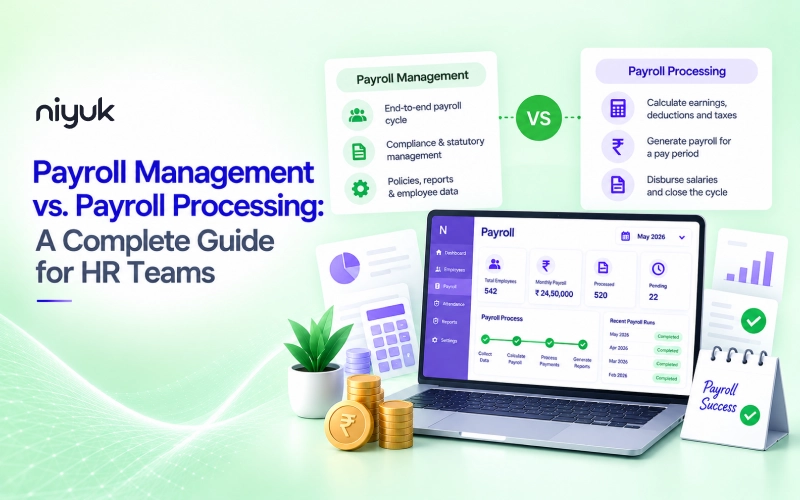
Payroll control and payroll processing are cautiously related but serve one-of-a-type features in an organisation. Payroll manipulate consists of overseeing the entire payroll system, which incorporates employee sales structures, compliance, policies, and payroll planning. Payroll processing specializes in calculating salaries, using deductions, generating payslips, and ensuring employees are paid successfully and on time. Understanding the difference permits HR agencies decorate payroll accuracy, hold compliance with applicable regulations, reduce errors, and streamline sales administration. Payroll software program can in addition simplify those obligations with the aid of using automating calculations, establishing worker records, and decreasing repetitive guide work. This blog explains the key differences between payroll management and payroll processing.
What Is Payroll Management?
Payroll management covers the entire system of organising, keeping, and tracking a corporation’s payroll procedures.
Payroll control includes preserving worker revenue records, dealing with compensation, monitoring attendance, calculating deductions, preserving payroll documents, and making sure compliance.
A payroll management system suggests employee income manages HR and finance analyses payroll reviews solutions questions, approximately employee income and improves payroll processes.
The most important goal of payroll management is to make sure personnel receive correct and timely salaries whilst the corporation continues particular employee information and complies with prison requirements.
Key Responsibilities of Payroll Management
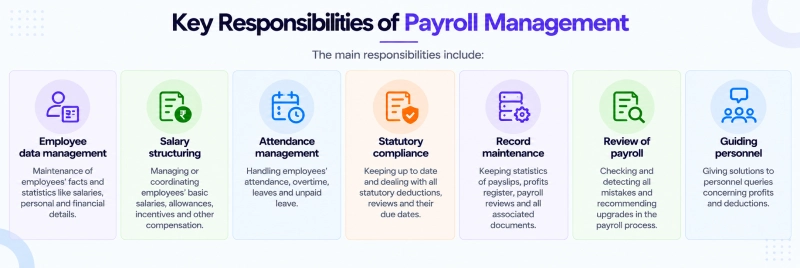
The main responsibilities include:
- Employee data management: Maintenance of employees’ facts and statistics like salaries, personal and financial details.
- Salary structuring: Managing or coordinating employees’ basic salaries, allowances, incentives and other compensation.
- Attendance management: Handling employees’ attendance, overtime, leaves and unpaid leave.
- Statutory compliance: Keeping up to date and dealing with all statutory deductions, reviews and their due dates.
- Record maintenance: Keeping statistics of payslips, profits register, payroll reviews and all associated documents.
- Review of payroll: Checking and detecting all mistakes and recommending upgrades in the payroll process.
- Guiding personnel: Giving solutions to personnel queries concerning profits and deductions.
For instance, while an organisation manages income structures, updates employee records, critiques payroll reports, and ensures compliance requirements, those sports shape a part of its payroll management function.
What Is Payroll Processing?
Payroll processing is the system of calculating employee salaries and organising payments for a particular period. It consists of amassing payroll records, calculating earnings, making use of applicable deductions, identifying net salary, and generating payslips.
Payroll processing is a central part of payroll management as it converts employee pay and attendance records into the amount payable to every employee.
Main Payroll Processing Steps
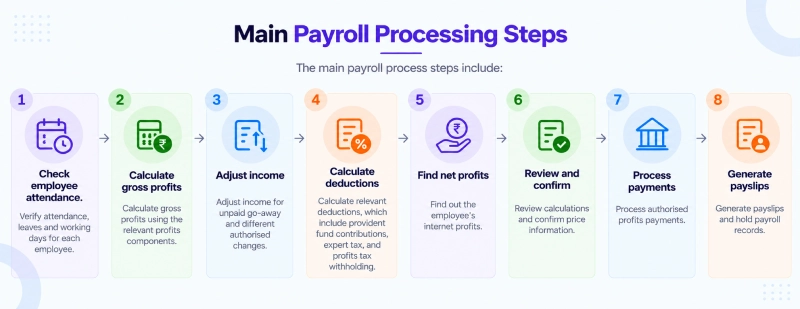
The main payroll process steps include:
- Check employee attendance.
- Calculate gross profits using the relevant profits components.
- Adjust income for unpaid go-away and different authorised changes.
- Calculate relevant deductions, which include provident fund contributions, expert tax, and profits tax withholding.
- Find out the employee’s internet profits.
- Review calculations and confirm price information.
- Process authorised profits payments.
- Generate payslips and hold payroll records.
The actual deductions rely upon employee eligibility, income structure, relevant laws, and organisational policies.
Example of Payroll Processing
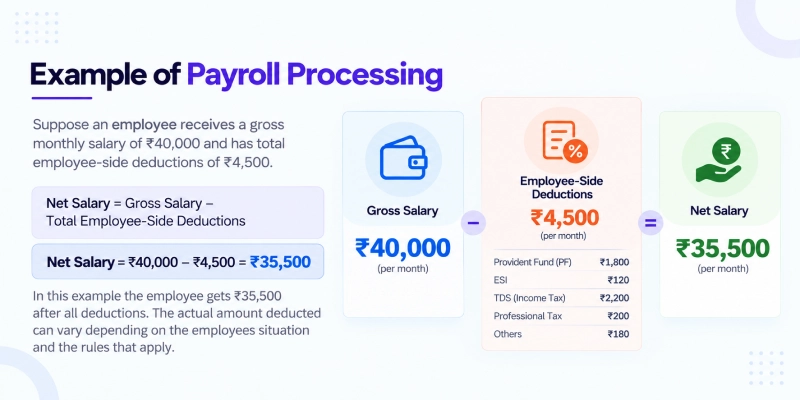
Suppose an employee receives a gross monthly salary of ₹40,000 and has total employee-side deductions of ₹4,500.
Net Salary = Gross Salary − Total Employee-Side Deductions
Net Salary = ₹40,000 − ₹4,500 = ₹35,500
In this example the employee gets ₹35,500 after all deductions. The actual amount deducted can vary depending on the employees situation and the rules that apply.
Payroll Management vs Payroll Processing: Key Differences
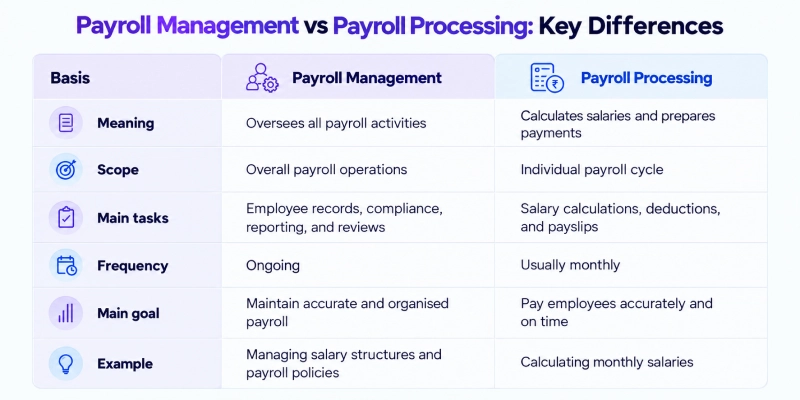
The essential distinction between payroll management vs payroll processing is their scope. Payroll management oversees the general payroll function, while payroll processing specialises in income calculations and bills in the course of a selected payroll cycle.
| Basis | Payroll Management | Payroll Processing |
| Meaning | Oversees all payroll activities | Calculates salaries and prepares payments |
| Scope | Overall payroll operations | Individual payroll cycle |
| Main tasks | Employee records, compliance, reporting, and reviews | Salary calculations, deductions, and payslips |
| Frequency | Ongoing | Usually monthly |
| Main goal | Maintain accurate and organised payroll | Pay employees accurately and on time |
| Example | Managing salary structures and payroll policies | Calculating monthly salaries |
Both competencies paintings together. Payroll control establishes the tactics and controls, at the same time as payroll processing applies them in the course of each payroll cycle.
Why Are Payroll Management and Payroll Processing Important?
Accurate payroll operations useful resource worker satisfaction, financial planning, and green HR administration.
1. Ensure Accurate Salary Payments
Employees rely on their salaries to be paid efficiently and on time. Mistakes in attendance income parts or deductions can cause bills and many corrections. Reliable payroll procedures help groups figure out calculations before bills are sent.
2. Support Payroll Compliance, In India
Businesses must understand and review the payroll needs that apply to their staff and operations. I think that depending on eligibility and conditions those desires may also consist of provident fund contributions, employee insurance, expert tax and tax deducted at source. Payroll manipulation allows coordination of compliance duties while payroll processing applies the calculations and deductions.
3. Reduce Administrative Work
Manual payroll methods usually involve spreadsheets, repeated data entry and approval follow-ups. Standardised workflows and proper automation can cut tasks and let HR teams focus on useful employee resources and other duties.
4. Improve Employee Experience
Clear payslips, bills and clear deductions help build employee confidence. A well-organized payroll system also makes it much easier to spot and fix mistakes.
How Does the Payroll Process Work?
Payroll management remains in the vicinity during the employee lifecycle, whilst payroll processing follows a routine.
Step 1: Update Employee Information
Keep employee details correct; update pay structures, bank information and employment data.
Step 2: Collect Payroll Inputs
Gather employee attendance, leave records, overtime hours, bonuses, pay revisions, and any allowed payroll changes.
Step 3: Calculate Salary and Deductions
Compute earnings, practice vital adjustments, and determine on deductions that in shape every employee’s state of affairs and present-day rules.
Step 4: Review and Approve Payroll
Check pay calculations, deductions, employee data and fee details. Fix any errors before approving payroll.
Step 5: Process Payments and Generate
Payslips: Arrange authorised pay disbursements, produce payslips and keep payroll data.
Step 6: Reconcile Payroll Records
Compare payroll summaries against the data on fees and financial information. The practice allows organisation to detect mistakes and improve processes in time and increase efficiency of payroll cycle.
What Are the Common Payroll Challenges?
Companies may be forced to experience a multitude of challenging scenarios if payroll procedures are performed manually or through unconnected systems.
| Challenge | Possible Solution |
| Incorrect employee information | Update and validate employee records |
| Attendance discrepancies | Maintain accurate attendance and leave records |
| Incorrect deductions | Review applicable rules and verify calculations |
| Manual calculation errors | Use tested formulas and payroll automation |
| Delayed approvals | Establish clear payroll deadlines |
| Disorganised records | Maintain consistent, secure documentation |
Addressing those demanding situations calls for correct data, described responsibilities, ordinary reviews, and suitable payroll technology.
How Can Payroll Software Improve Payroll Management?
Payroll software is a tool used to manage employee compensation records. It plays payroll computations, prints paychecks, and shops payroll data. Depending on its features, payroll software program also can help with payroll control and payroll processing functions. Payroll software is a tool that simplifies payroll management and is essential for organizations that need to streamline payroll processing.
1. Automates Salary Calculations
Payroll software can calculate earnings, deductions and net salaries through the use of configured salary structures and payroll rules. HR companies need to test the accuracy of payroll inputs and tool settings.
2. Integration with Attendance and Leave Data
Where integrated, payroll software can use verified attendance, overtime, and leave records to calculate salaries accurately and reduce manual data entry.
3. Supports Compliance Activities
Depending upon the product, payroll software can also assist with calculations, for deductions, payroll reviews and compliance documentation. Businesses need to make certain that their selected solution meets their requirements.
4. Payslips and Reports Can Be Generated by Payroll Software.
These include payslips, income registers, payroll summaries and exceptional opinions. This helps HR and finance teams keep records. Automated calculations and standard workflows reduce tasks.
5. Saves time and Effort.
Businesses need to check software program packages carefully. They want to test features, security, integrations, reporting, scalability and issuer documentation. Testing need to show up earlier than deciding on a solution. This guarantees the software program meets all requirements.
Payroll Management Checklist for HR
- Use this checklist to review your payroll procedures:
- Employee records and income systems are updated.
- Attendance, leave, overtime, and incentives are verified.
- Gross income and authorised changes are checked.
- Applicable statutory deductions are reviewed.
- Salary calculations are checked earlier than approval.
- Employer contributions are calculated one by one from employee deductions.
- Employee financial institution info and internet income are verified.
- Payroll totals are reconciled with charge records.
- Payslips and supporting documentation are maintained.
- Applicable statutory bills and filings are finished on time.
- Employee payroll queries are resolved promptly.
Conclusion
Payroll Management vs Payroll Processing: Payroll manage vs payroll processing is a tough idea for businesses that want to optimise their HR and monetary processes. The former implies a whole set of sports for processing and administering payroll, and the latter refers to calculations of gross and internet pay, deductions, and remittance.
In general, each idea is a quintessential factor for efficient and error-free payroll that assists in enhancing the bottom line of organisations. The latter is accomplished via the preservation of all employee data, standardisation of payroll procedures, evaluation of relevant regulations, and adoption of applicable software programs.
Frequently Asked Questions
1. What Is the Difference Between Payroll Management and Payroll Processing?
Payroll control is set overseeing all the responsibilities associated with payroll. It consists of planning, organising, and ensuring the whole lot runs smoothly. Payroll processing, on the alternative hand, is greater specific. It’s the step where you calculate how much each employee should get paid, take-out deductions like taxes and get the payments ready. So, payroll management is the picture, and payroll processing is one part of that picture.
2. Is Payroll Processing Part of Payroll Management?
Yes, it is. Payroll processing is a part of payroll management. Every time payroll runs, you need to do the math. Figure out pay, take out the right amounts for taxes and benefits and make sure payments are correct. That’s what payroll processing does. It supports the payroll management process by handling the actual calculations and cost details.
3. What Are the Main Payroll Processing Steps?
There are steps. First, you gather all the employee information. Like hours worked or salary rates. Then you calculate the pay based on that. Next, you apply any changes, like bonuses or overtime and subtract deductions like taxes or insurance. After that, you figure out the pay. What the employee actually takes home. You review all the numbers to make sure they’re right. Then you process the payments. Send checks or direct deposits. Finally, you create payslips for each employee to show their pay details.
4. How Does Payroll Software Help HR Teams?
Payroll software makes life easier for HR. It can automatically calculate pay, which saves time and reduces errors. It can also connect with attendance systems, so you don’t have to enter hours. The software program can generate payslips for every employee, maintain all payroll facts in a single place, and create reviews that display such things as payroll prices or tax amounts. This helps HR focus on important work.
5. What Is a Payroll Management System?
A payroll control device is a software program that is designed to address every aspect of payroll. This device enables one to have total control over the entire process, from calculation to deductions. In addition, one can use it to produce payslips, reports, and manage approvals for adjustments and shop employee records. Depending on the device, one may also be able to manage tax computations and other related functions. The device is an ultimate payroll management software that handles all aspects of payroll management and serves as the focal point for all other human resource management systems.
6. Can Payroll Management and Processing Be Automated?
Yes, each may be computerized with the software program. The software program can perform the pay calculations, generate payslips, maintain payroll information organised, or even automate approval workflows. But even with automation, you will still want to make sure the facts is correct and evaluation matters regularly. Automation helps. But human exams are nonetheless crucial to trap errors and preserve matters strolling correctly.