
Payroll is one of those business processes that must be right every month. A small error in salary, deductions or attendance can quickly turn into employee complaints, correction work and compliance issues.
For Indian businesses, payroll is also no longer limited to calculating salaries. It can involve attendance, leave, reimbursements, salary revisions, PF, ESI, TDS, Professional Tax, payslips and statutory reports. Managing all is manually becomes harder as the workforce grows.
That is where payroll software in India can make a practical difference. Instead of moving information between spreadsheets and separate systems, businesses can bring employee data, attendance, payroll and reporting into a more connected workflow.
But each payroll platform is not built for the similar type of business. A small startup can go for an affordable and simple payroll. On the other side, a growing company may need a full HRMS, attendance management and employee self-service. Larger organisations may require multi-location compliance, integrations and strong controls.
This guide compares 10 payroll platforms based on their payroll capabilities, compliance support, HR features, attendance integration, business fit and overall usability.
Why Indian Businesses Need Payroll Software?
Payroll software is a system automating the process of calculations, processing and management of employee salaries.
In a manual setup, HR or finance teams can maintain employee information in single spreadsheet, attendance in another, leave records somewhere else and salary calculations in another payroll sheet. Each month, these sources must be checked and reconciled before salaries can be processed.
Payroll software brings much of this work into a streamlined system.
A payroll workflow can typically look like this:
Employee data → Attendance and leave → Salary inputs → Deductions and taxes → Payroll calculation → Payslips → Reports and payments
This connection matters because payroll is affected by what happens during the entire month. An employee could take unpaid leave, get a salary revision, claim for a reimbursement or work overtime. If those changes are not displayed correctly in payroll, the final salary can be uneven.
Indian payroll also has specific statutory requirements. Depending on the organisation and employee circumstances, these may include Provident Fund (PF), Employee State Insurance (ESI), Tax Deducted at Source (TDS), Professional Tax and Labour Welfare Fund.
Automating these calculations and keeping the relevant records together can reduce repetitive work and the risk of manual errors. Attendance and leave data can also be connected to payroll instead of being manually transferred at the end of each month. This relationship between workforce data and payroll is an important part of modern payroll management.
Cloud-based payroll software adds another practical advantage. HR and finance teams can access the system from different locations without depending on software installed on a single office computer. For growing businesses, that can make payroll easier to manage as teams and locations expand.
What to Look for in Payroll Software in India?
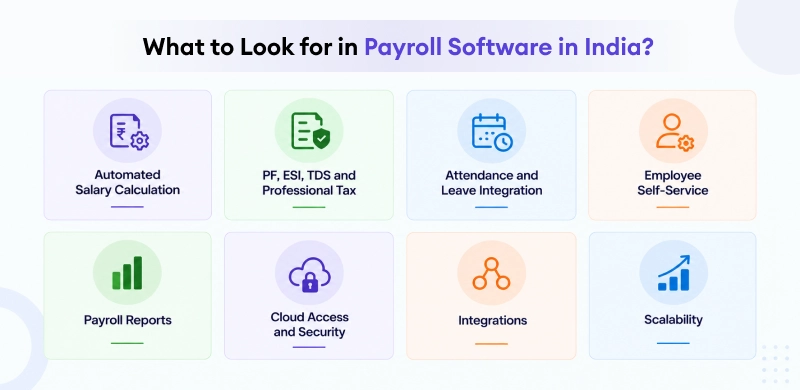
Choosing the best payroll software in India starts with understanding what your payroll team actually needs.
Automated Salary Calculation
The platform should handle salary structures, earnings, deductions, bonuses, reimbursements, arrears and other applicable components with minimal manual calculation.
PF, ESI, TDS and Professional Tax
Indian payroll software should support the statutory components applicable to your organisation. However, check what the vendor means by “compliance.”
Compliance support may include calculation, reports, filing preparation or managed filing services. These are not necessarily the same thing.
Attendance and Leave Integration
Attendance and leave can directly affect salary. Connecting these inputs with payroll reduces duplicate data entry and manual reconciliation.
Employee Self-Service
Employees must be able to access payslips, tax information, attendance details and other payroll documents without any need to contact HR for each request.
Payroll Reports
Payroll teams need reports for finance, accounting, statutory requirements and internal review. Custom reporting becomes increasingly useful as payroll becomes more complex.
Cloud Access and Security
For the payroll software based on cloud, check access controls, user permissions, backups, security practices and data management policies.
Integrations
Check whether a payroll management system could connect with accounting software, attendance devices, banking platforms, HRMS or other systems are in use by your company/business.
Scalability
The software should be able to support your business as employee numbers, locations and payroll complexity increase.
The best system is not necessarily the one with the longest feature list. It is the one that fits your actual payroll process without creating unnecessary complexity.
Top 10 Payroll Software in India (2026) : A Quick Comparison
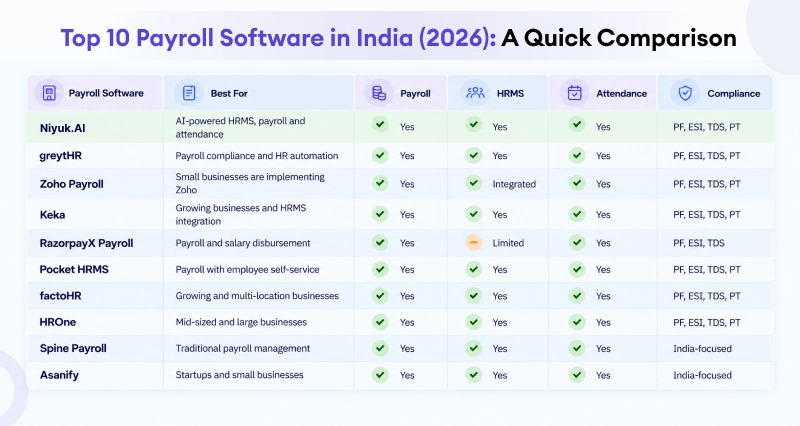
Features, pricing and plan structures can change, so businesses should verify current vendor information before making a purchase.
1. Niyuk: Best for AI-Powered HRMS, Payroll and Attendance
Niyuk is a particularly relevant option for businesses that want payroll connected with broader HR operations rather than running payroll as a standalone process.
Its current payroll platform covers salary calculations, salary structures, deductions, bonuses, reimbursements and payslips. It also connects payroll with employee information and the wider HR workflow.
The bigger differentiator is the connection between payroll and workforce data.
Consider a typical monthly process:
Employee joins → employee data is added → attendance is recorded → leave is approved → salary inputs change → payroll is processed → payslip is generated
When these activities are handled in disconnected tools, HR teams often spend time checking and transferring information. Niyuk positions its HRMS around keeping employee records, attendance, leave and payroll within one connected system.
Its attendance platform is also designed to connect attendance and leave directly with payroll. This includes support for shifts, mobile attendance and multi-location workforce management.
Beyond payroll, Niyuk adds up HRMS function including employee records, onboarding, attendance, leave and HR operations. It’s a broad platform available with recruitment and AI-oriented capabilities like AI sourcing, assessment and interviews.
That makes Niyuk more than a basic salary-processing application. It is positioned as an HR and payroll software in India for businesses needing their employee information and payroll processes connected.
Best for: Startups looking for HRMS, attendance and payroll in single system, Small and mid-sized businesses,
Key strengths: Connected HRMS with payroll, attendance and leave integration, salary automation, employee self-service and AI-driven HR capabilities.
What to consider: Businesses that only need basic standalone payroll may not need the wider HRMS functionality.
Niyuk also publishes a customer testimonial reporting a 90% reduction in payroll processing time for Applikon IT Solutions. That is a customer-specific result and should not be treated as a guaranteed outcome for every business.
2. greytHR: Best for Payroll Compliance and HR Automation
greytHR is a renowned payroll and HR platform for businesses in India. Its payroll capabilities compatible with attendance, leave, employee self-service and other HR functions, making it most suitable for organisations wish to have more than just a standalone salary processing.
The platform supports Indian payroll requirements and provides tools for payroll processing, statutory reporting, employee access and HR administration. Its attendance and leave capabilities can also feed into payroll workflows.
For an HR team managing a growing workforce, this can reduce the need to maintain many disconnected spreadsheets.
Best for: Small, mid-sized businesses looking for payroll and broader HR automation.
Key strengths: Payroll processing, statutory support, attendance, leave, employee self-service and reporting.
What to consider: Very small businesses with easy payroll may not need the complete range of HR functionality.
Current 2026 payroll comparisons continue to include greytHR among the established options for Indian businesses. (Trilliant Software Pvt Ltd)
3. Zoho Payroll: Best for Small Businesses Using Zoho
Zoho Payroll is very much attractive for businesses already using Zoho products. Its connection with the wider Zoho ecosystem can reduce the need of manual movement of information among payroll, accounting and HR systems.
The platform helps in salary processing, statutory payroll requirements, payslips, employee self-service and related payroll administration.
For small organisations, its pricing structure may be attractive because Zoho offers entry-level options for smaller teams. Anyhow, businesses must check the current plan, employee limits and available features before decision.
Best for: Startups and small businesses already using Zoho applications.
Key strengths: Zoho integrations, payroll automation, statutory support and employee self-service.
What to consider: Companies with tough enterprise HR requirements or many entities must compare its capabilities with broad HRMS platforms.
The strongest reason to choose Zoho Payroll is not simply payroll functionality. It is the ability to fit payroll into an existing Zoho-based business environment.
4. Keka: Best for Growing Businesses and HRMS Integration
Keka focusses payroll as part of a wide HRMS rather than treating it as a standalone finance process.
Its platform brings payroll together with attendance, leave, employee management, recruitment, onboarding and performance-related processes. That makes it useful for growing businesses where payroll depends on information coming from several HR activities.
Keka emphasises strongly on employee experience, with mobile access and employee-centric HR functionality.
Best for: Growing businesses keen for HRMS and payroll in a single platform.
Key strengths: HRMS integration, payroll, attendance, leave, employee experience and broader HR workflows.
What to consider: Smaller companies should compare the overall cost against their actual HR requirements, particularly if they only need basic payroll.
Keka’s current comparison positioning also highlights integrated attendance and leave workflows and its suitability for growing startups and mid-sized businesses.
5. RazorpayX Payroll: Best for Payroll and Salary Disbursement
RazorpayX Payroll takes a payments-first approach. Instead of stopping at salary calculation, it connects payroll with salary disbursement through the RazorpayX ecosystem.
That can simplify the final stage of payroll for businesses that already use Razorpay’s financial services.
The platform supports salary calculations, statutory deductions, payroll processing, reimbursements and employee payslips. Its biggest advantage is the reduced handoff between payroll and salary payment.
Best for: Startups, SMBs needing payroll closely connected with salary disbursement.
Key strengths: Payroll automation, financial workflow integration, salary payments, and compliance support.
What to consider: Businesses going for extensive recruitment, performance management or wider HRMS functionality can prefer a much more, HR-focused platform.
For a business already using RazorpayX, the connection between payroll and payments can be more valuable than simply comparing feature counts.
6. Pocket HRMS: Best for Payroll with Employee Self-Service Feature
Pocket HRMS aligns payroll with core HR functions like attendance, leave and employee self-service feature.
Employee-facing approach is useful when workers regularly need access to payslips, attendance information, tax documents or other HR details.
The platform offers mobile access, which can be much useful for organisations with distributed employees.
Best for: SMBs looking for payroll with employee self-service.
Key strengths: Payroll, attendance, leave, mobile access and employee self-service.
What to consider: larger organisations must assess integrations, configuration options and scalability against their certain requirements.
Pocket HRMS is a sensible option for businesses expect payroll to sit within an HR system rather than operate as a solo finance tool. Current 2026 comparisons also highlight its combination of payroll, attendance, leave and employee self-service.
7. factoHR: Best for Growing and Multi-Location Businesses
factoHR is designed for organisations that need payroll alongside wider HR management. Its capabilities cover payroll processing, attendance, employee information, reporting and compliance-related requirements.
It becomes particularly relevant as a business grows across locations or develops more complex salary structures.
For example, when attendance data, salary changes and payroll calculations are handled in connected workflows, HR teams have few spreadsheets to reconcile before running the payroll.
Best for: Growing and multi-location-based businesses.
Key strengths: Payroll automation, attendance, HRMS, reporting and accounting integration.
What to consider: Small organisations with very simple payroll may not need its broader functionality.
Current comparison material also highlights factoHR for businesses with more involved payroll structures and accounting integration requirements.
8. HROne: Best for Mid-Sized and Large Businesses
HROne is a broader HRMS that includes payroll, attendance, leave, expenses and employee self-service.
It is particularly relevant for businesses where payroll complexity increases with workforce size and geographical spread.
Multi-location payroll deserves special attention in India because Professional Tax and other requirements can vary depending on employee location. A centralised system can make it easier to manage these differences instead of maintaining separate processes for every branch.
HROne also focuses on structured HR workflows extending across the employee lifecycle.
Best for: Mid-sized and large businesses with structured HR operations.
Key strengths: Payroll, HRMS, attendance, employee workflows, compliance and multi-location support.
What to consider: Smaller companies may find the implementation and broader functionality unnecessary for basic payroll.
The 2026 comparison material around HROne places particular emphasis on multi-state compliance, attendance, employee workflows and enterprise requirements.
9. Spine Payroll: Best for Traditional Payroll Management
Spine Payroll is a renowned option for organisations needing structured payroll administration and statutory processing.
Its approach can appeal to businesses that are more focused on dependable payroll management than on adopting a broad, modern employee-experience platform.
It can handle the core requirements related with payroll processing, reporting and compliance.
Best for: Established organisations with conventional payroll requirements.
Key strengths: Payroll processing, statutory management and reporting.
What to consider: Businesses prioritising a modern cloud HR experience, extensive employee self-service or advanced HR workflows should compare Spine with newer HRMS platforms.
For organisations already comfortable with a traditional payroll approach, the familiarity of the system can itself be an advantage.
10. Asanify: Best for Startups and Small Businesses
Asanify offers cloud-based solutions that digitize and automate such human capital management and payroll tasks as possible for start-ups and small businesses. It is good to select this solution over expensive enterprise management systems, if an organization want to simplify its workflow.
Best for: Startups and small businesses.
Key strengths: Payroll automation, HR management and startup-oriented workflows.
What to consider: Companies, those expecting a significant rise in their staff headcount must consider the software’s user limits, integrations, reports, and payroll customization options before the use.
For startups, having a comprehensive set of features is less important than an intuitive interface because such companies need to remain agile in their operations and have limited staff to handle a high number of operations. The software should be scalable, easy to use while also providing a sufficient feature-set for the entry-level organization.
Conclusion
The best payroll software in India is not necessarily the platform with the most features. It is the one that fits your employee count, payroll complexity, compliance requirements and existing HR processes.
For established payroll and HR automation, greytHR is a strong option. Zoho Payroll makes sense for smaller businesses already using the Zoho ecosystem, while Keka is better suited to growing companies looking for a broader HRMS experience.
RazorpayX Payroll stands out when salary disbursement is closely connected to payroll. Pocket HRMS brings employee self-service into the payroll process, while factoHR and HROne are worth considering for growing and multi-location organisations.
Spine Payroll remains relevant for businesses that prefer a more traditional payroll approach, while Asanify is aimed at startups and smaller teams.
Niyuk brings a different angle to the comparison. Niyuk possess the ability to integrate HRMS, attendance, leave & payroll features make it a viable option over disconnected HRIS tools and spreadsheets. The broad AI-powered HR ecosystem, it resides in will, also enable you to extend to other areas beyond payroll processing.
Before finalizing, your decision makes sure to test itself. Take some sample data, add an employee, register attendance and leaves, make a salary adjustment, process and apply deductions, generate the payslip and examine the reports. In case, it gets you through without any issues and having to constantly switch between various systems to get the data to where it needs to be. You have just found a much better option than what you might have initially thought of, as most products tend to appear on a ‘top 10’ list.
Looking for the best payroll software in India for your business?
Streamline salary processing, attendance, payslips, and statutory compliance with an automated solution
Select payroll software saving time, minimising errors, and grows with your team
FAQs
1. What is the best payroll software in India?
There is no black and white answer to the most cost-effective payroll solution in India. Depending on an organization’s needs, a small startup may prioritize an intuitive and easy-to-use software with minimalistic features, whereas an enterprise-level business will benefit from more advanced statutory compliance and integration with other tools. The most popular payroll software in India is Zoho Payroll, Keka, greytHR and RazorpayX Payroll.
2.Which payroll software in India supports PF, ESI and TDS compliance?
In case, PF, ESI and TDS are a priority, select PF ESI software keeping statutory calculations and payroll together. Reputed and set platforms like greytHR, Zoho Payroll and Keka provide compliance-related features. Still, check what your selected plan covering, particularly around return preparation, filing and regulatory updates, before committing to statutory compliance software in India.
3.Is there free payroll software available in India?
Yes, free payroll software in India may work for the smallest team that only needs basic payroll functions. The solution lies in free plans, often come with limits on employees, automation or compliance features. If payroll becomes more complex natured as you hire, a paid plan may be worthwhile to skip handling calculations and manual handling compliance.
4.How much does payroll software cost in India?
There is no fixed payroll software price in India because providers charge differently based on employees, features and support. Basic plans may fall around ₹50–₹200 per employee each month, while advanced or enterprise plans cost more. When comparing payroll software in India price, check the complete cost rather than looking only at the advertised starting price.
5.What is the best payroll software for small businesses in India?
The best payroll software for small business in India is usually the one handling routine payroll without making the process complex. Salary calculations, payslips, PF, ESI, TDS and attendance integration are good essentials. Easier setup, responsive support and pricing that remains manageable. Employees added are equally important.
6.Is cloud-based payroll software better than on-premises in India?
For many Indian businesses, cloud-based payroll software in India is the more practical option. There is no server to maintain, employees can access the system remotely, and software updates are generally handled by the provider. Online payroll software in India can also be easier to scale, although some organizations may still prefer on-premises systems for internal IT requirements.
7.Can payroll software in India handle attendance tracking too?
Yes. Many payroll systems now connect attendance, leave and payroll instead of keeping them as separate processes. The best attendance and payroll software in India can pull information from biometric devices, mobile apps or other attendance systems and use it during salary processing. That means fewer spreadsheets, fewer manual corrections and less work at the end of the month.
8.How do US companies pay employees in India?
A US company hiring in India can pay employees in India via its own Indian entity, a local payroll provider or an Employer of Record (EOR). For a company without an Indian entity, EOR India services are mostly the simpler route because the provider may take care of employment, payroll, taxes and required local statutory compliance.
9.What’s the difference between HR software and payroll software in India?
Payroll software is mainly concerned with getting salaries, deductions, taxes and payslips right. HR payroll software in India brings those functions together with employee records, attendance, leave, onboarding and other HR tasks. For those businesses needing few disconnected systems, the best HR and payroll software in India may provide a place to manage these daily processes.
10.Which payroll software is best for startups in India?
Startups normally, do not required advanced or technology driven HRMS right from their starting day. Good payroll software for startups in India must cover salary calculations, payslips, PF, ESI and TDS. They are quick to set up and reasonably priced. As the team grows, features like attendance, leave management, reporting and broader level of HR automation become much useful.
