
Leave Policy in India: Types of Leave, Rules & Leave Application Guide
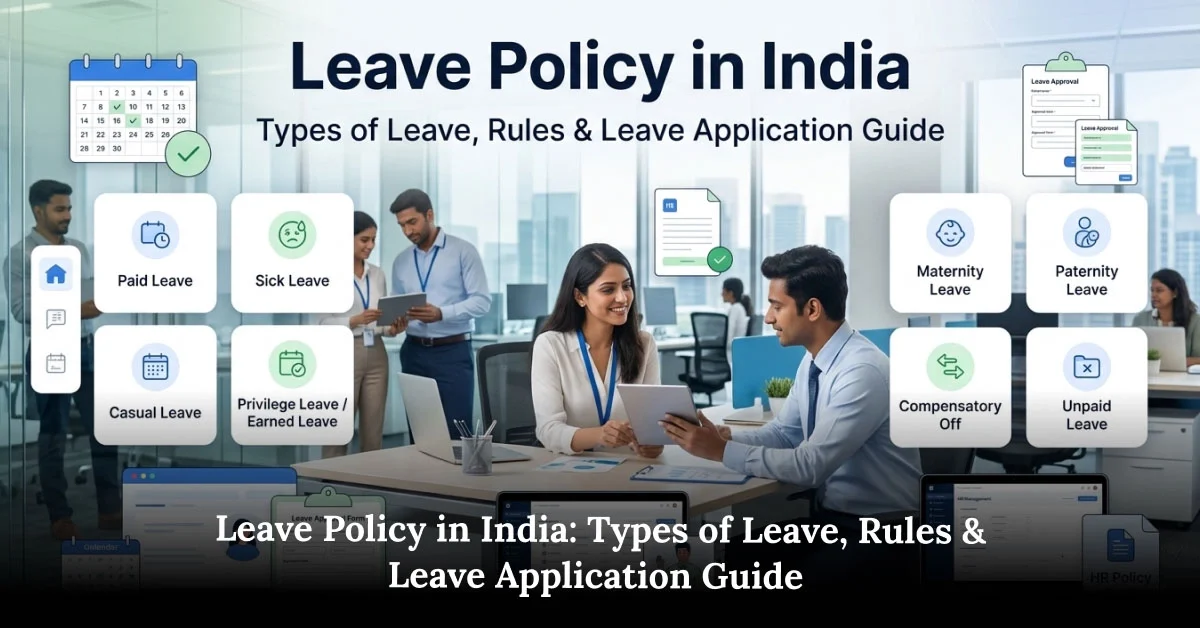
Leave policy in India is important for the people in the HR team and the employees. The leave policy is like a set of rules that explains how employees can take leaves how paid leaves they are allowed to take, how to get leaves approved and how to apply for leaves in the company.
In India most companies give their employees leave, sick leave, privilege leave, maternity leave and unpaid leave and this is all based on the labour laws and the policies of the company.
This guide will tell you everything you need to know about leave policy in India including the types of leaves what a leave letter should look like examples of leave application the rules for leave encashment and the best ways for the HR team to manage leaves.
What is a Leave Policy?
Leave policy is the official company document which clarifies the company guidelines regarding employee entitlements and the approval process for taking leave, along with its other specifications and the regulations surrounding leave.
It essentially dictates answers to all your leave related questions. A properly laid out leave policy will specify:
- What types of leave employees can avail?
- How many days are they entitled to for each category?
- The process for requesting and approving leave.
- Documentation requirements (if any).
- Legal compliance with Indian labour laws.
- Consequences of policy violations.
Why Every Organisation Needs a Clear Leave Policy?
So, a well-documented leave policy is more than just good HR; it’s critical to business. Also, no employee wants to be in a situation were getting time off feels like being in a hostage negotiation.
Compliance Is Non-Negotiable
Under Indian labour law, various categories of leave have been prescribed. Absence of a written policy causes ramifications such as legal issues, penal provisions and labour disputes. The policy ensures compliance with provisions such as earned leave, maternity benefit, etc. These are legislated and mandatory in nature.
Transparency Builds Trust
If employees know what they have a right to, you eliminate the perception or reality of favouritism. It also eliminates the ambiguity. When everybody understands what the expectations are, HR disputes should diminish and trust in the organisation increases.
Employee Satisfaction and Retention
Companies that provide defined, flexible leave policies retain their employees at 25-30% more. Employees want to work for companies that support work-life balance without being made to feel guilty and getting stuck in red tape.
Better Workforce Planning
A well-documented policy guides the manager, so that there is appropriate cover for the projects and the business continues uninterrupted. This is especially critical during high-demand seasons or during the festive periods.
Payroll Accuracy
Leave directly impacts salary calculations. Paid leave, unpaid leave, and leave encashment all will impact your payroll. Having a well-defined policy and implementing it into your HRMS software, helps in correct salary processing with minimal payroll errors.
HR staff will spend their time answering repetitive questions over and over, physically recording the leave balances, settling conflicts and other administrative issues. An effective and clearly designed policy, coupled with technical tools, will eliminate most of the administrative burden.
What are the Types of Leave in India?
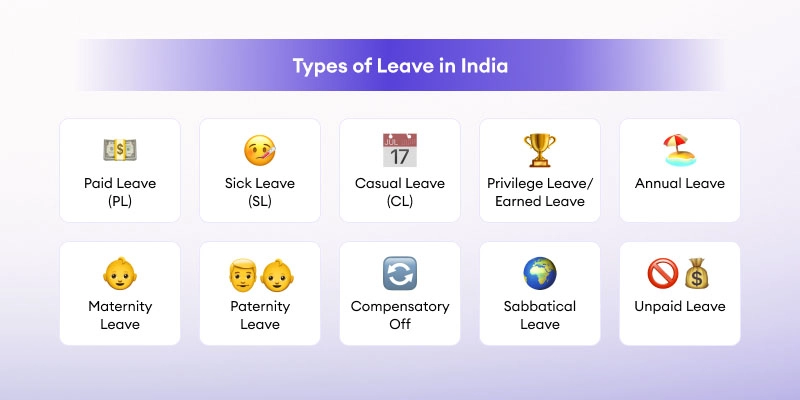
There are several types of leave for employees in India. It is important to know them, whether you are preparing your own company’s policy or an employee determining what type of leave to apply for:
Paid Leave (PL):
Paid leave refers to time off from work where employees continue to receive their regular salary without deduction. This is the umbrella term that covers most leave types where you still get paid.
In India, paid leave typically includes casual leave, sick leave, and privilege leave (earned leave). Your pay check doesn’t suffer when you take time off for legitimate reasons.
Most Indian companies offer between 12 and 30 days of paid leave annually, though this varies by industry, organisation size, and seniority. This leave types are the days as your earned right.
Eligibility: Generally available to all full-time employees after completing the probation period.
Sick Leave (SL):
The purpose of sick leave is only for illness and other medical reasons when you cannot do your work due to a health-related problem. Indian companies generally have 7 to 12 days of paid sick leave each year.
When You Can Use It:
- Sudden illness or injury
- Medical appointments or procedures
- Recovery time after hospitalisation
- Mental health days. (newly introduced)
Documentation needed: Single day absence may only require a self-declaration. On sick leave of 3 or more days, an employer may request a medical certificate from a registered practitioner to protect both employee and employer.
Sick Leave Application FormatSubject: Sick Leave Application Dear [Manager Name], I am suffering from fever and will be unable to attend work on 15 May 2026. Kindly approve my sick leave for one day. Regards, [Employee Name] |
Casual Leave (CL):
CL full form is casual leave which is meant for planned short-term absences for personal matters that don’t require extended time off. These are for unexpected occasions, neither an emergency nor a full commitment, but require your presence.
Usage Guidelines:
- Typically 7-12 days per year.
- Can usually be taken in half-day increments.
- Requires advance notice (usually 1-2 days).
- Cannot be carried forward to the next year.
- Cannot be encashed.
Limitations: Most organisations allow blackout periods during high business months, when no casual leave is allowed. Typically, you are also not allowed to club your casual leave with your weekly off or gazetted holidays.
Common Scenarios:
- Attending family functions.
- Personal errands requiring a full-day absence.
- Minor household emergencies.
- Short local trips.
Casual Leave Application FormatSubject: Casual Leave Application Dear [Manager Name], I would like to request casual leave on 15 May 2026 due to personal work. Kindly approve my leave for one day. Regards, [Employee Name] |
How It Works:
- Accrual: Generally 1 day per 20 days worked (15-18 days per year).
- Accumulation: Can be accumulated up to 30-45 days, depending on company policy.
- Carry Forward: Yes! Unused privilege leave typically carries forward to subsequent years.
- Encashment: Can be encashed at the time of resignation or retirement in most organisations.
Key Benefit: This is your long-vacation leave. If you are planning a two-week trip, you can use your accumulated privilege leave.
Annual Leave:
Annual leave is a comprehensive yearly leave allocation that combines various leave types into a single bucket. Some modern companies are moving toward a simplified “annual leave” model instead of segregating casual, sick, and privilege leave. You’re given an allowance of days off per year (say, 25-30).
This model is growing in popularity in startups and tech companies for the simple reason that it assumes adults are responsible, and it dramatically cuts down on HR paperwork.
Each employee is entitled to 28 days of annual leave per year. This allowance can be used for holidays, illness, personal matters or any other need. Just ensure proper advance notice and handover.
Annual Leave Application FormatSubject: Annual Leave Application Dear [Manager Name], I would like to request annual leave from [Start Date] to [End Date] due to personal reasons. Kindly approve my leave request. Regards, [Employee Name] |
Maternity Leave:
Maternity leave is the total number of days or time period provided to a working woman during her pregnancy, as well as after her delivery. As per the Maternity Benefit Act 1961 (2017 amendment), every working woman is provided with the following:
Key Provisions:
- 26 weeks of paid maternity leave for the first two children
- 12 weeks for third and subsequent children
- Can be taken up to 8 weeks before the expected delivery date
- Includes miscarriage and medical termination of pregnancy benefits
- Adopting mothers get 12 weeks from the date of adoption (for children under 3 months)
- Commissioning mothers (surrogacy) also get 12 weeks
- Entitlement: minimum 80 days worked in the 12 months before the anticipated delivery date.
- Many progressive employers offer extended maternity leave beyond the statute (up to 6-9 months), to address early childcare needs.
Maternity Leave Application FormatSubject: Maternity Leave Application Dear [Manager Name], I would like to apply for maternity leave starting from [Start Date] as advised by my doctor. Kindly approve my leave for the required duration. Regards, [Employee Name] |
Paternity Leave:
This is a short time off granted to a man when his wife gives birth. Its purpose is to enable the man to spend time with his family and develop bonds with the newborn baby.
While the Central Indian laws don’t cover it yet, forward-thinking companies provide paternity leave. It’s normally for between five and 15 days, although some companies provide up to four weeks.
Scientific studies say paternity leave builds family ties and helps the mother to recover. It also brings greater gender equality and benefits employee loyalty.
Compensatory Off (Comp-Off):
Compensatory off is leave granted instead of working on weekly offs, public holidays, or extra hours beyond regular working time. Are you working on Saturday to meet a project deadline, pulling an all-nighter before a product launch, then you can apply for your compensation
How It Works:
- Earned by working on designated holidays or overtime
- Usually must be availed within 30-90 days
- Typically cannot be encashed
- Requires manager approval for both earning and availing
- It is common in IT companies, consulting firms, and organisations with project-based work.
Sabbatical Leave:
A sabbatical is long, unpaid leave from your job that will permit you to further a personal interest, complete education or recuperate, all while still being employed with the organisation. Sabbatical allows for these sorts of personal interests; just make sure you’re prepared for the unpaid leave and be aware it’s not a standard offering.
Duration: Anywhere from 1 month to 1 year, depending on company policy and approval.
Eligibility: Usually requires a minimum service period (often 3-5 years) and manager/leadership approval.
Benefits:
Job security maintained
No break in employment continuity
Valuable for personal development
Returns refreshed and motivated employees
Considerations: While on sabbatical, benefits like health insurance may be suspended, and there’s no salary. But for many, the personal and professional growth is worth it.
Sabbatical Leave Application FormatSubject: Sabbatical Leave Application Dear [Manager Name], I would like to request a sabbatical leave from [Start Date] to [End Date] for personal/professional development purposes. Kindly consider and approve my request. Regards, [Employee Name] |
Unpaid Leave (Leave Without Pay – LWP):
Unpaid leave is time off without salary, typically used when all paid leave is exhausted but additional absence is necessary. It is used when you’ve run out of paid leave but still need time off. Maybe it’s been a longer illness than expected, a family crisis taking weeks to resolve, or too many holidays:
When It’s Used:
- Extended personal emergencies
- All paid leave is exhausted
- Extended travel beyond leave balance
- Bridging employment gaps (between resignation and the last working day)
Impact:
- No salary for LWP days
- May affect leave accrual and increments
- Excessive LWP might raise red flags with management
- Affects payroll calculations
Important Note: Some companies have limits on how much consecutive or annual LWP they’ll approve. Excessive unpaid leave might even lead to employment termination in some cases.
Leave Types in India at a Glance:
Leave Type | Paid/ Unpaid | Typical Duration / Allocation | Carry Forward | Encashment |
Paid Leave (PL) | Paid | 12–30 days per year | Depends on leave type | Depends on leave type |
Sick Leave (SL) | Paid | 7–12 days per year | Usually No | No |
Casual Leave (CL) | Paid | 7–12 days per year | No | No |
Privilege Leave / Earned Leave (PL/EL) | Paid | 15–18 days per year | Yes | Yes |
Annual Leave | Paid | 25–30 days per year (varies by company) | Depends on company policy | Depends on company policy |
Maternity Leave | Paid | 26 weeks (first two children), 12 weeks thereafter | No | No |
Paternity Leave | Usually Paid | 5–15 days (company policy based) | No | No |
Compensatory Off (Comp-Off) | Paid | Based on extra work/holiday work | Usually No (must be used within 30–90 days) | No |
Sabbatical Leave | Usually Unpaid | 1 month to 1 year | No | No |
Leave Without Pay (LWP) | Unpaid | As approved by employer | No | No |
What are the Leave Policy Rules Every Employee Should Know?
Understanding leave types is just half the battle. Here are the essential rules that govern how leave works:
1. Advance Notice Requirements:
The notice period required to take leave depends on the leave type and policy of the company, i.e., it is generally one to two days in case of casual leave and three to seven days in case of privilege leave. Long leave and sabbatical could require up to thirty days of prior notice.
However, there is no such notification requirement in case of accidents and sudden illnesses. Despite that, it is highly recommended that you notify your supervisor as much in advance as possible, as you have greater chances of your leave getting approved, and the burden on your colleagues will also be minimised, and you will present yourself as more professional.
2. Documentation Requirements:
Different leave types have different paperwork:
- Sick Leave (1 day): Self-declaration usually sufficient
- Sick Leave (3+ days): Medical certificate required
- Maternity Leave: Medical certificates, expected delivery date
- Marriage Leave: Marriage certificate or invitation card
Digital HR systems like Niyuk.ai allow employees to upload these documents directly during the application for leave process, no more chasing HR with physical copies.
3. Approval Process:
Standard flow:
- Employee submits leave request
- Manager reviews (checks team availability, project deadlines)
- Approval or rejection with comments
- HR updates leave balance
- Confirmation sent to employee
Rejection reasons might include Peak business period, inadequate handover, insufficient leave balance, or team coverage issues. Good managers will suggest alternate dates rather than flat-out rejecting.
4. Leave Carry Forward Rules:
- Privilege/Earned Leave: This can usually be carried forward, but up to a certain limit (30-45 days maximum carry forward).
- Casual Leave: Expires at year’s end; use it or lose it.
- Sick Leave: It generally cannot be carried forward.
- Comp-Off: These should generally be used within 30-90 days.
5. Leave Encashment:
Leave encashment means converting unused leave into monetary compensation. Here’s how it typically works:
What can be encashed:
- Privilege Leave/Earned Leave (most common)
- Usually during resignation, retirement, or once annually
What cannot be encashed:
- Casual Leave
- Sick Leave
- Comp-Off
- Calculation: (Unused Leave Days) × (Daily Basic Salary)
Tax Implication: Leave encashment is taxable under income tax laws (though retirement encashment has certain exemptions).
6. Leave Cancellation:
Sometimes plans change. You applied for leave, it got approved, but now you need to cancel it. Most companies allow cancellation before the leave start date without penalty. You might lose those days or need special approval.
Best Practice: Avoid cancelling approved leave unless necessary. It disrupts planning and might affect future leave approvals.
Consequences of Leave Misuse:
The following abuses of your leave allowance may also have severe consequences:
- Fake medical certificate: disciplinary action, dismissal
- Unauthorised absence: Marked as LWP or considered absconding
- Excessive leave: Performance issues, warning leave letter
- Working for competitors during leave: Breach of contract
What are the Common Leave Policy Mistakes Companies Should Avoid?
Employees and the HR department are on the same page when the leave policy is designed correctly. Nevertheless, companies still end up making errors that confuse employees, create issues with payroll and also dissatisfy them.
1. Unclear Leave Entitlements
When leave entitlements and conditions for eligibility are vague, employees often wonder what the actual extent of the leave is and under which leave category to apply it. The types of leaves should be clearly stated in a policy with detailed conditions and carry-over information.
2. Relying on Manual Leave Tracking
Mistakes, lost paperwork, and excessive admin work are common consequences of managing employee absence requests through a series of spreadsheets, emails or even on paper forms. A fully automated leave management system will ensure accuracy.
3. Poor Documentation
Several companies don’t offer any written leave policy for employees. Such a situation leads to misinterpretations and inconsistent decision-making. A formal leave policy should be maintained and distributed to all employees in all organisations.
4. No Defined Approval Process
Knowing who approves their leave, and how long approvals normally take. A clear workflow minimises delays, increases transparency and eases the planning of the workforce.
5. Inconsistent Policy Application
Distributing the application of leave regulations amongst the staff may breed injustice and foster loss of confidence among them. Leave policy should be uniformly implemented throughout all teams and divisions.
6. Disconnect Between Leave, Attendance, and Payroll
You can end up making several payment errors and having several disputes if leave is not linked to attendance and payroll systems. HR systems keep these updated.
7. Ignoring Legal Requirements
An organisation’s leave policies should adhere to relevant labour laws and regulations. Not following such regulations might have legal implications and attract penal consequences to an organisation.
8. Discouraging Employees from Taking Leave
The working environment which makes staff feel guilty taking time off contributes to a rise in stress, burnout and lower productivity. Also, businesses have a part to play in showing the example to their employees and by making it accessible and simple to take leave to which the employees are eligible, which helps improve the work-life balance of their staff.
By avoiding these pitfalls, an organisation can implement an employee-friendly leave system which is fair and compliant for all.
Conclusion
Not just an HR policy requirement, a clear leave policy helps create a fair, equitable and efficient working environment. A clear understanding of leave entitlement and approval process for employees can minimise confusion, enhance compliance and provide a better work-life balance for everyone.
When combined with the above clear policies and current leave management technology, approvals are faster, and the leave is always correctly logged with little or no manual effort from either side. Tools such as Niyuk.ai make it easier to handle leave, attendance and HR operations all from a centralised system to ensure both employee and HR personnel are productive.
After all, when leave management is simple and transparent, employees feel supported, and businesses perform better.
Frequently Asked Questions
What is a leave policy?
A leave policy is a set of guidelines that explains the types of leave available to employees, their eligibility, application process, and approval requirements. It helps organisations manage employee absences fairly while ensuring business continuity.
What are the rules for leave policy?
Leave policy rules vary by company and state labour laws but generally cover leave eligibility, accrual, approval procedures, notice periods, carry-forward provisions, and encashment rules. Employees are expected to follow the company’s leave application process before taking leave.
What is CL, PL, and SL?
CL (Casual Leave) is used for short-term personal needs, SL (Sick Leave) is granted for illness or medical reasons, and PL (Privilege Leave/Earned Leave) is accumulated based on service and can usually be carried forward. These are the most common leave categories offered by employers in India.
What are the rules for taking annual leave?
Annual leave is usually planned in advance and requires manager approval before it is taken. Employees must ensure proper work handover and comply with company notice requirements. The number of annual leave days varies depending on the organisation’s policy.
How to calculate PL leave?
Privilege Leave (PL) is generally calculated based on the number of days worked during a year. In many organisations, employees earn one day of leave for every 20 days worked, resulting in approximately 15–18 earned leave days annually, depending on company policy.
What is the HR policy on leave?
An HR leave policy defines how employees can request, use, carry forward, or encash different types of leave. It ensures compliance with labour laws while maintaining consistency, transparency, and fairness in leave management across the organisation.

Ujwala Panchbhai
Ujwala is an HR expert with over 10 years of experience helping businesses build efficient, people-focused workplaces. She specializes in talent management, employee engagement, performance management, and modern HR practices. Through her blogs, Ujwala shares practical insights, industry trends, and actionable advice to help organizations navigate today’s evolving HR landscape.

Ujwala Panchbhai
Ujwala is an HR expert with 10+ years of experience in talent management, employee engagement, performance, and modern HR practices and insights.