
- Home
- Candidate Screening
Find Best-Fit Candidates Fast with
Smart Candidate Screening
Reviewing large volumes of applications manually often slows hiring and makes shortlisting difficult to manage consistently. Niyuk Candidate Screening helps teams organize evaluations, move qualified candidates through hiring stages faster, and spend less time on repetitive screening tasks.
Trusted by next-generation teams






What is Candidate Screening?
Candidate screening is the process of reviewing and selecting candidates, to move on to the subsequent stages of the hiring process. Screening includes but is not limited to; resume screening, screening questions, requirements for the job role, candidate eligibility and skills. An organized screening process can ensure the team can save time and reduce the workload by selecting candidates.
Key Features of Niyuk’s Candidate Screening
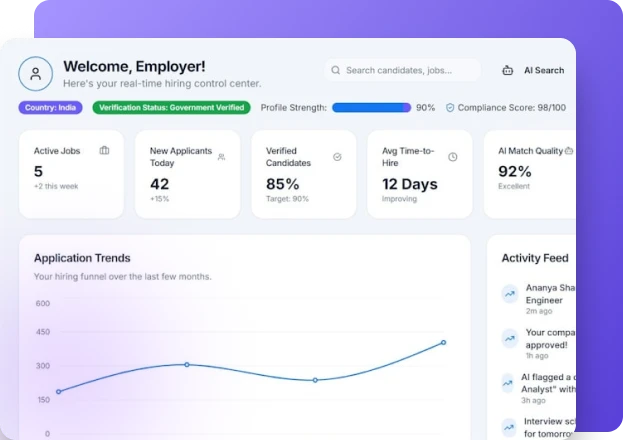
Automated screening & resume parsing
AI-powered candidate matching
Custom screening criteria & filters
Candidate scoring & ranking
Bulk screening capabilities
Real-time screening insights
Candidate Screening vs Manual Resume Screening: Which Improves Hiring Quality and Speed?
| Candidate Screening Area | Manual Resume Screening | Candidate Screening Recommended | Why It Matters |
|---|---|---|---|
| Screening Speed | Recruiters review resumes individually | Automated screening workflows prioritize candidates faster | Reduces hiring delays |
| Resume Review Volume | Difficult with large applicant pools | Handles higher application volumes efficiently | Supports scaling recruitment |
| Candidate Shortlisting | Depends on manual evaluation | Structured screening criteria improve consistency | Better shortlist quality |
| Hiring Team Collaboration | Multiple spreadsheets and emails | Shared workflows and centralized evaluation | Faster decisions |
| Screening Consistency | Varies between recruiters | Standardized evaluation workflows | Improves fairness |
| Candidate Matching | Manual keyword reviews | Skills and criteria-based matching | Better fit identification |
| Recruiter Workload | High administrative effort | Reduces repetitive screening tasks | Improves productivity |
| Screening Visibility | Limited tracking | Real-time screening visibility | Better pipeline management |
| Candidate Experience | Slower communication cycles | Faster movement through stages | Better engagement |
| Hiring Accuracy | Higher risk of inconsistent reviews | Structured evaluation processes | Better hiring outcomes |
| Scalability | Difficult during large hiring cycles | Supports higher recruitment volumes | Easier growth management |
| Data & Reporting | Manual reporting | Built-in hiring analytics | Better decision-making |
Last updated: June 3, 2026
Which Option is Better?
The scanning may be doable manually if you are not recruiting in large numbers. If you are recruiting in larger numbers, manually scanning through every application will be additional work for recruiters and it will take longer. It may also result in biases. Screening the candidate will give you an optimized workflow, as you can sort through your high number of applications more efficiently, making the screening more effective and creating higher quality shortlists.
Built for Every Industry
Client Testimonials
“Niyuk Hr Cut payroll processing time by 90% for Applikon IT Solutions Pvt.Ltd.”
Frequently Asked Questions
Got questions? We’ve got answers. Here’s everything you need to know about getting started with Niyuk.
Can candidate screening improve candidate experience?
Yes. It cuts the delays at the shortlisting stage and moves qualified candidates through the process faster. Clearer communication, quicker evaluations, and a more organized workflow make the whole thing smoother, which keeps candidates engaged instead of waiting around.
Why is candidate screening important in recruitment?
It lets recruitment teams evaluate applications more consistently and avoid getting stuck in the early stages. A clear process makes selection more organized, takes effort off recruiters, and gives everyone better visibility into the pipeline, all of which speeds up decisions.
Can candidate screening improve hiring speed?
Yes. It cuts the time spent reviewing applications by hand and helps recruiters spot suitable candidates earlier. Faster evaluations and an organized workflow mean teams move people through the stages more efficiently, with less repetitive admin along the way.
How does candidate screening improve hiring quality?
It sets clearer evaluation criteria and a more consistent review process. When everyone is screened the same way, hiring teams can compare candidates fairly, find the stronger matches sooner, and shortlist more accurately.
Can candidate screening support high-volume hiring?
Yes. It helps teams handle larger applicant pools, simplify evaluations, and cut repetitive screening work. A more structured workflow keeps quality up even as hiring demand grows.