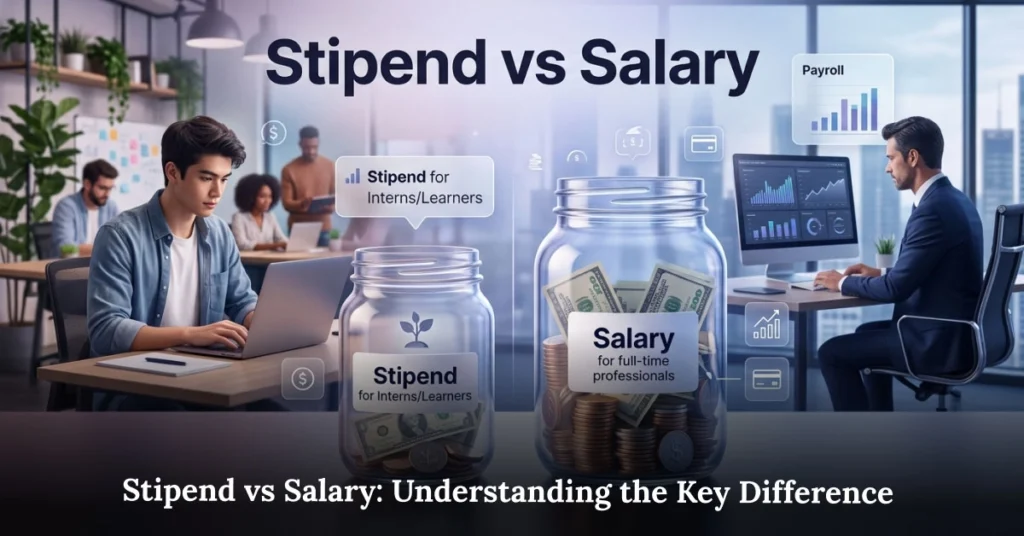
Some years back, companies used to pay their employees traditionally. They were paying salaries, incentives and some benefits package. But in today’s time, things have been changed remarkably. Today employees are expecting Remote work allowance, a wellness budget, learning Stipends etc.
HR teams are centre of movement here. They are fully functional and responsible for organising, structuring upon full plan for delivering such privileges to today’s employees within the company structure.
But here only the twist appears. Stipends and salaries are not the same but similar with fundamental difference. Also, structure wise, and from a tax perspective. Mixing them or replacing them with each other attracts a big compliance issue, which is hard to resolve soon.
In this blog article, we have tried to melt down the key differences in Stipend vs Salary, when to use which one, and how to collide them inside a compensation structure which is more competitive, compliant, and easy to elaborate further always.
What is a Stipend?
Stipend is the fixed payment to be given to a trainee, intern or temporary staff under certain program or as a part of some project. Even today, employees get it as remote work stipend / allowance etc.
Employers can offer stipends apart from regular wages or salaries to support with required costs like commuting, housing, wellness, or professional development or learning program etc.
Unlike salary, a stipend is given fixed for a purpose and can be paid as a recurring allowance or a one-time lump sum payment. As its calculation is not time-based, a stipend need not to follow minimum wage rules, which regular wages do, even though it can be treated as taxable income depending on its structure.
Regular examples of stipend are including remote work costs, transportation or commuting, wellness and lifestyle benefits, and education or professional development.
Example:
A company with a distributed workforce gives each full-time employee a Rs.3000 monthly remote-work stipend to support cover home internet and workspace costs.
This amount is separately paid from regular payroll and classified as a “remote work allowance”.
So, employees also are aware about its structure –it is just an allowance to work and not the regular pay out.
Now, let us know the basics or fundamentals of salary, the most important compensation structures of today.
What is a Salary?
A salary is a regular, set sum or amount that an employer compensates an employee for their continuous labour. It can be stated as a yearly amount and can be split into standard payment intervals (such as biweekly or monthly).
Salaries compensate employees for working on the overall scope of their role and responsibilities and are normally documented in an offer letter or an employment agreement.
In case of the US, salaried employees are paid via payroll with standard tax deductions like federal and state income tax, Social Security, and Medicare, and can have additional deductions for benefits and under retirement contributions.
Many salaried roles are exempted under the Fair Labor Standards Act (FLSA), means employees are not eligible for overtime, if they are meeting the salary basis and duties tests, in fact, some salaried roles can not be exempted.
In India, wage and overtime rules work little differently compared to the U.S. Rather than, dividing employees into “exempt” and “non-exempt,” Indian labour laws highlight more on working hours, wages, and role responsibilities. Main regulations like the Payment of Wages Act, 1936, the Minimum Wages Act, 1948, and the Code on Wages, 2019 direct us on how salaries and overtime can be handled.
In many cases, if an employee works beyond standard working hours, they are eligible for overtime. Usually paid at twice their normal wage rate.
This applies whether the employee is salaried or not. That said, specific senior roles like managerial or supervisory positions, will not always qualify for overtime, depending on the certain rules under state-level laws like the Shops and Establishments Acts.
For businesses, payroll isn’t only about paying salaries. It’s about accurately tracking working hours, applying overtime rules exactly, and staying compliant with state-specified regulations. A well-structured payroll system making it easy and helps avoiding compliance issues.
Example:
An HR generalist is hired at a $52,000 annual salary, paid twice a month. Each pay period, they get the same gross amount irrespective of small fluctuations in weekly hours, and their payment includes tax withholdings and benefit deductions processed via the company’s payroll system.
With both the concepts, let’s differ them dimension wise, so that will be clearer and convenient to use for HR teams here.
Key Differences Between Salary and Stipend
A salary is a set payment amount for daily duties and job roles, whereas a stipend is a fixed sum to be given to assist with certain costs or initiatives.
Salary gives the primary compensation, whereas stipends are basic supplementary to address specific needs i.e wellness, commuting, or remote work.
Comparison: Stipend vs Salary
This side-by-side view creates it easy to answer common questions from managers. Let us check them out here:
|
Dimension |
Stipend |
Salary |
|
Primary purpose |
Supports fixed needs or programs over paying for hours worked |
Pays employees for current job duties and performance as their main income source |
|
What it pays for |
specified expenses or contribution in a program |
Overall role and responsibilities, not fixed to a single common expense category |
|
Link to employment status |
Can be given to employees, interns, trainees, or occasionally contractors |
Tied to an employer-employee relation under labour and tax law |
|
Payment structure |
Mainly a fixed stipend, disbursed either as a single payment or at regular time intervals (monthly, quarterly, yearly) |
Configure annual total allocated across regular payroll times (weekly, biweekly, semi-monthly, or monthly) |
|
Variability |
Usually standardized by programs and not on performance-based |
Personalised and negotiable, may change with promotions, market adjustments, or performance |
|
Flexibility for employer |
Highly configurable and may be targeted to certain groups or goals |
More rigid as variable salaries affect base pay, budgets, pay equity, and need updated agreements |
|
Usage restrictions |
Often comes with category rules or worthy expenses and can involve documentation for non-taxable treatment |
No usage limits, employees decide how to use take-home pay |
|
Tax handling |
Can be taxable or treated under specific fringe-benefit rules relying on objective and plan design |
Treated as consistent taxable wages with standard payroll withholdings |
|
Minimums and compliance |
No minimum amount, but it cannot substitute for the mandated minimum wage for non-exempt labour. |
Must adhere to relevant federal, state, and local wage and overtime regulations at a minimum. |
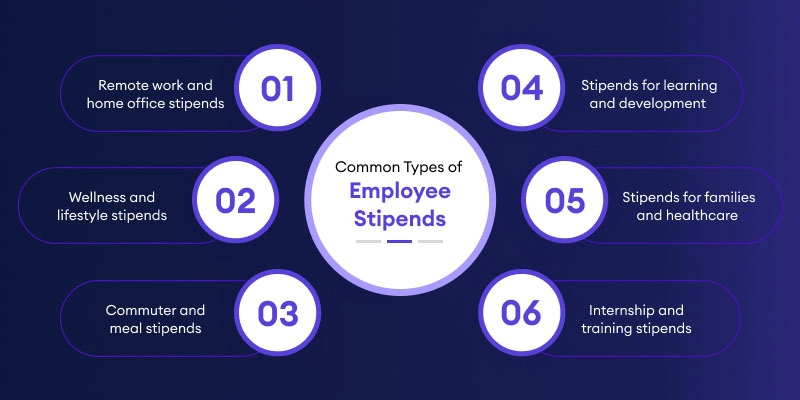
Common Types of Employee Stipends (With Examples)
Modern stipend programs are changing from traditional intern or housing stipends and covering wellness, family support, commuting, and more. Because they are easier to setup, HR teams can blend and match stipend types aligning with culture, budgets, and workforce needs.
1.Remote work and home office stipends
These help remote or hybrid employees include equipment, furniture, and internet, or utility costs fixed to working from home.
Technology / cell phone stipends : When employees choose personal devices for professional use, employers may provide a set allowance to assist with some of their phone, data, or equipment expenses.
2.Wellness and lifestyle stipends
- Wellnessstipends: Employers provide a monthly or annual allowance to employees. Which can use on fitness classes, gym memberships, meditation apps or other health- services.
- Lifestyle spending accounts (LSAs): Itgive employees with a dynamic stipend to address lifestyle expenses i.e. wellness, family, professional growth, or home- office expenses, following company’s guidelines.
3.Commuter and meal stipends
- Transportation and commutingStipends: Employers cover to and fro travelling expenses for workplace, that is- public transportation, parking, ridesharing, or biking costs.
- Food& meal Stipends: Meal Stipends for employees are for everyday meals or frequent team lunches.
4. Stipends for learning and development
- Professional development and education stipends: These stipends are beneficiary for continuous learning opportunities i.e. conferences, certifications, online courses, or memberships in professional upskilling associations.
5. Stipends for families and healthcare
- Healthcare relatedstipends: Other than basic health insurance, employers give stipends to help with extra medical expenses, mental health, or some areas i.e. reproductive / gender-affirming care.
- Family& caregiving stipends: Family – related stipends help in the adoption process, fertility treatments, child-care, senior’s care, or pet-care.
6. Internship and trainingstipends
- Apprenticeships stipends or internships: In place of salaries, certain internship programs give a set stipend to help with living / travel costs to trainees.
- It is more important on how and when to use stipends rather than knowing their all types.

When can Employers Offer a Stipend?
An employer can offer stipends for certain purposes without changing the basic pay. Stipends function as dedicated, flexible tools to improve benefits, reinforce culture, and address defined needs, without increasing complete payroll costs.
1.Expanding or modernizing benefits
Stipends allow you to add perks without redesigning your full compensation structure or making a new insured benefit package. They are useful when you need to differentiate your total rewards and reply quickly to employee feedback or market trends.
2.Cost-controlled and flexible budgeting
As stipends are fixed amounts and time-bound, they’re easy to budget, cap, start, or end than salary increases, which compound every year and affect pay-equity benchmarks. This makes stipends suitable for pilots, seasonal programs, or temporary steps.
3.Supporting development, wellness, or lifestyle needs
Stipends are very suitable to aid professional development, education, wellness, transportation, or remote-work costs, areas where you want to give employee’s choices within defined categories.
4. Usingtax benefits
Specific education and commuter benefits can qualify for favoured tax treatment under IRC Sections 127 and 132 with correct structure, enabling employers to reduce costs and, in some cases, offer tax-free help up to specific limits. HR and finance teams must work with counsel or tax advisors to make sure for program design and reporting to follow IRS guidance.
5.Supporting diverse and global teams
For distributed workforces, stipends may be more practical than repeating identical insured benefits across each jurisdiction. They offer a consistent budget while allowing local flexibility in how given stipends are used.
Stipends are a strong tool, but they’re not always the right solution. There are certain situations where salary is not only preferred but legally needed.
When is Salary the Better Compensation Model?
Salary is required when employees are making regular work and must be paid under wage and hour laws.
In most US employment scenarios, the real question is not “stipend or salary”. It’s “salary, plus optionally stipends.” But in India, it is not but anyone of them in majority cases.
Scenario 1. When the worker is a regular employee
If an individual meets the criteria for employee status under federal and state law, they must be given their wages or a salary compiling with minimum wage and overtime rules. Stipends are unable to replace required wages for non-exempt employees. They can only be added on top.
Scenario 2. When predictable income and role clarity matter
Salaries give employees a payment that is tied to the job they do. This helps employees manage their money and feel good, about their job. It also helps them want to stay with the company.
For the company owners, salaries make it easy picture to plan how much money to pay to employees. Salaries help companies to see how their pay compares to companies and if they are paying employees fairly within the company.
Scenario 3. When role is long-term, strategic, or central
For key positions like managers, engineers, and rest of professional roles, salary offers commitment, stability, and career progression are ahead of stipends. These employees may still get stipends, but their primary compensation is base salary plus any bonuses or incentives processed via payroll.
Scenario 4. When you need to make sure everything is done right and reports are easy to understand
Salaries are paid through the payroll system with the taxes taken out and W-2 reports are done which helps avoid mistakes like treating someone incorrectly not paying them enough or doing their taxes wrong with the payroll system handling salaries and W-2 reporting salaries are paid through the payroll system. Stipends mainly need separate tracking’s, documentation, and sometimes 1099 or fringe benefit reporting, which must complement not replace the wage records needed under FLSA and IRS rules.
When compliance and clean reporting are a priority in India, it’s always safe to run salaries with a payroll system rather than treating payments as allowances or stipends.
Salaries that go through payroll automatically have taxes and other deductions taken out like income tax, provident fund, ESIC and professional tax. This shows up in reports like Form 16. This way mistakes like classification, underpayment or incorrect tax handling are avoided. This is because laws like the Income Tax Act of 1961 and the Code on Wages of 2019 are followed.
Stipends and reimbursements are different. They need to be tracked and documented clearly. They must be classified for example as allowances or reimbursements. These payments should not replace salary records. If not handled properly they can cause problems, with compliance during audits or when filing statutory reports.
Getting that when to use every structure leads naturally to weigh the broad trade-offs.
Tax Implications in the US on Salaries and Stipends
The salary is always treated as wage income. This is how it works. The salary is taxable. On the hand stipends are different. Stipends may be taxable. They may have tax advantages. It really depends on how the stipends structured. The stipends can be taxable. They can have tax advantages. It is, about how the stipends are set up. The salary is always taxable. The stipends are not always taxable. They can have tax advantages.
Salary taxation
Salary is taxable under federal rules. Employers must take out taxes and state and local taxes from the money they pay to their workers. They also must take out money for Social Security and Medicare. The Internal Revenue Service has rules for this. The amount of money that employers take out depends on what the worker puts on their Form W-4. The employer uses the payroll system to take out these taxes.
At the end of the year the employer sends the worker a Form W-2 that shows how much money was taken out for taxes and, for Social Security and Medicare.
Stipend taxation
Most cash stipends are taxable until they fall under categories that the IRS says are not taxable. The IRS has rules about what kind of money’s taxable. If you get a stipend, from your job it is usually taxable.
The company will add this money to your W-2 wages. You will have to pay income tax and FICA on it. If the company pays you outside of your job and you are not an employee, they must report it on a Form 1099-NEC when it reaches a certain amount.
Stipends may be non-taxable
Some stipends can be set up so they are not taxed, or they get tax treatment if they follow the rules set by the IRS. The IRS has rules like the ones for education help under Section 127 commuter benefits under Section 132 or getting money back under a plan that does what the IRS says.
In these situations, the money that qualifies does not have to be included in the employee’s income.
The employers still must keep records and follow the rules; about how much they can give and how they must prove it for stipends that are not taxed like these stipends.
Tax Implications on Salaries in India
When you pay employees through a formal payroll, taxation is straightforward and well-addressed under the Income Tax Act, 1961.
How salaries are taxed:
- Salaries are fully taxable under the head “Income from Salary”
- Employers must deduct TDS (Tax Deducted at Source) for each month
- Employees receive Form 16 as proof of salary and tax deduction
- Salary structure may include basic pay, HRA, Allowances, bonuses, etc.
Compliance impact:
- Makes sure for proper tax reporting and transparency
- Reduces risk of penalties or notices
- Aligns with labour laws and payroll compliance
In easy terms:
Salary = structured, taxed, and fully compliant income
Tax Implications on Stipends in India
Stipends are treated differently and depending on the nature of payment.
Stipend to interns/trainees
- If paid as part of training or internship, it may be taxable
- Usually taxed under “Income from Other Sources” or sometimes salary (based on relationship)
- TDS may apply depending on amount and classification
Stipend as scholarship
- If it gets qualified as an education scholarship, it can be released from Section 10(16) of the Income Tax Act, 1961
Fixed stipends in place of salary
- If a stipend is paid regularly like a salary, authorities may reclassify it as salary
- This can rise a compliance issue if payroll rules were bypassed or violated
Key Compliance Risks with Stipends
- No automatic payroll tracking (requires human documentation)
- Risk of misclassification (stipend vs salary)
- Possible tax notices if used to skip TDS or statutory deductions
- No standard proof like Form 16 in many cases
In simple terms:
Stipend = flexible, but needs careful classification and documentation
Salary vs Stipend (Quick Comparison)
|
Aspect |
Salary |
Stipend |
|
Tax Treatment |
Income from Salary |
Depends on nature |
|
TDS |
Mandatory |
Conditional |
|
Compliance |
High & structured |
Needs manual handling |
|
Reporting |
Form 16 |
Varies |
|
Risk |
Low |
Moderate to high if misused |
Conclusion
The salary vs stipend debate sounds bigger than it is. It’s not about selecting one over the other. It’s about using both in the right manner.
Think of salary as the base. It’s the part keeping everything stable and compliant, whether you’re following the Income Tax Act, 1961, the Code on Wages, 2019, or in the U.S., the Fair Labor Standards Act. Salaries go via proper payroll, taxes are taken care of, and there’s a clear paper trail.
Now, stipends are the add-on layer. They give you flexibility. Either it’s supporting interns, covering specific expenses, or offering targeted benefits. But they work best when they sit on top of a proper salary structure, not when they try to replace it. That’s where things can get messy from a compliance point of view.
What really makes this whole setup work is clarity. People should know exactly what they’re getting as salary, what the stipend is for, and how it all works out. When that’s clear, stipends stop feeling like random extras and start making sense.
The companies that get compensation right don’t overcomplicate it but keep it well- grounded as: salary for structure and compliance, stipends for flexibility, and clear policies without any confusion.
You just need to shape up your salary and stipend structure without thinking of any replacement or as a replacement solution between them. For more details and for similar topics like this, please visit us on www.niyuk.AI or mail us on: sales@niyuk.ai
Feeling stuck in stipend vs salary
Get a clear idea of stipend & salary
Frequently Asked Questions
Q: What is the difference between stipend and salary?
A: The stipend vs salary difference comes down to structure and purpose. A salary is a fixed, formal payment made to employees through payroll, with taxes and compliance handled properly. A stipend is usually a smaller, flexible payment given for training, internships, or specific support.
Q: Is stipend taxable in India?
A: Yes, a stipend can be taxable in India depending on its nature. If it’s paid as income (like for an internship), it is generally taxable under the Income Tax Act, 1961. However, certain stipends classified as scholarships may be exempt.
Q: Is stipend considered a salary?
A: A stipend is not usually considered a salary, as it’s meant for trainees or interns rather than full-time employees. But if a stipend is paid regularly like a salary, it can be treated as salary for tax and compliance purposes.
Q: What are the disadvantages of stipend?
A: While a stipend is flexible, it does come with limitations:
- No structured payroll or standard benefits
- May not include PF, ESIC, or other statutory coverage
- Can create confusion in taxation or compliance
- Less financial stability compared to a salary