

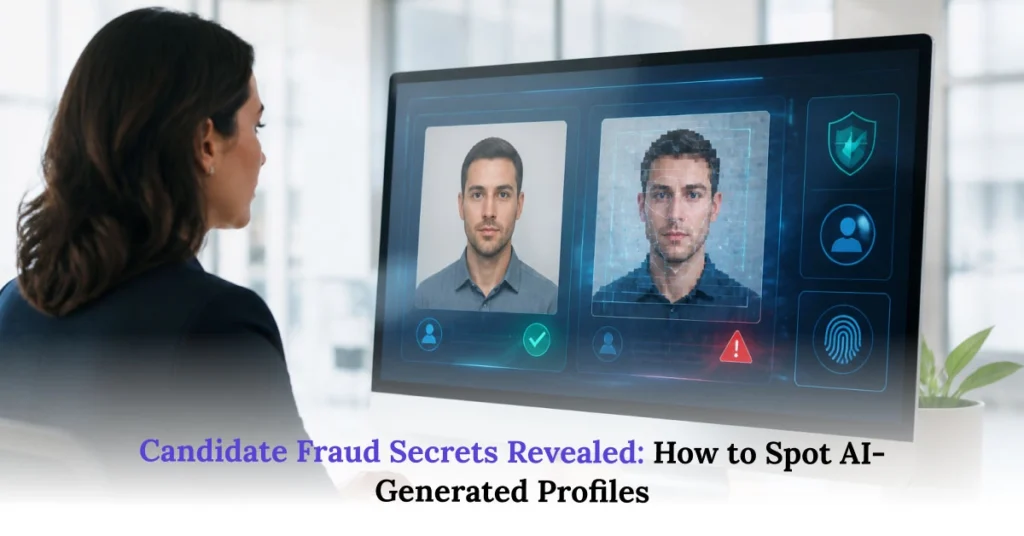
The recruitment landscape has shifted. While your team is busy leveraging AI to streamline operations, candidates are using those same tools to game the system. In 2026, “embellishing a resume” has evolved into high-tech deception. From deepfake video interviews to perfectly synthesized identities, the risk of hiring a “phantom” employee is at an all-time high.
If you are still relying on manual resume reviews and standard video calls, you are vulnerable. You aren’t just looking for top talent anymore; you are filtering out sophisticated AI-generated profiles.
Here is how you can spot the fraud and reclaim control of your hiring pipeline.
The New Face of Candidate Fraud
Candidate fraud is no longer about small white lies. It is systemic. Recent data suggests that over 59% of hiring managers now suspect candidates of using AI to misrepresent themselves. The barrier to entry for deception has collapsed.
Today’s fraudsters use LLMs to create keyword-perfect resumes, AI voice cloners for screening calls, and even real-time deepfake overlays to pass technical interviews. They aren’t just trying to get the job; they are building synthetic identities that can bypass standard background checks.
To stay ahead, you need to transition from the “old way” (manual, fragmented, and slow) to the “new way” (automated, unified, and secure).
Top 5 Red Flags of an AI-Generated Candidate Profile
Spotting AI-generated fraud requires a sharp eye for detail and the right AI recruitment software. Watch for these behavioral and documentation signals:
- The “Flawless but Flat” Resume: If a resume hits every single keyword perfectly but lacks concrete, messy, real-world examples (like specific team conflicts or project failures), it’s likely AI-generated.
- Audio-Video Desynchronization: During video calls, look for mouth movements that don’t perfectly align with the audio. In 2026, deepfakes have a “micro-lag” that is distinct from typical internet latency.
- Unnatural Facial Glitches: Deepfake overlays often struggle with rapid movement. Ask the candidate to turn their head side-to-side or wave their hand in front of their face. A digital “shimmer” or glitch around the edges is a dead giveaway.
- The “New Digital Footprint”: Be wary of candidates with a 15-year career but a LinkedIn profile or GitHub repository created only three months ago. Synthetic identities are often built from scratch using AI-generated headshots.
- Formulaic Interview Responses: If a candidate answers every question with a polished, three-point monologue that sounds like a textbook, they might be using real-time AI coaching tools on a second screen.

The Assessment Trap: How Candidates Cheat on Technical Tests
The days of “take-home” assignments are over. Candidates are now using sophisticated code assistants and LLMs to produce near-perfect scores on unsupervised tests.
When a candidate delivers a perfect coding solution but fails to explain the logic behind a specific variable name during a live session, you have a problem. This is where AI assessment becomes critical.
Niyuk’s platform addresses this by pairing unsupervised tests with live, witnessed problem-solving environments. By tracking keyboard telemetry and copy-paste spikes, our system flags unusual behavior that suggests external assistance.

Spotting Deepfakes in AI Interview Screening
Remote hiring is essential for modern teams, but it opens the door to “exam proxies”: where a qualified individual interviews on behalf of the candidate.
Using an AI interview screening tool is your best defense. Niyuk’s AI Interview interface uses audited algorithms to verify liveness and identity throughout the conversation.
How it works:
- Identity Verification: The system prompts the candidate to show a government ID and performs a biometric match against the live video feed.
- Liveness Detection: The AI tracks subtle facial movements and eye-tracking patterns to ensure you are speaking to a real human, not a pre-recorded video or a deepfake.
- Consistency Checks: The AI compares the candidate’s verbal proficiency and technical depth against the claims in their initial application.

Why Traditional Sourcing Fails
Manual sourcing is a magnet for fraud. When you manually scroll through LinkedIn, you are susceptible to “profile baiting”: fake profiles designed to attract recruiters.
Stop wasting hours on manual sifting. AI recruitment software like Niyuk changes the game by cross-referencing candidate data across multiple platforms simultaneously. If a candidate’s history doesn’t match their professional certifications or public records, the system flags it before you ever pick up the phone.
Learn more about modern sourcing in our Ultimate Guide to AI Candidate Sourcing.

Protecting Your Organization with Bias-Free Hiring Technology
The fight against fraud shouldn’t lead to unfair profiling. The goal is authenticity, not exclusion.
Niyuk utilizes bias-free hiring technology to ensure that while we are hunting for fraud, we aren’t penalizing legitimate candidates who might have unconventional backgrounds. By focusing on objective data: verified skills, biometric liveness, and real-time problem-solving: we remove the human bias that often leads to both “bad hires” and “missed gems.”
Our audited algorithms ensure that the verification process is transparent and compliant with global hiring standards.

Summary: The New Standard for Verification
Identity and skill verification are no longer “extra steps”: they are the foundation of a secure hiring process. To protect your organization, you must:
- Switch from manual CV sifting to AI-powered sourcing that verifies data.
- Start using AI interviews with built-in liveness detection.
- Transform your assessments into live, supervised sessions.
- Stop relying on unverified remote references.
Frequently Asked Questions
Can AI-generated resumes be detected by standard ATS?
Most traditional ATS platforms are built to read keywords, not detect AI patterns. Niyuk’s AI recruitment software goes a step further by analyzing syntax and depth, flagging profiles that are statistically “too perfect” or lack human variability.
How do I know if a video interview is a deepfake?
Look for “digital artifacts”: blurring around the chin or neck, unnatural blinking, or lighting that doesn’t match the background. Niyuk’s AI interview screening tool automates this detection by analyzing video frames for biometric consistency.
Is using AI to write a resume considered fraud?
Using AI as a drafting tool is generally acceptable. However, using AI to fabricate experience, skills, or employment history is fraud. The key is to verify the substance of the claims through automated assessments.
Does Niyuk integrate with existing HRMS?
Yes. Niyuk is an all-in-one platform, but it also integrates with your existing tools to ensure a smooth transition from sourcing to automated payroll processing.
How does bias-free hiring technology help with fraud?
It shifts the focus from subjective “gut feelings” (which are easily manipulated by a charming fraudster) to objective, verified data points. This creates a higher barrier for fraudsters while making the process fairer for real candidates.
Ready to stop the fraud and start hiring real talent?
Don’t let your hiring pipeline become a playground for AI bots. Experience the power of an all-in-one, AI-powered HR automation platform.
Explore Niyuk’s AI Interview Tools Today