
Automated Interview Scheduling: The Assured Secret to Faster Time-to-Hire
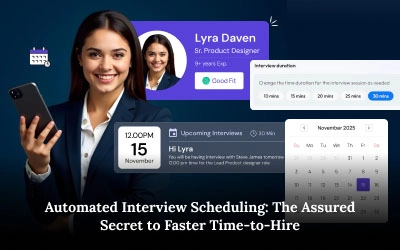
Discover Niyuk. Experience effortless screening and assessments. Book A Demo Fast and efficient hiring with quality candidates is a need of the hour in today’s time. This helps in right moment engagement, prompt interview schedules and timely updates to keep them informed. The right solution is – Automated interview scheduling. Upon successful shortlisting of a candidate, the real task of suitable time for interview schedule appears up for the HR desk. Both sides time suitability is the main factor to consider. Calendar and time availability must be checked for both sides. More emails for this task can be written towards the final confirmation. Sometimes, one side wishes to change the fixed appointment at the last moment. This leads to a major delay in this task. These delays are frustrating for both ends. According to Cronofy’s Candidate Expectations Report (2024), 42% of candidates report dropping out of the hiring process due to long scheduling. Slow scheduling cost time as well as best talent to lose forever. This calls for a more simplified and automated interview scheduling process to help you to drop off time-to-hire, free up many productivity hours, and give candidates a personalized, modern experience. Interview scheduling automation allows interview management more efficiently without any active human coordination. Availability Time clock can be set for the selection of the candidates as per their convenience. The system updates calendar automatically, manages time zone differences, and sends reminders, making sure about timely interviews to happen. This not only saves many administrative works but also minimises errors like double-bookings, and gives candidates a seamless, more predictable hiring experience with automated recruitment. Time-to-Hire Concept and It’s Importance Time-to-hire calculates the days between when a candidate enters in your recruitment process till, they accept an offer. By simplifying recruitment and lowering hiring delays, organisations may make candidates engaged and drop-down recruitment costs significantly. It’s tough to differ in time-to-hire and time-to-fill: Time-to-hire: It is the measured time limit from a candidate arrives in your recruitment drive channel and when he gets an offer in actual. Time-to-fill: Sums up the total duration from the job posting is done until it’s filled up, with both sourcing and hiring. A long hiring process gives more damage than anticipations. Finding ways to drop down time-to-hire is tough because: It improves the risk of losing top talent to close competitors It lowers down productivity rate and affects revenue It raises your cost per hire (currently averaging about US$4,683 in 2025 globally) According to a 2025 survey by HR Lineup, the worldwide average time-to-hire is 36 days, and various employers report talent shortages, making hiring speed more is becoming critical than ever. Stressed of Coordination Delays? Implement Automated Hiring and speed up your time-to-hire. Start Automating Interviews Today with Niyuk! Interview Delays Affects Hiring Results At actual, scheduling looks like a tiny task. But it forms candidates’ perception of your company and indicates the smoothness of the hiring journey. There are Problems with Traditional Scheduling: 1. To-and-fro Emails Every interview request normally propels a chain of emails between you, your hiring manager and the candidate. This slower the process and spoils measurable time which could be useful in evaluating talent. 2. Scheduling Conflicts Upon the availability of candidates, hiring managers often tight calendars. This forces for restarting the cycle, causing inefficiencies and delays. Poor Candidate Experience: Candidates normally receive many follow-up emails or to deal with last-minute rescheduling. They must wait for a long time for the final confirmation. This uncertainty makes stressful situation and replies poorly on your employer brand. 3. Time-bound Human Coordination Other than working on certain hiring tasks like talent evaluation or relations-building, you as a HR/recruitment person, become only a schedule generator. Almost 35% of the time is wastage in the last year only in humanised scheduling task. 4. High Risk of Errors With number of human steps, the double-booking issue, mismatched time zone, or improper invites increase. These errors lead to wastage of time and can damage candidate trust. 5. Global Hiring Becomes Messy For remote or international candidates, time zone conversions and availability matching make additional challenge, making manual scheduling nearly impossible to measure. These Problems Affect Directly on Hiring End-Results: 1. Candidate Drop-Off Candidates don’t prefer for waiting. If you’re working slowly in the process, you may lose them. 2. Employer Image Candidates mostly relate slow interview process with bad organizational culture. Their enthusiasm for the role may get down, even though they are in the process. 3. Recruiter Work Volume Instead of talent engagement, recruiters spend hours in administrative hurdles. This lowers their ability to fill pipelines smoothly. 4. High Risk of Errors With so many manual steps involved, the double-bookings, missed time zone adjustments, or wrong invites may rise. These mistakes spoils time and may damage candidate trust. 5. Global Hiring Becomes Tedious For remote or international candidates, time zone conversions and availability matching create additional complexity, making manual scheduling nearly impossible to update or improve. These Problems have a Direct Impact on Hiring Outcomes: 1. Candidate Drop-Off Candidates don’t like to wait for interviews. If your interview process is very slow, you are going to lose them. 2. Employer Reputation Candidates mainly resonate slow scheduling with lowered level organizational culture. Even if they stay in the process, their interest for the role may drop. 3. Recruiter Workload Without getting engaged with the talent, recruiters spend many hours in administrative work. This reduces their ability to fill pipelines effectively. In an industry where speed and efficiency matter more than ever, interview scheduling delays can quietly derail hiring success. Upgrade your workflow with smart tech. Leverage AI Hiring Process tools for perfect Automated Scheduling. Request A Demo Now! Statistical Facts to Note Find here the major statistical facts we are discussing in this blog in a summarised chart below: Metric Value Implication for Manual Scheduling Source Cited (Year) Candidate Drop-off Rate (due to long scheduling) 42% Almost half of candidates are lost because the scheduling process is very slow. Cronofy’s Candidate Expectations