
How Automated Interview Scheduling Changed Manual Hiring Back-and-Forth
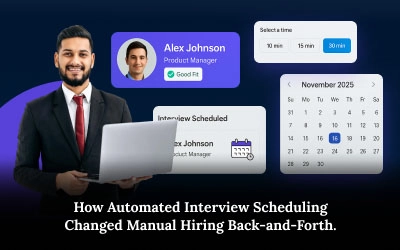
Discover Niyuk. Experience effortless screening and assessments. Book A Demo Manual interview scheduling for the headhunt of the ever-best talent for every required role. But manual scheduling has a lot of flaws like delays, inefficiencies and loss of opportunities to grab top talent. For HR professionals and recruitment managers, interview scheduling is not only time –taking but also puts on extra administrative burden and causing scheduling conflicts. This ultimately, damages the candidate satisfaction. Automated Interview Scheduling is the master key for all such HR people to save their valuable time and efforts. Niyuk comes up with some transforming approach about interview scheduling. It makes life easy for the recruiters by simplifying the entire process from resume screening to assessment of the candidate with the help of AI technology. With the use of Niyuk, HR recruiters not only able to simplify the operations but also drops down time-to-hire, saves remarkable work time and efforts, to divert themselves on more priority tasks. In this important blog article, we are going to discuss about the transformation of conventional manual interview scheduling over automated interview scheduling. Let us unfold this discussion in following sections here. The Bottlenecks in Manual Interview Scheduling Manual interview scheduling is the main hurdle in many organisations today. HR professionals and recruiters use to work for long lasting hours just in mailing candidates for discussing the suitable interview schedules, arranging their interview slots with the calendars and getting their confirmations after such hard efforts. This complex coordination mostly shows: Last-moment cancellations or no-shows due to lost interview chances Prolongness in candidate’s journey via the hiring process Double(multiple) bookings and scheduling hassles Negative candidate experiences due to inefficient communication Bulk workload on recruiter and administrative burden Such types of inefficiencies hamper HR resources and risk of top talent loss to active competitors. Our Automated Interview System Runs 24/7 Vetting skills for your team Start Automating Interviews Today with Niyuk! What is Automated Interview Scheduling and How it Functions? Automated Interview scheduling is a software solution removing humans from the calendar-coordination loop in recruitment process. It is a software allows candidates for self-schedule and reschedule interviews without recruiter’s intervening efforts, as per the industry analysts. It acts in below 4 things: Calendar sync in real-time The application synchs with Google or Outlook calendars and collects open and occupied time slots without considering event specifications. Mutual-availability engine The mutual-availability engine which compares the candidate’s time zone and the interviewer’s schedules to recommend only options that are comfortable for both parties. Self-service booking link Candidates get a branded URL or SMS that promptly updates all stakeholders’ calendars. Clever follow-ups and reminders SMS, emails are sent an hour before the call and 24 hours in advance. Benefits of Automated Interview Scheduling In actual, a timely shift from manual to intelligent interview scheduling gives more constructive benefits for HR staff, recruiters: 1. Recruiter Workload Interviews scheduling automation and prompt candidate communication makes recruiters free from routine, time taking administrative tasks, permitting them to focus more on strategic talent evaluation and engagement. 2. Higher Interview Completion Rates Automated reminders and multiple-channel communication options reduces no-show rates substantially, making sure for smooth hiring channels and fast decision making. 3. Accelerated Time-to-Hire Simplified scheduling increases candidate progress, consumes time effectively and giving edge to the HR people to close certain positions in today’s smart job market. 4. Enhanced Candidate Experience Gives flexibility to the candidates to plan their own interview schedules and set proactive reminders. This improves their satisfaction level up too much extent. These benefits directly impact recruitment results, making Niyuk as a strategic investment for HR leaders expecting important improvements in hiring efficiency and quality. Types of Automated Interview Scheduling Tools There are different types of automated interview scheduling tools are available. Every type comes with some unique features and benefits. Here are some popular types: 1. Calendar Integration Tools Calendar integration tools get integrated with your current calendar software, like Google Calendar or Outlook. These tools allow recruiters to share their availability status with candidates. Candidates can view, choice for their available interview time directly from the calendar of recruiter. Calendar integration tools are easy for use. They may save time by removing the need for dual-sided communication for a while or for a longer time than usual. Calendly is a popular calendar integration tool allowing recruiters to share their calendar availability and do changes in their booking page with their brand colours and logo. Candidates may select a convenient time slot for them, which gets added automatically to the recruiter’s calendar. This tool helps for auto reminders sending to candidates before the interview. 2. Chatbot Tools Such tools are based mainly on artificial intelligence (AI) technology to interact with candidates and schedule interviews. These tools answer basic queries, offer candidates feedback rapidly, and may help in simplifying the recruitment process. Chatbots can also help to deliver a better candidate experience by 24/7 availability and offering rapid and informative replies to candidates. 3. Interview Scheduling Platforms Interview scheduling platforms gives a centralized system for interview scheduling and hiring process management. These platforms offer features – automated reminders, confirmation status tracking, and scheduling data insights. They are especially useful for big sized organizations those need to manage multiple interviews across various hiring teams and locations. Well, Niyuk takes care about all such requirements for organisations as well as recruitment agencies. Selection of Right Automated Interview Scheduling Tool To select an automated interview scheduling tool, it’s crucial for considering many factors for making sure to pick a correct scheduling tool meeting required for your organization. Think about those features vital for the recruitment process. They may vary widely between various interview scheduling tools. So, it’s important to get a tool with features you are looking for. Suppose you schedule interviews frequently with candidates in various time zones, you may need to think a tool with a built-in time zone converter. And, if you are really managing a high-volume recruitment process, you can wish to look for a
Automated Interview Scheduling: The Assured Secret to Faster Time-to-Hire
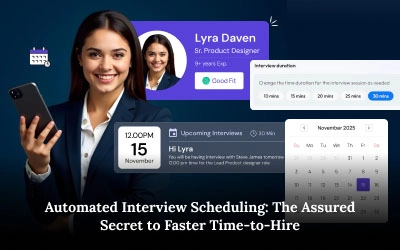
Discover Niyuk. Experience effortless screening and assessments. Book A Demo Fast and efficient hiring with quality candidates is a need of the hour in today’s time. This helps in right moment engagement, prompt interview schedules and timely updates to keep them informed. The right solution is – Automated interview scheduling. Upon successful shortlisting of a candidate, the real task of suitable time for interview schedule appears up for the HR desk. Both sides time suitability is the main factor to consider. Calendar and time availability must be checked for both sides. More emails for this task can be written towards the final confirmation. Sometimes, one side wishes to change the fixed appointment at the last moment. This leads to a major delay in this task. These delays are frustrating for both ends. According to Cronofy’s Candidate Expectations Report (2024), 42% of candidates report dropping out of the hiring process due to long scheduling. Slow scheduling cost time as well as best talent to lose forever. This calls for a more simplified and automated interview scheduling process to help you to drop off time-to-hire, free up many productivity hours, and give candidates a personalized, modern experience. Interview scheduling automation allows interview management more efficiently without any active human coordination. Availability Time clock can be set for the selection of the candidates as per their convenience. The system updates calendar automatically, manages time zone differences, and sends reminders, making sure about timely interviews to happen. This not only saves many administrative works but also minimises errors like double-bookings, and gives candidates a seamless, more predictable hiring experience with automated recruitment. Time-to-Hire Concept and It’s Importance Time-to-hire calculates the days between when a candidate enters in your recruitment process till, they accept an offer. By simplifying recruitment and lowering hiring delays, organisations may make candidates engaged and drop-down recruitment costs significantly. It’s tough to differ in time-to-hire and time-to-fill: Time-to-hire: It is the measured time limit from a candidate arrives in your recruitment drive channel and when he gets an offer in actual. Time-to-fill: Sums up the total duration from the job posting is done until it’s filled up, with both sourcing and hiring. A long hiring process gives more damage than anticipations. Finding ways to drop down time-to-hire is tough because: It improves the risk of losing top talent to close competitors It lowers down productivity rate and affects revenue It raises your cost per hire (currently averaging about US$4,683 in 2025 globally) According to a 2025 survey by HR Lineup, the worldwide average time-to-hire is 36 days, and various employers report talent shortages, making hiring speed more is becoming critical than ever. Stressed of Coordination Delays? Implement Automated Hiring and speed up your time-to-hire. Start Automating Interviews Today with Niyuk! Interview Delays Affects Hiring Results At actual, scheduling looks like a tiny task. But it forms candidates’ perception of your company and indicates the smoothness of the hiring journey. There are Problems with Traditional Scheduling: 1. To-and-fro Emails Every interview request normally propels a chain of emails between you, your hiring manager and the candidate. This slower the process and spoils measurable time which could be useful in evaluating talent. 2. Scheduling Conflicts Upon the availability of candidates, hiring managers often tight calendars. This forces for restarting the cycle, causing inefficiencies and delays. Poor Candidate Experience: Candidates normally receive many follow-up emails or to deal with last-minute rescheduling. They must wait for a long time for the final confirmation. This uncertainty makes stressful situation and replies poorly on your employer brand. 3. Time-bound Human Coordination Other than working on certain hiring tasks like talent evaluation or relations-building, you as a HR/recruitment person, become only a schedule generator. Almost 35% of the time is wastage in the last year only in humanised scheduling task. 4. High Risk of Errors With number of human steps, the double-booking issue, mismatched time zone, or improper invites increase. These errors lead to wastage of time and can damage candidate trust. 5. Global Hiring Becomes Messy For remote or international candidates, time zone conversions and availability matching make additional challenge, making manual scheduling nearly impossible to measure. These Problems Affect Directly on Hiring End-Results: 1. Candidate Drop-Off Candidates don’t prefer for waiting. If you’re working slowly in the process, you may lose them. 2. Employer Image Candidates mostly relate slow interview process with bad organizational culture. Their enthusiasm for the role may get down, even though they are in the process. 3. Recruiter Work Volume Instead of talent engagement, recruiters spend hours in administrative hurdles. This lowers their ability to fill pipelines smoothly. 4. High Risk of Errors With so many manual steps involved, the double-bookings, missed time zone adjustments, or wrong invites may rise. These mistakes spoils time and may damage candidate trust. 5. Global Hiring Becomes Tedious For remote or international candidates, time zone conversions and availability matching create additional complexity, making manual scheduling nearly impossible to update or improve. These Problems have a Direct Impact on Hiring Outcomes: 1. Candidate Drop-Off Candidates don’t like to wait for interviews. If your interview process is very slow, you are going to lose them. 2. Employer Reputation Candidates mainly resonate slow scheduling with lowered level organizational culture. Even if they stay in the process, their interest for the role may drop. 3. Recruiter Workload Without getting engaged with the talent, recruiters spend many hours in administrative work. This reduces their ability to fill pipelines effectively. In an industry where speed and efficiency matter more than ever, interview scheduling delays can quietly derail hiring success. Upgrade your workflow with smart tech. Leverage AI Hiring Process tools for perfect Automated Scheduling. Request A Demo Now! Statistical Facts to Note Find here the major statistical facts we are discussing in this blog in a summarised chart below: Metric Value Implication for Manual Scheduling Source Cited (Year) Candidate Drop-off Rate (due to long scheduling) 42% Almost half of candidates are lost because the scheduling process is very slow. Cronofy’s Candidate Expectations
Brief Overview About Top Features of Interview Bot
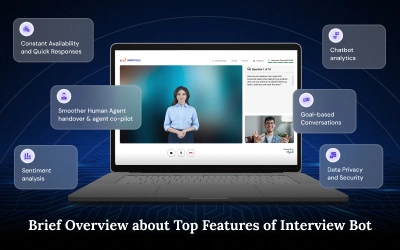
Discover Niyuk. Experience effortless screening and assessments. Book A Demo Let us explore in this blog article, how Interview bot improves the hiring efficiency. Here, we are highlighting some exciting features of Interview bots like 24/7 availability. AI recruitment platform has its own capability to deliver timely results. Let us unfold all trending features of recruitment chatbot in this blog article. Due to the use of Interview bots, hiring tasks such as resume screening, Interview schedule and candidate screening become automated. Automated hiring or automated recruitment is a need of the hour. Cut Time to Hire. Apply our AI recruitment platform & interview bot. Start Now with Niyuk Features of Interview Bot Features of AI driven Interview bot is simplifying as well as making more engaging candidate experience, also for HR teams. We will discuss each of them here: 1. Constant Availability and Quick Responses Timeframe plays an important role in today’s competitive. Interview bots have changed the game by offering 24/7 availability and prompt replies to candidate queries – solving a major issue of conventional hiring processes. Chatbots enable candidates across the globe to acquire the information they need instantly, irrespective of the time zone. This constant access offers various benefits for employers and job seekers as per given below: Lower Drop-off Rates: Fast answers keep candidates engaged, declining the chances of them shifting to other opportunities or losing their interest. Regular Communication: Every communication is professional and accurate, no matter the night or day. No Time Zone Limitations: Candidates can chat with the hiring process as per their convenience, no matter of their location. The value of instant reply goes beyond comfort level. These chatbots make HR teams free for doing more tedious and priority tasks. This is very helpful in-between high-volume hiring periods, where chatbots can handle many conversations at once without ignoring the quality. Interview bots offer personalized, suitable real-time answers. When joined with ATS, chatbots retain their efficiency also during peak application times. This instant feedback keeps candidates engaged and boosts their overall experience. These bots 24 X7 availability breaks all time zone barriers, establish consistent communication and make people comfortable using them across the globe. In fact, they simplify other priority processes due to all time availability. 2. Smoother Human Agent Handover & Agent Co-Pilot Interview bots can handle many dynamic interactions at a time, in some moments, it requires handling like a human agent. By considering this urge, this feature gives an easy transition from interview bot to human agent support, and, agent co-pilot, with its latest AI and document cognition, strengthens the human agents and simplifies reply sourcing for agents from manuals, guides, e-books, webpages, PDFs etc. and more remarkably declining processing times up to 30%. This new blend maximizes customer service, balancing automated accuracy and personalized manual interaction, developing a classic solution for customer-focussed businesses. The feature of chatbot adds well-defined fallback scenarios (for human assistance) for when the bot faces a complex query or when users opt for human support. Chatbots are programmed to identify fast the kind of a customer’s problem and instantly route them to the appropriate manual agent. Information collected by the chatbot, including chat history and user inputs, is passed on to the human agent to offer context and offer a swift resolution. 3. Sentiment Analysis This is a human related feature of a chatbot. This feature goes deep beyond customer communication, goes into the emotional undertones. It is just like chatbot becomes a customer to show if your customers are happy, normal or stressed. This bot measures the mood behind the face in deep. This is interesting to know. The chatbot works out the emotional tone as well as the magnitude of it. It uses these things to make conversations more humanised, real-time, personal with many details, too. It’s like having a senseful radar, supporting you to know your customers on a deeper level. Robotic responses are completely avoided. The chatbot chats in such a way that it reflects in form of a human feeling. It also provides full insights categorizing customers based on their feelings about your services or products. Businesses can use this emotional type of data to hype their sales and support strategies, making sure those are in line with customer sentiments. Sentiment analysis can be used as feedback tool. It may give a complete 360-degree view of customer satisfaction. 4. Chatbot Analytics Chatbot analytics is your watch – window into customer interactions. This bot feature is not only about knowing your customers and not just numbers. Think of it as the back side entry to the show, showing you a complete picture of how your chatbot is performing and how your customers are replying. Here’s reasons why all this to keep on analytics: Total User Count: It’s like taking count – how many customers are interacting with your chatbot. Bounce Rate Analysis: Find out how many visitors visited your website but don’t stay for a long time, giving you clues to improve engagement. Interaction Rate: This is where you measure the performance of your conversations – how engaged are your customers when they chat to your chatbot? Fallback Rate (FBR): A thorough analysis of your bot’s potential problems and how it can offer more pertinent answers. Chatbot analytics gives you their preferences, behaviours, and needs. It’s like a status for your chatbot, showing you how perfectly it’s replying to customer queries. You can use these insights to regulate your chatbot strategy, making sure that your bot is not just chatting, but also helping to your business growth. 5. Goal-Based Conversations Goal-based conversations are not just any chatbot feature rather it’s a strategically changing game for businesses aiming to improve sales and create leads. Imagine a chatbot that does more than answer questions – it’s a dedicated sales assistant, guiding each chat towards your business goals. Either it’s turning inquiries into leads or casual chats into purchases, this feature is all about making every chat count. Say goodbye to standard chatbot