
How Niyuk Handles 5 Top Challenges Faced by Modern Recruiters (2026)
Discover Niyuk. Experience effortless screening and assessments. Book A Demo Hiring professionals in 2026, are operating in an increasingly tough environment where conventional recruitment methods juggle to maintain required speed with business demands. From uneven expectations among the stakeholders to pressure- driven admin tasks, recruiters get stucked unnecessarily sometimes, between giving quick results and maintaining quality. Such challenges faced by modern recruiters are not just incidents. But they represent system issues affecting recruitment efficiency across global industries. The latest recruiter’s day often involves handling of endless email chains, manually screening thousands of applications, expecting feedback from very busy hiring managers, and struggling to show strategic value while drowning in operational tasks. These kinds of bottlenecks make a cascading effect which affects time-to-hire, candidate experience, and business results. What’s frustrating is that many such issues are generated out of very old processes and backword technology used for talent acquisition. Anyhow, forward-thinking companies are changing these recruitment bottlenecks into competitive advantages via strategic process improvements and smart automation. By mitigating five critical areas professionally, recruitment teams can transform from reactive order-taking to strategic business partnership, delivering measurable value while making exceptional experiences for candidates and hiring stakeholders both. Solutions e.g. AI screening offered by platforms like Niyuk.AI reducing administrative cost up to 60-75%, while improving candidate experience and hiring results. Uneven role expectations raise time-to-hire by 40% and responsible for 30% turnover rates in the first year. Recruiters spend up to 40% of their valued time on communication instead of searching quality candidates. Popular positions now receive 200-300 applications needing 20-40 hours of manual screening time role wise. Delays in giving feedback more than72 hours result in candidate drop-off rates ahead of 25%. AI-based screening platforms get a 75% drop in time-to-shortlist while maintaining assessment standards. Organizations with 48-hour screening reply time experience 35% higher candidate acceptance rates. Automated recruitment solutions drop administrative tasks by 60-75% while improving quality of the process. The transformation from tactical recruitment function to strategic business partnership needs systematic attention to these interconnected challenges. Successful organizations deploy complete approaches aligning process improvements with smart technology adoption, allowing recruitment teams to focus on relationship building, strategic workforce planning, and market intelligence delivering genuine strategic value to business’s success. Let us elaborate on challenges faced by recruiters. Automate your Busy Work to Focus on the Talent Switch to latest recruitment methods saving your daily hours Advance My Hiring 1. Mismatched Role Expectations from Stakeholders This is very long-term challenge for recruitment professionals is the mismatch between different stakeholder’s expectations to meet for the role. Hiring managers mostly have some expectations or requirements regarding an ideal candidate for the post. HR teams have requirements based on company policies and budget limits. But the executives may have fully different expectations based on strategic objectives. This mismatch makes a domino effect via the recruitment process. This leads to waste of time, frustrated candidates, and in actual, failed placements damaging both efficiency parameters and professional relations. 1. The Loss of Mismatched Job Requirements The basic cause of this misalignment stemming from less upfront collaboration during role definition phases. Placement managers focus on prompt tactical needs without thinking about any broad organisational context. As HR professionals may focus on compliance and cultural fit over certain technical requirements. Meanwhile, executives mostly introduce sudden changes based on market conditions or strategic moves, making moving targets that creates regular candidate evaluation mostly impossible. 2. Filling up the Gap of Communication This alignment gap becomes certainly hassle when recruitment teams invest remarkable time sourcing and candidates screening who really do not match stakeholder expectations which were not communicated or documented. How Niyuk Fixes This: Creates a single, shared role definition for hiring managers, HR, and leadership, so that they can easily align among them for the best fit. Documents and prioritises expectations upfront (must-haves vs flexible criteria). This will ease the exact expectation for the role from a candidate. Applies consistent, role-based screening rules for all candidates, so fair chance to each one of them will be given by the employer to prove their skills. Makes expectation changes visible to all stakeholders in real time, to avoid further confusions before final shortlisting. Prevents wasted shortlisting and late-stage candidate rejections with AI driven processes of sorting in time. Keeps hiring aligned, faster, and fair throughout the process by all process’s automation. 2. Continuous Two-end Communication Cycles As per the research, poor job requirements increase time-to-hire by an average of 40% and support to turnover rates more than 30% in the first year of employment. When stakeholders are not happy with the basic role expectations, recruitment teams mostly find themselves starting the process for many times with various candidate profiles. This makes a cascading effect where prospective candidates lose interest due to prolonged timelines, quality candidates are lost based on shifting criteria, and recruitment teams also lose credibility with both internal stakeholders and external talent pools. The financial impact extends apart from the immediate recruitment costs to include lost productivity from unfilled positions, extra workload for existing team members, and the hidden costs of re-recruiting when mis-hired employees inevitably quit. Organisations with clear and aligned job requirements normally see 60% fast placement rates and remarkably grow in new hire satisfaction scores, displaying the tangible benefits of time investment in proper role definition upfront. Good organisations implement well-designed requirement-gathering processes which bring all stakeholders on a common page before hiring. This consists of conducting workshops where recruitment managers, HR representatives, and executives join to define required and preferred qualifications, discuss and analyse real- market availability for expected skill combinations, and to set clear decision-making criteria guiding the actual candidate evaluation. These activities could produce documented job profiles that all parties duly sign on, creating accountability for maintaining consistent expectations via the hiring process. Latest recruitment mostly becomes ineffective by communication overheads, with recruiters incurring up to 40% of their time only in management of email chains, coordinating schedules, and offering repetitive status updates over identifying and engagement of quality candidates. These communication cycles typically involve multiple stakeholders who need different information at different frequencies, making a tedious web of human coordination becoming increasingly tough to manage as hiring volume improves. The challenge intensifies when considering the global type of many organisations, where stakeholders operate across various time zones and have variable communication preferences. A single recruitment process might involve hiring managers in multiple locations, interview panels with challenging schedules, and executives needing regular updates with limited availability for complete discussions. This develops a situation where recruitment progress slowdowns to accommodate the lowest common denominator of communication efficiency, mostly results in top candidates accepting other offers while internal coordination goes on. How Niyuk Fixes This: Brings all hiring communication into one shared platform to avoid any hassle among them to provide ultimate synchronisation. Keeps role requirements, updates, and feedback visible to all stakeholders to offer a uniform level of transparency throughout the process. Enables structured, stage-wise feedback instead of ad-hoc discussions to offer clear communication to candidates and stakeholders. Reduces coordination effort and speeds up hiring decisions so that right candidates can be acquired in timeline. 1. Emailing Stress and Scheduling
What Makes Niyuk AI Interviewer Different from a Regular Chatbot
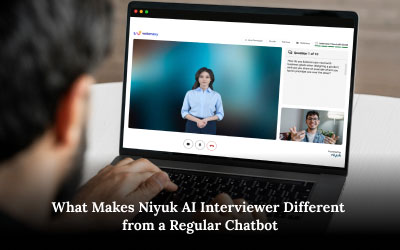
Discover Niyuk. Experience effortless screening and assessments. Book A Demo Conventional recruitment chatbots may schedule interviews and reply to basic questions, but they can not interview candidates. Niyuk’s AI Interviewer tool changes that it’s one of the best AI powered tool that conducts real, adaptive conversations to evaluate talent at scale. Stiff Rule-Based Interactions Conventional chatbots use decision trees for example if a candidate says X ask Y. They lack the ability to comprehend context and depart from scripts. In response to a candidates unexpected response the bot either becomes perplexed or reroutes them to predefined routes. Stop sifting via hundreds of resumes with AI screening that rapidly identifies the best-fit candidates. Limits of Recruitment Chatbot 1. Zero Knowledge of Response Quality A chatbot may ask Tell me about your leadership experience but it is unable to discern between a planned generic response and a well-considered specific example. Both answers are sent to human reviewers in the same way. 2. No Conversational Depth In a real interview you must ask follow-up questions provide clarification and expand on your responses. Chatbots handle every query as if it were a stand-alone question losing chances to delve deeper into intriguing answers or provide clarification on ambiguous ones. 3. Frustration for Candidates As they realize they are speaking with a simple script. It feels impersonal and transactional more like concluding a form than discussing about their career with someone. 4. Limited Recruiter Value Recruiters continue to get raw transcripts or simple keyword tags other than all the AI interaction. When humans are still required to analyse manually all conversation, the committed efficiency gains vanish. As a result, the majority of chatbots used for recruitment normally result in becoming costly scheduling tools improving workload. Hiring teams are already overburdened with the task of screening out candidates but they do not assess talent. Stop Getting Overwhelmed by Applications Initialize an AI powered solution to automate and elevate your hiring process Contact Us Objective-Based AI Interviewing Niyuk is an AI interviewer that was created from the ground up not a chatbot with interview questions added on. Niyuk evaluates candidates through structured adaptive dialogues that are based on sophisticated language models. The Procedure: Candidates are invited for interviews. Niyuk has role-specific discussions and follows up with astute observations. Responses are instantly evaluated in relation to competency frameworks. Instantaneous generation of comprehensive reports with scores and insights is possible. Because everything takes place asynchronously scheduling snags are removed without sacrificing the depth of the interview. Your hiring process deserves more than a basic chatbot. The Unmatched Value of an AI Interviewer vs. AI-Powered Chatbots There is more than just a semantic difference between Niyuk and a conventional chatbot there is a fundamental difference in purpose and value. Even though standard AI-powered chatbots work well for AI screening which is the first step in the hiring process they use a simple pass / fail logic to weed out unqualified applicants based on keywords and basic responses. This ignores the most important and time-consuming task which is the actual evaluation and interview. AI powered chatbots have limitations. Niyuk can meet this challenge. It’s a real AI interviewer that offers a comprehensive approach to candidate assessment. In addition to gathering data it actively processes and analyzes it to produce insightful information that is unmatched by a basic AI screening tool. Niyuk provides an enhanced candidate experience that resembles a genuine AI-powered interview by conducting a dynamic two-way dialogue. It forces applicants to be more creative provide more detail in their responses and showcase their abilities than a generic script could ever hope to. As a result, bias that may infiltrate human-led initial interviews is removed leading to a more comprehensive and equitable assessment. The insights gained from Niyuk’s AI-powered interview are revolutionary for recruiters. Instead of having to sift through dozens of transcripts they receive a thorough report that includes a breakdown of competencies and a clear objective score. Niyuk’s AI-powered chatbots are ready to move beyond just simple conversations and engage your customers. Under the Hood: The Technology Powering Niyuk A complex fusion of state-of-the-art technology rather than a straightforward script is what enables Niyuks conversational intelligence. Fundamentally Niyuk is based on sophisticated language models which are the same technology that underpins contemporary conversational assistants but have been tailored especially for the subtleties of hiring. Niyuk can do the following thanks to this technology. Know Context and Nuance: Niyuks underlying models can understand the sentiment and meaning of a candidate’s response which sets them apart from keyword-based chatbots. It can distinguish between a hesitant ambiguous response and a confident well-reasoned one even if the keywords are similar. Evaluate Response Quality: Niyuk scores answers using a pre-established rubric using machine learning. A candidates communication style approach to problem-solving and how their responses match the required competencies for the position are all carefully considered in this assessment which is not a straightforward pass/pass/failure decision. What really sets Niyuk apart from other AI screening tools is its integrated evaluation engine. Power Adaptive Questioning: Niyuks conversational engines capacity for real-time learning and adaptation is its fundamental component. Niyuk can probe further with more difficult follow-up questions if a candidate provides a compelling initial response. It can request clarification if a response is not clear. A fair and comprehensive AI-powered interview requires this kind of dynamic and responsive interaction which is the distinguishing feature of a true AI interviewer. A New Standard for Fairness: Overcoming Bias with AI The ability of an AI interviewer like Niyuk to significantly lessen human bias in the early phases of the hiring process is one of its most important advantages. No matter how well-meaning they may be human interviewers are prone to a variety of unconscious biases that may distort their assessment of a candidate. The AI powered interview automates your initial hiring rounds with intelligent, adaptive questions. You can practice makes perfect with our AI powered mock interview to build your confidence for the real thing. On the other