
The Complete Checklist to Implementing an AI Interview Tools
Discover Niyuk. Experience effortless screening and assessments. Book A Demo There are over 60% companies leveraging AI implementation in recruitment and hiring processes this year. A major shift has taken place from manual to AI interview platform. Many AI Interview tools are making life easy for HR recruiters. HR tech integration connects your AI hiring tools smoothly with current running systems. Direct switchover to AI without any set groundwork and structure will create a mess. A pilot test offers you a chance to check the tool’s impact and customize it to your organization’s culture and technology landscape. Niyuk is the most trending AI interview platform available today. Setting up interview automation simplifies your initial screening processes. Niyuk offers a smarter way to handle initial job interviews, saving recruiters a lot of time – 60-70% less effort in those earlier stages. It delivers the same and fair experience to each candidate, raising the same questions and their objective assessment. This means you may search the right people, suitable for the job without trusting on manual screening only. Actually, Niyuk frees up your team from all repetitive tasks, making them focus on building, developing real connections and creating intelligent hiring choices. In this blog article, we provide a 10-point beginner’s complete checklist, a simplified roadmap for HR leaders to pilot their first AI hiring tool with assurance. This approach guarantees that you achieve quantifiable outcomes, leadership trust, and momentum for full-scale implementation, from setting SMART goals to iterating based on actual feedback. An interview automation checklist directs a perfect success roadmap. Transform Your Hiring Process Leverage an advanced AI Interview Platform to find your perfect candidate easily Contact Us Step 1: Outline Plain Objectives Action Plan: find 2–3 SMART goals, like reducing screening time with 30%, boosting recruiter satisfaction scores with 20%, or raising candidate diversification feature by 15%. Incorporating goals like Specific, Measurable, Achievable, Relevant, and Time‑bound (SMART) take along internal teams and set ups a certain checking structure. Importance: objectives direct vendor selection, pilot(trial) scope, with KPI tracking. Without them, it’s tough to prove value-to-scale. Step 2: Secure Executive & HR Buy-In Action plan: give a reworked pilot(trial) proposal to main users, CHRO, CFO, IT, and Legal with distinct KPIs, timelines, and risk catering plans (e.g., data privacy and ROI vision). Facilitate single page summary highlighting expected benefits and budget requisites. Importance: Executive sponsorship assures that you have the required support budget, way to systems, and executive oversight vital for pilot success. Step 3: Assemble Your Pilot Team Action plan: Compose a cross-functional steering group with: HR managers and recruiters Talent acquisition specialists IT or systems integrator Data/privacy officer (for GDPR/CCPA compliance) An HR “AI champion” to lead adoption Importance: This balanced team mixes recruitment needs, technical possibility, compliance oversight, and internal advocacy, making sure a seamless pilot journey. Experience unbiased, efficient candidate screening with our intelligent AI Interviewer Get Your New AI Interview Platform Talk to Our Expert Step 4: Select Use Cases & Roles Action plan: Select 1–2 use cases like high-volume customer service roles or early-career technical positions, as your pilot entrusts. Importance: A stiff scope helps isolate variables, streamline workflows, and produce rapid learning. Start with non‑executive roles to lessen risk. A focused pilot skips complications, come from trying to implement across 50 roles from the very first day. Step 5: Define Success Metrics Action plan: Select KPIs, such as the applicant drop-off rate, the time to screen drop off, the net promoter score (NPS) from recruiters, and the relationship between AI scores and recruiter checks. Both quantitative and qualitative data, such as recruiter comments, should be included in your pilot dashboard. Importance: Predefined KPIs support you to judge pilot success objectively and set on scalability. Step 6: Prepare Your Data & Integration Action plan: Clean candidate data for consistency and set integration channels via your ATS or other HR systems. Make consent for capture and data retention matching with GDPR/CCPA. Run a small test import of trial data to verify the syncing flow and field mapping. Importance: Seamless, secure data integration avoids errors, safeguards candidate privacy, and retains operational continuity. A key mistake to avoid skipping rough(trial) data testing. You’ll discover mismatches soon, like mis formatted dates or incompatible scoring fields, saving hours of repairing later. Step 7: Configure & Customize the AI Tool Action plan: Upload your competency framework into the tool. Set up async interview questions (video, avatar, or chatbot style) and declare structured scoring headings with thresholds. Use vendor templates as an initial point but customize them to reflect your company’s culture and role expectations. Importance: Out-of-the-box templates hardly fit all. Customising ensures that every element aligns with your hiring requirements and brand identity, from language to score logic. Pro Tip: You can compare performance and candidate feedback with pilot having two interview sets, one exact vendor variant and one tailored variant. Step 8: Train Users & Communicate Action plan: Schedule a half-day meeting for hiring managers, recruiters. Get along with live walkthroughs, role-play reply to reviews, and Q & A. Share quick reference materials and record a voice-over of 10 minutes “how-to” demo. Importance: Familiarity is the catalyst for adoption. HR teams mainly prefer to use this tool, give exceptional or outstanding feedback, and depends on AI-driven insights upon it’s use. Step 9: Launch Pilot & Monitor Closely Action plan: Go live with pilot roles. Monitor key metrics, completion rates, average reply length, and candidate drop-offs on daily or weekly basis. Deploy a standing 30-minute check-in to review dashboard fluctuations and qualitative feedback of candidate. Importance: Early alerts correct or restrict your increasing mistakes. Missed queries? Twist the instructions. Low completion? Adjust alerts or question count. Real-time visibility keeps process on and assures for a smooth rollout. Step 10: Collect Feedback & Iterate Action plan: At the pilot end, survey recruiters and candidates using brief NPS questions (e.g., “Would you refer this experience?”). Connect surveys with AI data review, looking at confidence scores, declining patterns, or flagged bias trends. Utilise
How to Use AI Interviewer to Eliminate Hiring Bias
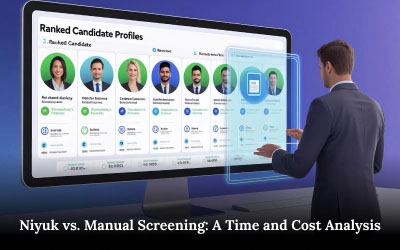
Discover Niyuk. Experience effortless screening and assessments. Book A Demo Everywhere Recruitment bias is a common issue. But thanks to AI, due to tools like AI interviewer, recruiters can easily eliminate hiring bias. Recruitment bias prevents your company back from searching for its ideal candidate. Unconscious or conscious, human based decision making always come with biases in the recruitment process. In this blog article, Let’s find out how AI Interviewer from Niyuk helps recruiters overcome hiring bias. Transform Your Hiring Process Leverage an advanced AI Interview Platform to find your perfect candidate easily Contact Us Types of Recruitment Bias As per a study, 90% of job recruiters do some bias during their hiring decisions, as per the candidate’s views for the hiring process. Almost 19 out of 20 recruiters believe in this- unconscious bias, that affects the hiring process, and some of them call it as a ‘big problem.’ Many recruiters feel the same. Bias may well be unconscious and fully unintentional, but that doesn’t indicate we should not try to decline or remove them with the tools available with us. Niyuk has come up with AI interviewer tool with the same objective. Now, here we will go through all types of biases one after the other. Affinity Bias: When someone favours other person because they share similar characteristics. This is the most generic unconscious bias in the recruitment arena. Beauty Bias: This explains about people’s belief that attractive people will do a best job than anyone who is not conventionally attractive. Contrast Bias: Contrast bias is nothing but, judging one thing over the another, instead of accepting on its merit. Gender Bias: This type of bias mainly arises from a strong belief that, one gender is uncapable to do certain tasks over the other gender. Halo Bias: This bias type focusses on the highest positive thing by ignoring other little less positive things. Horns Bias: It is exactly opposite of halo bias; horns bias is nothing but focusing too much on a single negative aspect. In all above discussed biases, age bias is the most prevalent. The candidates also report biases depending upon their appearance, mental health, disabilities, weight, parental & maternal status, accent, race or gender. Unconscious biases are nothing but unknowingly people do while taking their recruiting decisions. Implementation of AI Tools in Your Hiring Processes The Ai technology implementation in HR hiring (recruitment)process is a vital task needing for utmost care and attention always. Refer to implement below mentioned tips to make sure that you integrate AI tools as smoothly, effectively as possible: Review your Full Hiring Process: At first, you simply must start a complete review of your hiring processes. It needs to understand the pinch points in your processes, where you’re under-resourced, and where processes could be simplified before going to AI assistance. Identify Areas Where Biases Could Occur: As part of your hiring processes review, find areas of your recruitment that will be affected by bias. These may be intentional or unintentional biases. Sure, on Inputs: One need to have clear idea about inputs. AI tools will take care for recruiter biases via these inputs given by them only. Be contained and deeply involved when designing inputs, to decline the chances of bias getting in. Don’t Bypass the Human Factor: AI tools are here to support and not to replace or bypass humans today. Be alert when human input is needed, and use AI tools to convey your decisions, not to decide them for you. Get Team Buy-In: Some people may easily treat new AI tools with fear and scepticism. It’s important to make sure that total buy-in from your recruitment team and management, so the results are not challenged or doubted next down the line. Do trainings to explain the benefits of these powerful Ai recruitment and AI Interview tools to your hiring teams. How AI interviewer tool from Niyuk helps in removing Hiring Bias Structured and Consistent EvaluationsNiyuk.ai makes sure for fair hiring decisions by offering structured evaluations and AI-generated reports. This systematic approach reduces human subjectivity and making sure that all candidates are assessed within the same criteria. Zero Human Bias in ScreeningThe platform is applied to remove human bias from the initial screening process. By using AI, it entrusts mainly on objective data and candidate qualifications, other than unconscious biases those influencing human reviewers. Fair Interview ExperienceNiyuk’s AI Interviewer feature gives a consistent and genuine interview experience for each candidate. This standardization supports in assess candidates equitably, irrespective of their background or remaining factors, which might unconsciously oscillate a human interviewer. Objective Insights from AI AssessmentsThe AI Assessment capabilities offer objective insights into a candidate’s real skills and potential.By cutting via conventional biases, it entrusts on displaying abilities, making sure a more perfect and unbiased evaluation. Ethical AI Recruiting via Audited AlgorithmsTo encourage fair and diverse hiring, Niyuk’s AI algorithms are well trained with dynamic datasets and are frequently audited. This ongoing process supports in identifying and minimizing any inherent biases inside the algorithms themselves, making sure for ethical AI recruitment practices. Experience unbiased, efficient candidate screening with our intelligent AI Interviewer Get Your New AI Interview Platform Talk to Our Expert AI-Powered Resume Screening: Removing Identifiable Information/Details AI tools will remove bias with identifiable details removals like names, gender and ethnicity from CV’s. This makes sure that candidates are evaluated entirely on their qualifications and experience. Emphasis more on the job-related criteria, AI-driven hiring systems stop unconscious biases from affecting hiring decisions. For instance, AI algorithms may anonymize resumes. They allow you to assess candidates without any earlier assumptions. Skills Analysis and Objective Experience AI based screening assesses candidates on the predefined criteria’s- skills, experience, and job relevancy etc. Not like human recruiters, AI analyses data without demographic influences, making sure for the objective assessments. Automated tools for resume screening apply machine learning to score candidates on merit basis. This removes subjective impressions and supports you identify the most qualified resources. With AI, you can extract bias