
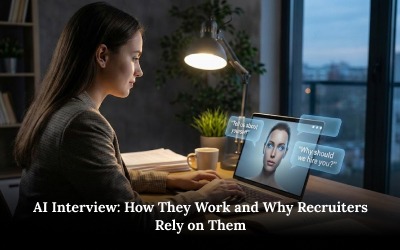
AI Interview: How They Work and Why Recruiters Rely on Them
Discover Niyuk. Experience effortless screening and assessments. Book A Demo Artificial Intelligence has entered in every walk of human life today. In every domain, AI can outperform the given tasks in record time, saving optimum human efforts and time for those tasks. Especially, AI interview is a prospective story to share. Tasks like candidate evaluation, assessment along with AI interview can be automated with AI based softwares or platforms. This not only reduces human bias, task redundancy and massive human resources with their dedicated time to accomplish these tasks but also offers quality hiring without any natural human bias. A real top talent can be hired in a record time without wasting measurable time with zero human bias for any technical or non-technical domain for the AI using HR team. In this blog, we will disclose all vital aspects about AI for interview in details. Let us start with the core concept of AI interview i.e. what exactly it means? https://youtu.be/fOE0MtpQHso?si=RCCni7ANF4SrETgi AI Interview: A Core Concept It is nothing but Interview taken with Artificial Intelligence technology or using AI for interview. Such interviews are arranged on real time and may be pre-recorded mostly based on conveniences or comfort of the candidate by automating the interview schedule. This reduces the to and fro communication required before the actual interview. Also, AI can analyse speech, behaviour, language and tone of the candidate. It can pre-evaluate the required eligibility criteria for the role in terms of qualification, skills and background verification check. AI helps in initial candidate screening. This reduces the natural human bias making the decision more consistent, best for the businesses. The streamlining of entire HR process makes AI interview, an ideal tool for remote as well as bulk hiring for businesses using the same. Why to Go for AI Interviews? Today, as per latest data, almost 92% of the businesses are going for AI implementation. That may be for the overall processes of the business, which may lead to more time and slow ROI for it. At the same time, going with interview AI in HR’s recruitment process takes care for the entire operations. Right from initial screening to the final onboarding process AI automates majority of the tasks. It also reduces the human bias, which is an issue in conventional or human based hiring process. AI takes care for the skill assessments, candidate screening etc. And takes a lion’s role in saving the ultimate recruitment time. This is not all. It also helps in quality-of-hire by reducing time-to-hire. From goals setting to final selection of a right deserving talent is done by AI. So, the AI Interview implementation has got fast and optimum ROI for those companies who have initialised it. AI for interviews is the need of an hour. Many businesses have realised this and have started implementing the same to faster their bulk and quality recruitment drives with minimum human intervention. The output possesses quality with ultimate money saving in the long run. AI Interview Types 1. AI-Led Interviews AI-led interviews are interviews fully run by artificial intelligence. This type of interview has human intervention free conversation. It is interesting to check out how it goes: You need to join an interview link or app. An AI system asks questions to you. These could be text-type based or loudly spoken by an AI chatbot or a digital avatar selected. The AI analyses your replies in real-time or after the submission, looking at: What have you said? (keywords, content) How did you say it? (tone, confidence level, clarity) Sometimes it also catches your facial expressions or body language (if video-based). After this, the system generates a report or scores that recruiters or hiring managers may utilise to decide your next step – or, in some cases, the AI itself moves you forward towards the next step of your recruitment journey or reject you automatically. 2. AI-Assisted Interviews AI-assisted interviews are job interviews those are improved by artificial intelligence tools that support and not replace the human decision-making throughout the candidate assessment process. These systems are designed to simplify interviews, boost objectivity, and enhance efficiency without doing any sort of compromise with the human touch, which is equally important in hiring. The process normally looks like this: AI acts as a co-pilot, helping the interviewer during the session. It tracks the interview in real time, recommends follow up questions, checks the interviewer’s performance and suggests ways to improve the same. Simultaneously, it checks candidate performance and helps generate “interview summaries”. Across both formats, AI analyses candidate replies – looking at oral content, tone, clarity, body language, and more. Then the system creates scores or recommendations to help hiring decisions. Additionally, AI can proctor interviews to make sure for the fairness and integrity via the process. How AI Interview Works? 1. JD Indulgence (Job Description Indulgence) The AI system starts by “reading” the job description offered by hiring manager or the recruiter. It applies natural language processing (NLP) to know what the role really needs: Which skills are required? What experience is recommended? What type of questions must be asked to assess a certain skill? 2. Skills Mapping After job description indulgence, the AI takes out a list of must-have and nice-to-have skills. These skills would be technical (like “Python,” “SQL”) or soft skills (like “leadership” or “communication”). This forms the baseline for which every candidate will be evaluated. 3. Question Generation (Q Gen) At this stage, the AI prepares the interview questions. Fixed Questions: These are standard questions (or set of questions) asked to all candidates. They are used for regularity and benchmarking – so everyone gets a fair opportunity to perform. Example: “Explain a time you handled a tough stakeholder.” Dynamic Questions: These are fully personalized based on the candidate’s resume. If the resume mentions project management, the AI will raise a question, “Tell us about a project you have led from scratch to finish.” This mixture of static and personalized questions makes sure for both fairness and relevance. 4. Interview (Proctoring and Monitoring) When the candidate takes the AI interview (mostly recorded video or audio): The AI proctors the session to find out cheating or uneven behaviour (like someone else prompting or helping off camera). It tracks the tone, speech clarity, eye movement, facial expressions, manual pauses, and confidence levels to collect behavioural signals. It’s like having a “robot interviewer” watching and listening – without human availability. 5. Evaluation / Check Once the interview is over, the AI reviews of the content of the candidate’s answers and the way they were added i.e. tone, pacing, and clarity. It interprets the data for the job requirements. Recruiters get this structured output and can decide who to move further – without any need to see each interview from start to finish. The same conversational AI is used in AI call center companies in India, where businesses emplace intelligent systems to handle support exchanges at