

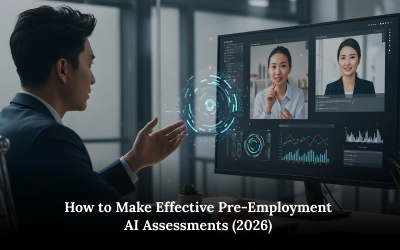
Recruitment has been less about resumes sorting and more about making quality decisions with speed and upgradation. In an environment, where talent is a key element, organizations may not afford fragmented workflows for recruiting or irregular assessments. The requirement for fast, accurate, and repetitive decision-making is pushing off HR teams to shift ahead of the conventional screening methods. AI assessments help in preparing early recruitment decisions fast, fair, and more regular. Moreover, relying on resumes or gut feelings, these tools evaluate candidates on real job-relative qualities, like how they resolve issues, communicate, adapt, or think under stress.
They are designed to highlight potential, not just experience. As a business study found, while they don’t replace human judgment, they give your team better data to make more confident, informed choices.
We have tried to break down how AI-based pre-employment assessments work, what they give to modern hiring strategies, and how to effectively deploy them in your organization, whether you’re growing a team or refining your assessment process in this blog article.
What Are AI-Powered Pre-Employment Assessments?
AI-powered pre-employment assessments are well-designed Assessment methods by artificial intelligence to assess candidates. Assessment is done on job-relevant traits, skills, and competencies. These assessments support screen candidates and simulate real-world work scenarios to reveal how a candidate thinks, resolving problems, and applies their skills in context. Rather than relying only on past work experience, AI assess how well someone is likely to perform in the role they’re applying for.
Mostly useful formats of AI-powered assessments are having:
- Video-based hiring assessments: Candidates answer to planned scenario-based questions visually, applying insights in their style, confidence level, and clarity.
- Technical tasks / simulations: These tasks test the functional, technical know-how in a job-specific context. Which is crucial for engineering roles, finance, or operations. For instance, to hire a Software Engineer position needing expertise in Python, the candidate may be prompted to solve Python test.
- Live situational assessments: Candidates interact with an AI agent to answer role-specific scenario questions and follow-up questions required to gauge decision-making, subject expertise, and practical thinking. Candidates do reply to statements / prompt revealing work preferences, personality traits, and compatibility within the team.
When combined, these formats give you a comprehensive view of a candidate’s capabilities, much objective what you would get from a resume or a phone screen.
How it Works?
Candidates complete the assessment from anywhere at any time. The AI acts as an agent and analyses replies for communication skills, problem-solving ability, learning agility, and behavioural patterns, based on the criteria set for the role.
Rather than having a recruiter present during the interview, AI agent acts as an intelligent assistant, automating repetitive initial screenings and resume shortlisting processes, while filtering top candidates based on their performance.
It allows hiring teams to find high-potential candidates fast, especially in high-volume recruiting scenarios where manual assessments may not be that much useful.
For example, instead of investing hours manually reviewing applications for a customer service position, recruiters may have candidates reply to a set of structured questions. The AI analyses reply for skills suitable to customer-service roles like tone, clarity, and communication skills.
This latest solution can be developed with the help of an AI driven platform.
A sales role can need confidence and adaptability, while a finance role may require analytical thinking and attention in detail.
These traits are not easily grabbed with only resumes. Making AI-based assessments a precious tool for deep candidate profiling.
Why to Use AI in Pre-Employment Assessments?
AI-powered assessments boost initial-stage hiring with the analysis of how candidates reply to real-world scenarios. They are like timed video questions, problem-solving tasks, or behavioural prompts in AI led LMS.
Inspite of resume scanning, these tools assess communication, adaptability, and critical thinking using structured, role-specific scoring. This allows organizations to hire at larger size without adjusting on candidate quality.
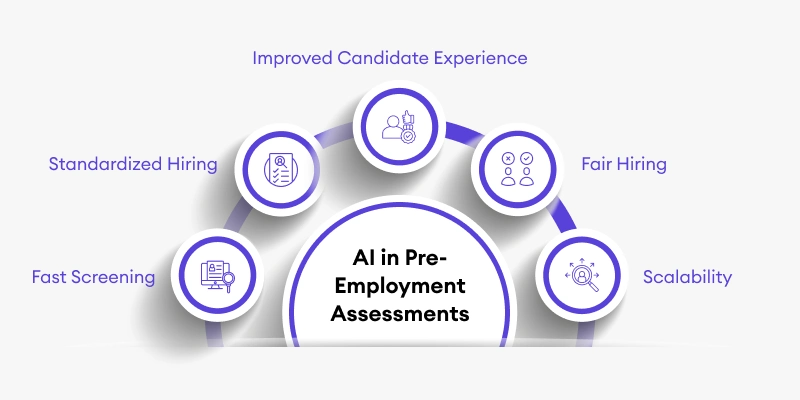
1. Fast Screening
AI tools help assess 10 candidates in the time. It would take to assess 1-2 candidates using conventional over-the-call screening. This is a remarkable drop in the time spent on screenings at the start. This is very useful for roles with high application volumes, like customer service, sales, or graduate hiring programs.
2. Standardized Hiring
With AI, each candidate is assessed with the use of the same parameters and scoring logic. This makes sure that each applicant applying for the same job; either it’s an entry-level role or a leader position, is assessed equally based on pre-specified job competencies.
3. Fair Hiring
AI algorithms are programmed to emphasis on role-driven traits and remove factors that can introduce unconscious bias. For example, scoring model does not consider a candidate’s name, gender, or religious background, only their reply content.
4. Improved Candidate Experience
AI algorithms are programmed to emphasis on role-driven traits and remove factors that can introduce unconscious bias. For example, scoring model does not consider a candidate’s name, gender, or religious background, only their reply content.
5. Scalability
Either you are screening 50 or 5,000 candidates, AI tools does it easily. You don’t need to expand your recruiting team. Set up of assessments done once and enable the system to do the heavy load.
Implementing AI Assessments into Initial Screening
Based on the replies, the AI refines out low-scoring candidates and recommends top performers for next technical interviews, cutting down recruiter’s workload by 70%.
You can take an AI development company’s help to make transparent and responsible AI hiring tools made to offer clear insights into decision-making processes, actively lower bias, and make sure for data privacy compliance.
AI-driven assessments are very effective when incorporate on the verge of your hiring strategy. It serves as a planned, regular method to screen and filter candidates who are best suit to the job requirements.
How to implement them intentionally is as per given below here:
Step 1: Find Your Hiring Goals

Inspite of AI’s evolving potential, various organizations stumble fast in their supply chain journeys due to certain persistent obstacles.The big issue is data quality and consistency. When formats are not matching, fields are missing, or data exist in isolated silos, also the smart AI can’t work efficiently.
1. Making Sure forData Quality & Unified SourcesBefore introducing AI into your screening process, get clear on what you’re solving for. It’s not only about use of AI. It’s about aligning AI with specific hiring goals.
- Do you want to reduce time-to-hire?
- Do you want to improve candidate quality?
- Is the goal to standardize hiring across departments?
How to do it?
Identify generic challenges in your early funnel. Connect with recruiters and hiring managers.
Are they stressed out by resume volume?
Struggling to evaluate soft skills objectively? Losing time to misaligned interviews.
Write these pain points down.
Example: “We get many resumes for customer-centric roles but can not assess quickly and assess communication skills.”
Review 2 to 3 latest hires or failed interviews.
What signals would’ve helped you spot the right (or wrong) candidates sooner?
Think in terms of skills, behaviours, or traits which are currently hard to screen for at larger size.
Translate those insights into measurable goals.
Your goals may look like this:
“Drop down time for reviewing resumes by 50%”
“Filter candidates with strong critical thinking for technical roles.”
“Get a regular view of soft skills before interviews.”
This becomes your base for deciding how to use AI later.
Step 2: Choose the Right AI Platform
Once you have defined what you want to improve in your early screening stage, the next step is to select an AI platform which directly helps the goal.
Aligning with AI Development services may help you make sure that the platform you select is customised to meet your hiring requirements. The right tool should simplify your shortlisting process and not compel you to change your full hiring flow.
Here’s how to assess platforms:
Start with your top screening goal from Step 1.
For example: “We have a fast way to assess communication skills before interviews.” Use this goal as your decision filter when searching the tools.
Shortlist platforms based on core features. Look for tools offering assessments designed specifically for early-stage screening.
These may have:
- One-way video interviews with automated scoring
- Written response assessments
- Role-driven cognitive or behavioural assessments
- Situational judgment simulations
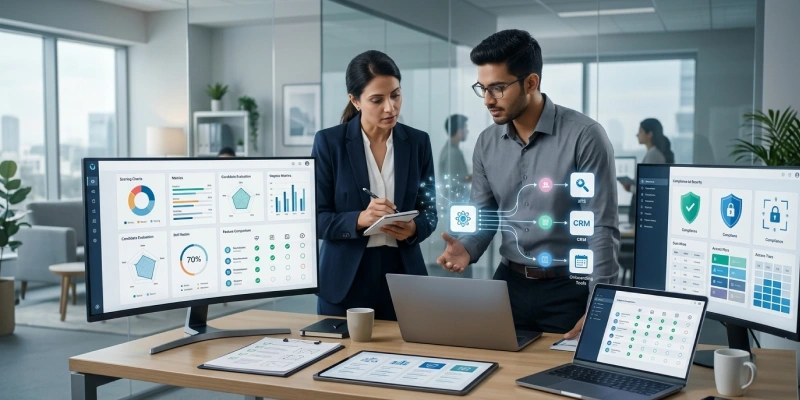
Check for compatibility with your current HR technical stack. Ensure for the AI interviewing management system can incorporate with your existing ATS, CRMs, calendar tools, onboarding systems, and recruiting workflow. Follow solutions like Microsoft Dynamics 365 and review licensing options offered by them, to ensure that you have the right plan.
Check compliance with global data privacy regulations like GDPR and CCPA. This helps avoid reduanding tasks or managing candidate data in two places. Partnering with a trusted Dynamics 365 partner making sure for a smooth setup process and best alignment with your business goals.
Actionable Tip: Make a checklist with 3 columns as follows:
- Must-have features: Directly tied to your goal (e.g., evaluate communication, has AI scoring abilities, and allows automation of shortlisting of candidates).
- Nice-to-have features: Features improving usability (e.g., multi-device compatibility and branding options).
- Deal-breaking features: Features helping you to pick pace and backen decisions with insights (e.g., entire reports, sharing and downloading interviews for collaborational hiring).
For example, offers customizable pre-employment assessments, ranging from subject knowledge tests to situational interviews and even role-specific coding challenges, has integrated AI scoring, and follows robust data protection protocols.
Step 3: Customization of Your Assessments

As you have chosen an AI assessment platform, you can try the readymade role-driven assessments or customize for your own. The goal is to screen for which matters in every role, not only checking a box. Composing tricky and brainy assessments makes sure that you are assessing candidates based on the right mixture of skills, traits, and role-specific expectations.
This is how you can customise AI assessments:
- Start with the deeply given job description. Discuss with the hiring manager and ask:
- What does this person required to be good at from day one?
- What skill to do we usually miss when screening for this role?
Example: For a junior marketing role, the manager might say, “They have to communicate effectively, understand campaign metrics, and be mindful of key marketing strategies in their industry.”
- Map such answers to assessment types. Based on the insights, select the best-fit assessment format:
- Sustain assessments short and suitable. emphasis on testing 2-3 high-impact skills per role. Do not overload candidates with long tests which could be risky, losing the candidate’s engagement. Restrict complete assessment time to 10-15 minutes, certainly for beginning or mid-level roles.
Step 4: Enrich Your Team

To unzip the full value of AI-driven assessments, your hiring team needs access as well as clarity which can be shared via extensive training and powerful communication. Structured training makes sure to understand the team and how the assessments work, how to break down the results, and how to use such insights in the screening and interview process.
- Beginwith a live walkthrough to give your recruiters and hiring managers a supported session on how to use the AI assessments platform.
Walk them via:
- How assessments can be sent to the applicants.
- The parameter to be used to judge a candidate’s performance.
- The expected score to place a candidate forward in the hiring process.
Share an example of an AI-based pre-employment assessment for a sales position and a real completed candidate interview.
Show the candidate’s AI scorecard
(e.g., Communication: 9/10, Adaptability: 6/10, Problem-Solving: 8/10).
Explain that a high rating could indicate strong skills.
- Fixtraining to real-life decisions and focus on how your team may use the results to:
- Prefer candidates for live interviews.
- Ask follow-up questions helping to collect more information about the skills available in the pre-employment assessment.
- Prospect for improvement and learning could help the candidate perform in your organization, also if the resume is weak.
Consider this, if 2 candidates score the same on technical skills. And one scores remarkably high in collaboration, the hiring manager would decide to speed up that candidate to the next round faster for a leadership role, such as Product Owner.
- Planfull refreshers each quarter or when you fix up your assessments, or to touch base with your team about any new issues or challenges which they are facing. Use this time to review what’s working well, address questions from recruiters, and share any new updates and features in the AI platform in use.
For example, if your AI platform changes the calculation for a cultural fit, review the new scoring logic and run a 20-minute team synchronisation to align to use it for evaluations.
Step 5: Monitor and Enhance Regularly

Deploying AI in pre-employment screening isn’t a single setup, but it’s a running process. To get regular results, you must monitor what’s working really, and what’s not, and where adjustments are going to be helpful. Tracking helps to assure you for assessments to stay relative, fair, and effective as hiring needs change.
Perhaps your assessments must focus more on cultural fit or adapt to new role requirements.
Track for easy, relevant 2-3 hiring metrics directly tied to hiring results, with:
- Assessment Completion Rate: This supports monitoring either candidates are finishing the assessment or dropping off in the midway. If completion is less, think for minimising the test / adjusting the format.
- Interview Conversion Rate: This helps ascertain the number of candidates who change to the next stage after shortlisted. A high match rate means your assessments are finding the right people. A low rate may mean your test requires to be upgraded.
- Time to Shortlist: This is the time it takes for the candidate to get from application to a shortlisted pool. If this number has gone down, AI is supporting your team for the fast movement.
Review the candidate and recruiter feedback you get for your platform and assessments. After each role is closed, ask recruiters, “Did the AI scores match your interview experience?” and if any good candidates were missed. Get feedback from candidates via email marketing or survey with questions like “Did the assessment feel clear and fair?” and “Were the assessment questions relative to the job?”. This helps you find blind spots, like if a question feels confusing or does not reflect the actual role.
As you have feedback, enhance the screening experience and revisit each assessment every quarter, or that time- you open the role again. Cancel or rework a question which candidates found not suitable at all, add a new video prompt for a critical skill the team found was missing, or adjust the scoring weight if a competency is more- or less-emphasized.
Resolving Common Concerns for AI in Hiring
As AI-based assessments have improvised hiring outcomes, HR leaders and recruiters too have valid questions about how these tools work, and how to use them responsibly.
Find here the most common concerns and how to manage them.
1. Transparency in Decision-Making
One of the high-volume challenges with AI in hiring can be missing of clarity around how decisions are taken. No transparency may damage both hiring decisions and candidate experience and may pose compliance risks.
To address this, your tool could really show why a candidate scored high or low.
Switch to AI platforms showing score breakdowns (e.g., 8/10 in communication, 6/10 in logical reasoning) and display what specific replies triggered for these results.
Also, retain fairness with your candidates by sharing how AI can be used in the hiring process, sharing disclosures about their collected data (if any), and how to interact with AI easily.
This way, recruiters can trust it and be confident in their decision. Candidates can perform their best during assessments comfortably.
2. AI Bias Reduction
AI models mostly learn patterns from current hiring data. Which could be biased.
For instance, if a company has hired more extroverted people for leadership roles, the AI could start scoring same profiles high without knowing the bias. Left not checked, this can take to the exclusion of diversified talent or reinforce stereotypes, which can by-pass the ethical considerations of using AI in hiring.
To attain it, make sure that your AI platform doesn’t rely only on previous hiring history. Activate anonymizing information like name, gender, and school names to make sure that role-relevant traits are assessed. At least quarter wise, compare success rates (shortlisted, rejected, assessed) across various candidate demographics, like gender, ethnicity, or age group.
3. Candidate Experience with Human Connection
AI tools excel hiring, but if candidates feel ignored, they may drop off or develop a negative impression of your company. This is certainly critical in starting stage or high-volume hiring, where candidates check with AI as their first point of interaction in the application process. The challenge syncs automation with authenticity.
To address this, candidates need to know they will conclude an AI-based assessment and brief how it works. When candidates know what’s being checked and why, their trust in the process raises. Let AI handle the initial screening and prefer scoring, while you invest more time to build candidate relationships and improve interview quality.
For instance, platforms like Humanize AI Text can support make AI-generated communications sound more natural and engaging, improving candidate experience and trust.
4. Data Privacy and Consent
AI-driven assessments mostly collect critical candidate information, video recordings, voice data, behavioural signals etc. As candidates aren’t sure that their data is being catered safely and ethically, it can remove the trust and pose compliance risks within the laws such as GDPR or CCPA.
To answer this, find a platform with GDPR/CCPA-compliant and gives features like data encryption, limited access controls, and role-based permissions. Enquire that-how long size data is preserved, who has got the access, and how delete requests are managed.
Let candidates know the reason why you are gathering the data, and for how much time it will be stored. Also, who will have access for usage. Consent must be explicit, unaffected with a generic privacy policy.
Conclusion
AI powered pre-employment assessments aren’t just a technology upgrade, they are a practical reply to the challenges hiring teams face today. They have high volumes, limited time, and pressure to get decisions right.
Top-performing organizations now see AI as a base to hiring efficiency. This means less missed opportunities and more confident final selections also in high-volume hiring scenarios. Here in HR arena, AI does not replace the human element, it supports it and handles the redundant, early-stage screening, so your team may focus on what it matters engagement with the right talent.
AI-powered hiring platforms allow this transformation without overhauling your current workflows. It brings together planned assessments, AI insights, and a recruiter-friendly interface making hiring smarter, simple and scalable.
If your objective is to make a fast, fair, and more effective hiring process, you can implement Niyuk platform for AI-powered assessments. For more details in this, you can email us on: sales@niyuk.ai
Frequently Asked Questions
Q: How do AI-driven assessments work in recruitment?
A: AI assessment tools assess candidates using structured tests, behavioural analysis, and real-time data. An AI assessment platform uses AI in hiring to evaluate skills, responses, and job fit more objectively.
Q: Why are AI assessments better than traditional hiring methods?
A: AI-powered assessments reduce manual bias and speed up evaluations. With AI in hiring, decisions are based on data rather than assumptions, making the AI-based assessment process more consistent and reliable.
Q: Can AI-powered tests improve hiring accuracy?
A: Yes, AI-powered assessments improve accuracy by analysing multiple data points like skills, performance, and behaviour. An AI assessment platform ensures better candidate matching via smart AI in hiring processes.
Q: Do AI assessments replace human recruiters?
A: No, AI assessment supports recruiters rather than replacing them. It simplifies screening via AI-based assessment, while final decisions still rely on human judgment in the AI in hiring process.