


In 2026, The talent acquisition teams are experiencing the deep challenges of hiring the right resources. Many efforts of the team, the concern recruiter’s efforts to locate the right fit candidate for some few weeks’ time-to-hire ends on the selection ending with an offer email to the candidate.
Th real twist is here. The offer receives reply from the chosen one that he has accepted some another offer. So, this is a complete loss of time-to-Hire and efforts as well.
Time-to-hire has become the biggest critical parameter in HR arena today. One must confess that in 2026, time-to-hire is the main success factor or a man liability for any organisation. This defines the agility of the business in broader aspect.
Why Is Time-to-Hire Vital for Candidate Experience and Retention?
Let us consider a genuine case here. A top-level AI expert or a high-performing Sales manager is going for a job hunt. Then they will look not only for a lucrative paycheque but also for a decent work culture.
In case of a slow hiring process, what it conveys to the candidate?
- “We are indecisive.”
- “We don’t value your time.”
- “Our internal communication is probably a mess.”
The best talent is off the market in 10 days or less in 2026. If your process takes up 3 weeks of “internal review” without any schedule for a second interview, you aren’t as it were being “thorough”, you are being undetectable.
A fast time-to-hire makes a “Halo Effect.” It explains the candidate, “This company is well organized, decisive, and they want me.” That feeling carries over at least for first 3 months the job, directly impacting retention.
How to Calculate Time-to-Hire: Formula and Best Practices
To sort out your speed, you need a gut feeling free foundation. The seasoned approach is to search for the average across all roles, but also the median to make sure for one difficult executive role doesn’t twist or tweak the data for your high-volume hiring.
1. The Basic Time-to-Hire Formula
Time to Hire = Day of Offer Acknowledgement – Day of Candidate Application
Pro-Level Measurement
Don’t just monitor the total days. Monitor the “Milestone Velocity”:
Application to Screen: (Goal: < 48 hours)
Screen to Interview 1: (Goal: < 3 days)
Interview 1 to Final Offer: (Goal: < 7 days)
By its further break up, you prevent guessing and start knowing which “lap” of the race is slowing down your process.
2. Industry Benchmarks: Actual vs. Expectation
Some regular talks are: “We are a law firm, we have to be slow.” or “We’re a technical startup, we are naturally fast.” While industry works for a role, the “benchmark” is mostly an excuse for inefficiency.
3. Global Benchmarks of 2026
|
Industry |
Avg. Time-to-Hire |
The “Danger Zone” |
|
Technology/IT |
20-33 Days |
> 40 Days |
|
Finance/Insurance |
44 Days |
> 50 Days |
|
Healthcare |
35 Days |
> 50 Days |
|
Retail/Hospitality |
14-18 Days |
> 21 Days |
|
Professional Services |
28 Days |
> 35 Days |
Global average time-to-hireis 44 days for all industries. Top candidates go off market in 10 days.
Don’t focus for the “average.” Take target to be 20% faster than your direct competitor. If the firm across the street hires in 28 days, and you hire in 22 days, you will always get the edge.
The Financial Effect: Calculating the Actual Cost of a Vacant Position
Many companies monitor the hiring cost (ads, software, agency fees). Less companies monitor the cost of not hiring.
Let’s work out some basic calculation which normally attracts the CFO’s attention.
We use the Vacancy Cost Formula:

If an employee makes $200,000 in revenue per year, and that role remains vacant for 40 days, you aren’t “saving” on their salary. You are at a loss of approximately $30,769 in unrealized value.
And it is the direct revenue. It doesn’t account for:
1. The Burnout Trap: Why “Covering” for a Vacancy is a Slow Poison
We normally tell ourselves, “The team is growing up,” as if that’s a long-term strategy. You can stretch this for some long period, but eventually it is going to break at some point of time.
- The “Invisible” Workload: When a seat remains vacant for 40 or 60 days, your top teammates don’t just take on additional tasks; they take on more mental load. They are context-switching regularly. This takes to “Decision Error.”
- Secondary Turnover: This is the furious part for any manager. Your “star” employees work more for that pending position. When they start feeling like they are doing double jobs for one salary, they do not complain; they only update their profile for new job. Suddenly, your “one vacancy” issue turns into a “two resignation” crisis.
- The Quality Slide: It’s a full erosion. You don’t notice it on day six, but by day thirty first, the “good ” standard becomes the new normal. Your culture shifts from innovation to survival.
2. The Brand Tax: Why Ghosting is a Financial Liability
In 2026, your “Employer Brand” isn’t what your website shows; but it’s what the unhappy candidate says in a private Slack community or a Glassdoor review.
- The Costing of “Stale” Jobs: If a candidate watches a job post for almost three months, he does not appreciate that but finds that something is uneven with the post. High-quality talent will not even click “Apply.” This keeps you with a pool of desperate candidates, which further improves the risk for a “bad hire” (the only thing more costly than an empty seat).
- The LinkedIn “Whisper Network”: Candidates whisper. If your hiring process is slow or if people feel “ghosted” because the team was very busy “covering” the vacancy to respond, that news uncovers. You end up with a “Reputation Damage.”
This means to hire the same talent next year; you’ll have to offer 10% to 15% more in salary mostly just to convince them to take the risk on a brand they assume as disorganized. - The Marketing Conflict: Imagine your company incurs thousands on marketing to look “latest and fast” to customers, while your HR process looks “slow and ancient” to candidates. That loss of connection kills your credibility. Today’s candidate is tomorrow’s customer.
Reasons of Hiring Delays and Ways to Fix Them
Those were the days when interviews were long lasting. Nowadays, stop gaps between interviews rounds or interviews are causing major delays. Let us discuss them with their solutions here.
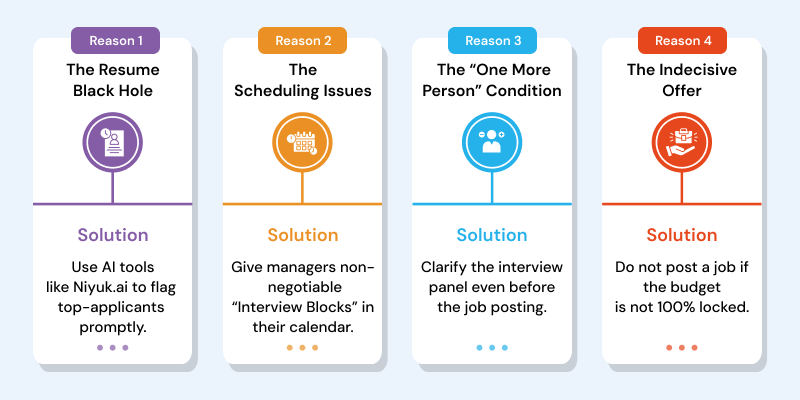
1. The Resume Black Hole
It takes 5 days for a recruiter to refer at a new application. By that time, the candidate has applied to 10 other places.
Solution: Use AI tools like Niyuk.ai to flag top-applicants promptly.
2. The Scheduling Issues
Scheduling is a tough task really. To get 30-minute time slot from 3 decision makers is a mighty task to schedule the interview, even with the online mode.
Solution: Give managers non- negotiable “Interview Blocks” in their calendar.
3. The “One More Person” Condition
The hiring manager takes decision at the last moment that “Finance Head” should also meet the candidate.
Solution: Clarify the interview panel even before the job posting.
4. The Indecisive Offer
Waiting for budget re-approval or a prolonged budget re-approval, after the candidate has already been chosen.
Solution: Do not post a job if the budget is not 100% locked.
Strategies to Lower Down Time-to-Hire
Speed does not mean hiring the first visiting candidate for the post. It means removing the unrequired friction which doesn’t add value to the decision.
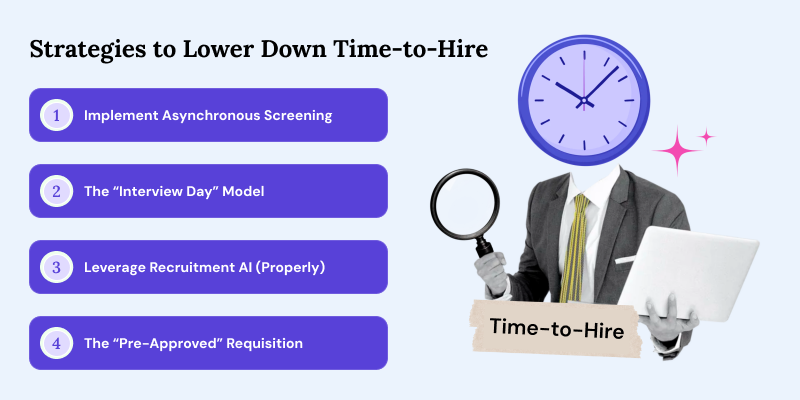
1. Implement Asynchronous Screening
Instead of going for an intro call with each candidate, you can use one-way video intros or automated skill assessments. This enables you to “meet” candidates at 11 PM or 6 AM, moving the best ones to the front of the line promptly.
2. The “Interview Day” Model
Rather than multiple rounds across 3 or 4 weeks, you can arrange all rounds in a single day for a candidate. You can also make all decision makers available in a single time slot or for the same day to finish up the interview process fully and speed up the ultimate selection decisions on all level.
3. Leverage Recruitment AI (Properly)
In 2026, AI should be making the “administration” decision but not making “hiring” decisions. Tools like Niyuk.AI can handle the primary shortlisting based on actual merit and skills, lowering down the “Resume Review” phase- from days to seconds.
4. The “Pre-Approved” Requisition
The budget approval before selection of the candidate is a must. Else, it will damage your employer brand, if you will select a candidate and then keep the position or joining decision on hold due to a pending budget approval. A pre-approval of budget is the right solution.
Why Your Time-to-Hire Affects Your SEO and Employer Brand
This is a new standard. When candidates look for jobs or “Best companies to work for in [City],” AI engines search for signals of a sound recruitment process.
If your company’s career page shows candidate testimonials with remarks like “clear, transparent and fast process” Time-to-Hire is an SEO signal now. A slow, sluggish process results in a high “bounce rate” on the job board, which tells Google your content along with your job board is not relevant.
How Niyuk HR Shrinks Time-to-Hire?
While an old process might take 45 days, Niyuk is designed to squeeze that timeline into below 15 days by removing those tasks that slow down human recruiters.
|
Feature |
The “Old” Way |
The Niyuk Way |
Impact |
|
Initial Screening |
Manual CV review (takes hours/days) |
AI Resume Scoring (minutes) |
70% faster shortlisting |
|
First Round |
Back-and-forth scheduling emails |
On-Demand AI Video Interviews |
Zero scheduling delays |
|
Evaluation |
Subjective notes and “gut feelings” |
Instant Competency Scoring |
Immediate data for decisions |
|
Communication |
Periodic manual updates |
Automated Candidate Engagement |
Reduced candidate “drop-off” |
Core Speed Pillars of Niyuk
While an old process might take 45 days, Niyuk is designed to squeeze that timeline into below 15 days by removing those tasks that slow down human recruiters.
1. The “Always-On” Interviewer
In a standard setup, an interview only happens when a recruiter and a candidate are both available. Niyuk’s AI Video Interview platform allows candidates to interview the moment they apply also at 2:00 AM on a Sunday. This removes the “email tag” that mostly adds 3–5 days to the process.
2. Deep Contextual Research
Niyuk doesn’t scan for keywords; it performs contextual resume screening. It can process hundreds of profiles in seconds, sorting only the top 5% -fit for the role. This means your hiring manager spends 10 minutes reviewing, and not 10 hours.
3. Proactive “Success Planning”
By using Success Planning and internal mobility tools, Niyuk helps you look at your existing team for potential fits before you post a job. This can turn a “hiring cycle” into an easy internal promotion, cutting Time-to-Fill down to nearly zero for crucial leadership roles.
Conclusion
At the end of the day, recruitment is for the people. It’s also about someone’s career, their family, and future. When you work on your time-to-hire, you are not just “making a metric.” You are honouring the human on the second side of the screen.
In other words, you are telling you candidates that, we know your value and we do not waste your time, even for a second.”
For more effective management of time-to-hire metric and other relevant metrics required for your recruitment and hiring process, you can mail our Niyuk team on: sales@niyuk.ai
Frequently Asked Questions
Q: If we move too fast, won’t we make a “Bad Hire”?
A: It is a valid concern. When leadership feels the burden of a vacant seat, the instinct is often to “just get someone in the chair.” However, the goal of a modern HRMS is not just to hire fast but to hire accurately. The “Bad Hire” is more expensive than a vacancy. Industry studies suggest that a mid-level bad hire can cost a company up to 1.5x to 2x their annual salary once you factor in recruitment costs, onboarding time, and the productivity tax they leave on the rest of the team.
Q: Does time-to-hire include the notice period?
A: No, time-to-hire typically does not include the notice period. It measures the days between opening a job requisition and the candidate accepting the offer. The notice period is a separate, subsequent phase representing the time between resignation and the starting date.
Q: How do we measure “Quality of Hire” alongside speed?
A: Measuring “Quality of Hire” (QoH) alongside speed requires balancing fast recruitment with long-term performance metrics, like new hire retention rates (6-12 months), hiring manager satisfaction, performance ratings, and time-to-productivity. A complete approach mostly involves tracking early performance against speed metrics.