

AI in recruitment is a current market trend for the corporate world. The recruitment arena is shifting from manual search to data-driven intelligence.
Today, talent acquisition does not depend on the database size, but on smart filters of the top talent for every required position or role.
As organizations face a “noise” crisis – thousands of AI-generated resumes are received for each job post – the role of AI in recruitment is evolving from a luxury to an essential element.
At Niyuk, we really believe that the next edge of hiring belongs to those who can transform massive datasets into precise selections.
By integrating a decent AI recruitment process, businesses can ultimately save several working hours lost to administrative friction in the current time.
Beyond Automation: The Strategic Value of AI Recruitment Software
Anyhow, modern AI recruitment software does more than just from a candidate from one position to the other. It analyses patterns.
By 2026, we expect recruitment platforms based on Artificial Intelligence to function as intermediaries analysing candidates’ information or details provided but mapping their skills with the organisation’s outcomes and objectives.
AI integration within a recruitment process allows your human recruiters to move ahead from their boring typing work. With platforms like Niyuk having features like Initial screening and resume matching, the team may concentrate on what really matters: improving customer relations and grabbing top-tier talent.
The traditional/old hiring pipeline is mostly slow and prone to bias. A structured AI recruitment process forms a consistency level that manual screening simply cannot match.
For instance, AI-driven metrics now allow us to track ” Hiring Quality ” with predictive accuracy, instead of waiting for six months to see if a new employee succeeds.
Key changes in the process include:
- Skill-First Ranking: Moving beyond keywords to know the context of a candidate’s experience.
- Reducing “Slipped” Leads: Making sure that each applicant receives an instant, intelligent touchpoint of communication within minutes.
- Bias Mitigation: Using “masked” screening to make sure that each hire is based on merit, not subconscious preference.
What strategic value Niyuk brings:
Niyuk not only speeds up tasks; it simply refabricates the hiring journey to optimise human impact. Niyuk does it for precision and quality. Niyuk automates almost 70% of administrative routine tasks, shifting its focus from manual data entry to high-value tasks such as candidate interaction, customer requirement study, etc. Niyuk gives more important value to a candidate’s career journey and potential over keywords.
With AI Assessments and AI interview features, Niyuk ensures quality hiring with fair competency.
Why Top Firms are Investing in AI Recruitment Software?
The conventional hiring landscape has reached a breaking point. For many years, talent acquisition teams have juggled under the weight of administrative debt, relying on fragmented Google Sheets and the labour work of scanning resumes line-by-line. This regular approach is not only slow; it is a major business risk. When a recruiter is stuck in a manual “paper trail,” top-tier talent accepts an offer elsewhere. That is even before the first interview is scheduled by the busy recruiter.
Modern organizations are now moving away from these outdated systems and putting their resources into AI recruitment software. The shift isn’t just about replacing folders with files; it’s about moving toward a centralized, intelligent dashboard that offers total visibility. Unlike a spreadsheet, modern AI recruitment software understands the context of a candidate’s journey.
It allows hiring managers to prevent guessing and start making decisions on real-time data, and the changeover of the recruitment desk from a reactive cost centre into a proactive growth engine.
1. Resolving the High-Volume Hiring Crisis
This technological shift is most visible in industries like BPO, retail, and hospitality, where hiring is a dynamic game of scale and speed. In these sectors, a single job opening can attract thousands of applications, making what we call a “high-volume hiring crisis.”
Trying to browse this manually is a mighty task – the process inevitably breaks, leading to “ghosted” candidates and exhausted HR teams.
By use of AI recruitment software designed for bulk hiring, companies can automate the initial screening stages without any adjustment or compromise on quality. The software acts as an efficient filter. It rapidly finds candidates expertise in specific language, technical, or available criteria.
For a BPO firm, this means the application time to the final shortlisting is dropped from weeks to hours. With the “noise” automation, recruiters can finally spend their time on the high-potential candidates.
2. How Niyuk Resolves the High-Volume Hiring Crisis?
With technical screening and technical vetting automation, recruitment software lowers manual review time by around 70%. The HR team becomes free to handle or address high-potential candidates.
This simplifies the AI recruitment process, removes candidate ghosting (fake candidates) and administrative issues, allowing BPOs to move their processes with speed a great hiring.
Redefining Efficiency via a Structured AI Recruitment Process
Automation is often misunderstood as a direct replacement solution to the human element, but a well-made AI recruitment process protects it. When a recruitment pipeline is manual, the human recruiter is too exhausted by data entry to get engaged with people. By shifting to an intelligent workflow, AI essentially clears the path, allowing the “human” parts of hiring – empathy, culture fit, and negotiation.
The modern AI recruitment process functions like a high-class filter. It begins the moment a candidate interacts with an advertisement, immediately triggering a series of background checks, skill validations, and logic tests.
So, it is all about gathering deep insights before a recruiter connects with the phone.
By the time a hiring manager sees a profile, the “process” has already verified that the candidate has the core competencies required for the role, effectively removing 70% of “mismatch” noise.
One of the main pain points in regular hiring is the “subjectivity trap,” where candidates are mostly moved forward because of resume formatting or keyword stuffing over actual ability (even missing those required skills). A data-driven AI recruitment process replaces this guessing with objective benchmarks.
Instead of a recruiter spending six hours a day in PDFs, the AI-based system uses semantic analysis to understand the depth of a candidate’s experience. It looks for patterns in career progression and cross-references them with the specific needs of the department.
This level of accuracy guarantees that your final list goes beyond merely including candidates who present on paper. Instead, it features a carefully vetted selection of candidates who are statistically positioned to grow within your unique company culture.
The outcome or result? A quicker hiring process and a notable increase in employee retention graph.
Streamlining the Candidate Journey via the AI Recruitment Process
AI Automation is often misunderstood to “remove” the human element, but a well-structured AI recruitment process protects it. When a recruitment pipeline is purely manual, the human recruiter is mostly too exhausted by data entry work to engage with people. By transferring to an intelligent workflow, we compulsorily clear the administrative path, enabling the “manual” parts of hiring – empathy, cultural fit, and negotiation – to take centre stage.
The modern AI recruitment process works like a highly accurate funnel initiating the moment a candidate deals with a job post. It smoothly seals the gap between Sourcing and Screening, where the system gathers deep insights before a recruiter comes in.
By the time a hiring manager sees a profile, the “process” has already filtered out the mismatch noise that typically clogs the top of the funnel, leaving only high-potential candidates ready for a conversation.
Automated Skill Assessments with Niyuk:
One of the most significant pain points in regular hiring is the “subjectivity trap,” where candidates are often moved forward based on resume formatting rather than actual ability.
Niyuk solves this by embedding Automated Skill Assessments directly into the initial stages of the journey. Instead of a recruiter spending an hour “guessing” if a candidate’s technical claims are true, the Niyuk platform triggers custom-built evaluations tailored to the specific role.
These assessments are unique. They imitate real-world scenarios, permitting candidates to exhibit skills in an unbiased setting. This thorough technical assessment assures that your selection comprises perfectly qualified candidates, and those are verified to match your company’s culture, values.
By standardizing the evaluation process, Niyuk enables you to hire based on real merit, boosting your hiring quality and lowering the time typically spent on arranging technical interviews in manual mode.
Critical Metrics: How AI in Recruitment Transforms ROI
By 2026, the success of a hiring team is no longer measured by the volume of resumes collected, but by the tangible impact of each hire on the company’s bottom line. The integration of AI in recruitment has shifted the focus from “process speed” to “strategic outcome.”
As highlighted in recent insights from Xponential Digital, the true ROI of modern talent systems lies in their ability to turn raw hiring data into predictive intelligence. Organizations are moving away from reactive hiring and toward a model where every penny spent on a job board is backed by a data-driven justification.
1. Cost-Per-Hire
One of the most radical shifts we are seeing is in the Cost-per-hire. Traditionally, this metric was bloated by “hidden” costs – recruiter burnout, multiple rounds of redundant interviews, and the high price of advertising on the wrong channels.
However, AI in recruitment significantly slashes these expenses by automating the “top of the funnel” noise. Zoho’s 2026 outlook suggests that by utilizing intelligent sourcing and automated vetting, firms are reducing their budgets for external agencies by up to 30%, as the software identifies high-potential talent within their own existing databases first.
How does Niyuk help in this?
By automating the “administrative burdens” like resume parsing and initial pre-screening, Niyuk helps organizations drop down their Cost-per-Hire by up to 35%, also by removing the need for costly external agencies. Also, by using predictive skill assessments to achieve Quality-of-Hire. The platform actively protects the bottom line by preventing the high costs of “mis-hires,” which can mostly exceed 150% of an employee’s annual salary.
2. Quality of Hire
While saving money is vital, the most critical metric for 2026 is undoubtedly the quality of hire. A bad hire can cost a startup up to three times that employee’s salary in lost productivity and re-hiring fees.
This is where the predictive power of AI in recruitment provides its greatest value. Instead of looking solely at historical data, these systems analyse “success patterns” -identifying which traits and skill sets lead to the longest tenure and highest performance within your specific team culture.
By aligning candidate profiles with long-term performance metrics, recruiters can move beyond the “probation period” gamble.
We are seeing a 25% improvement in candidate-to-culture fit because the AI in the recruitment process can cross-reference millions of data points that a human eye would simply miss.
How Niyuk Handles This?
At Niyuk, we view these metrics not only as numbers on a dashboard but as the roadmap for sustainable growth of the business, ensuring that your 2026 hiring strategy is both fiscally responsible and strategically superior.
3. Time to Hire
This is one of the popular recruiting metrics. It measures the period in terms of total days between a candidate applying for a job and accepting a job offer. This means that time to hire offers information about two vital recruiting processes.
- Recruiting efficiency: The time to hire metric calculates the speed at which a candidate is assessed, processed and interviewed, and accepted for a job. A long time to hire shows a slow, inefficient process with unnecessary issues.
- Candidate experience: This metric is also an indicator of candidate experience. If you are a candidate and can select, you will prefer a time to hire of two weeks rather than two months. A faster time to hire lead for a better candidate experience.
How Niyuk deals with Time to Hire Metric?
Niyuk optimizes the Time to Hire metric by replacing manual issues with a high-speed, automated intelligence layer. Where traditional methods take weeks to move from sourcing to a first interview, Niyuk’s AI recruitment software shortens this full phase into a matter of hours. This assures that high-potential candidates get immediate engagement, stopping them from moving to faster-processing competitors. By the time a recruiter enters, they are engaging with a pre-vetted, technical final list, allowing the organization to select top-tier talent with unbelievable speed and precision.
Shortlisting suitable AI Recruitment Software
Selecting the right technology can be tougher than the recruitment process itself. For a fast-expanding startup, the stakes are high; it’s required to get a tool that not only meets your current needs but can also grow towards your annual vision.
When evaluating AI recruitment software, it’s easy to get attracted to various “automation” claims.
The true value lies in how smoothly the software integrates into your current workflow, addressing bottlenecks over introducing new ones. As you examine your options, focus deeply than only the obvious features.
Strong AI recruitment software must improve your team’s capabilities.
This leads us to give priority to three essential pillars.
- Easy Integration with Current Tools: It is considered that, if the synchronisation of your selected AI recruitment software is best with current CRM, Slack channels, and Calendar Apps, then it is the most ideal one to go for the process automation.
- Bias Mitigation & Transparency: By 2026, ethical hiring practices are not just a requirement but mandatory. The software includes features for “blind” screening, hiding gender, age, or ethnicity, allowing you to focus fully on the candidate’s qualifications.
- User-Friendly Experience: If your hiring managers must undergo full training to browse the candidate journey, then the software is not catering to its objectives. Ultimate efficiency arrives from an intuitive interface.
Niyuk: The Best AI Recruitment Software
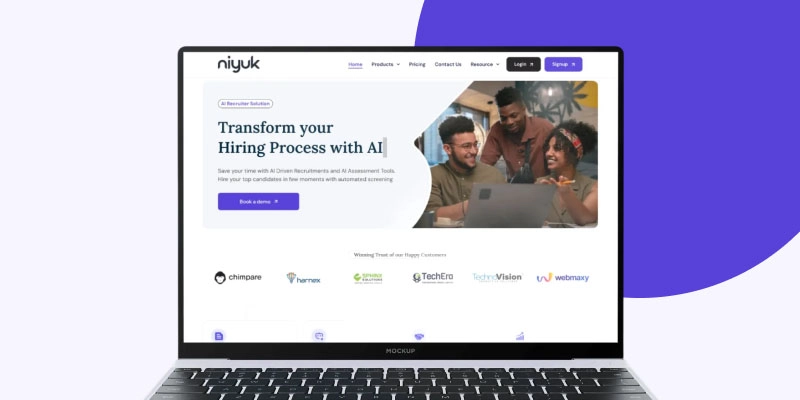
At Niyuk, we realized that startups don’t just need more resumes; they need better matches. This realization is what drives our approach to AI recruitment software. We’ve built a platform that bridges the gap between high-volume sourcing and high-quality selection.
Niyuk provides a transparent AI recruitment process that keeps your team in control while handling the heavy lifting of technical vetting and scheduling.
By selecting Niyuk, you’re gaining a strategic edge. We understand that your time is your asset. Our system is designed to search for the “needle in the haystack” before you’ve even finished your morning coffee. In case you are hiring your first ten employees or scaling to your first hundred, Niyuk makes sure that each addition to your team is a step taken toward your current year’s recruitment goals.
Conclusion: Futureproofing Your Talent Strategy
Entering 2026, the difference between conventional recruiters and technology-driven talent leaders is about to grow. Aligning AI into your recruitment strategy is more than a time-saver; it’s mandatory for maintaining your startup’s competitiveness in a market where top talent can be snatched up in a shorter period.
By adopting a structured AI recruitment process along with the appropriate AI tools, you can transform your hiring team from a bottleneck into a dynamic force. At Niyuk, we’re committed to making sure that every new team member is more than just a placement; they’re a strategic addition that contributes to your long-term success.
Just drop an email for further process and requirements to discuss: sales@niyuk.com
Frequently Asked Questions
Q: How to use AI in recruitment?
A: You can use AI in recruitment by automating redundant tasks like writing job descriptions, scheduling interviews, and initial screening, and by using algorithms for candidate sourcing, matching skills to roles, and analysing data for better decisions, all while maintaining human oversight for fairness, engagement, and cultural fit, ensuring efficiency and a strong candidate experience.
Q: Will AI replace recruiters?
A: No, AI won’t fully replace recruiters. It will transform their roles by automating redundant tasks (screening, scheduling) and allowing humans to focus on high-value activities like building relationships, strategic advising, assessing soft skills, and ensuring a positive candidate experience. This leads to a hybrid model where AI augments human capabilities for the best efficiency and results. Recruiters who adapt and focus on the complex, human-centric work will grow; those stuck on basic tasks risk being replaced by AI-driven automation, especially in bulk recruiting.
Q: Why are AI-driven recruitment metrics important in 2026?
A: AI-driven recruitment metrics are important in 2026 for achieving faster, higher-quality, less biased, and more cost-effective hiring by automating tasks. This uncovers hidden talent, optimizes workflows with data, and boosts the candidate experience, moving recruitment from a guessing game to a strategic, data-backed function.