

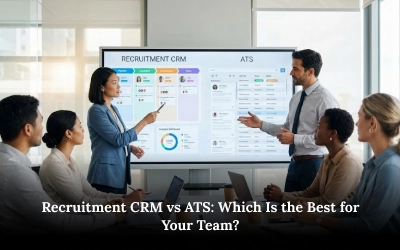
ATS and CRM are the latest recruitment tools responsible to save many hours of recruitment managers and teams. Still, we need to check it out that – Recruitment CRM vs ATS really make the life easy?
Are they both are required for the hiring team? Is any combination of both available for smooth working of Recruitment and hiring for organisations in the long run?
Let us unleash them all here in this blog. In this blog article, we are going review Recruitment CRM vs ATS difference with their importance, benefits etc. ATS vs CRM has some details to differentiate here.
What is an ATS?
An applicant tracking system (ATS) is an on-premises or cloud-based tool. ATS helps you automate important steps in your recruitment process to save your major time and lowers per hire cost. An ideal applicant tracking system will help you visualize your whole recruitment process, set and make recruitment stages and develop a recruitment experience for both candidates and hiring managers. The main purpose of an ATS is to support HR teams to manage the hiring process and applications. There are many ATS tools for recruitment based on recruitment purpose.
ATS for Recruitment
- You can post a job ad at once for all, no need for individual job board postingneeded.
- Interviews can be scheduled with ATS integration with the calendar tools, so there is also no need for to andfro communication with each candidate for scheduling their interviews.
- AnotherATS feature is the ability for resume sorting based on keywords or phrases to for the easy filtering of candidates. The ATS sends automatic response to those candidates who are selected in the process.
If someone is the right for a role, the ATS automatically sends that candidate’s application to the hiring managers for review.
If they are not selected, it can automatically send a rejection letter based on the recruitment process and given steps.
Main Functions of an ATS | ATS Recruiting Software
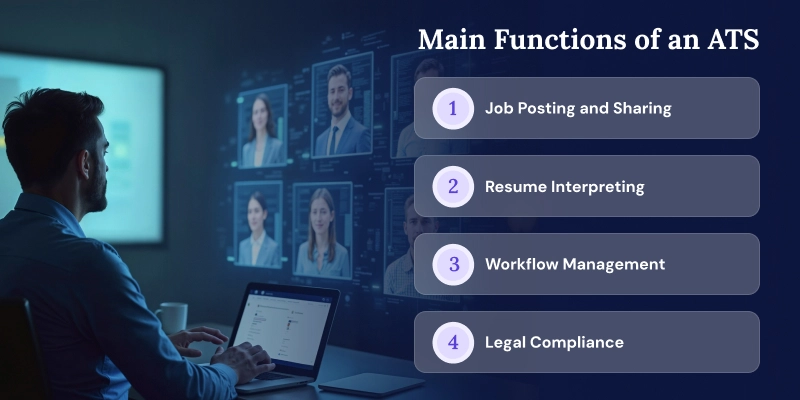
- Job Posting and Sharing: Exclusively shares job openings simultaneously on many websites and social media.
- Resume Interpreting: Automatically extracts, organises details of candidate applications.
- Workflow Management: Applicant’s tracking across many stages, from screening to onboarding.
- Legal Compliance: Makes sure for hiring follows all required laws and rules, like EEOC and GDPR.
A recruiting ATS is certainly for large HR teams handling many job openings and should comply with hiring laws.
There are various recruitment automation opportunities you can use with an applicant tracking system helping you offer a great candidate experience and get feedback from hiring managers.
A best modern applicant tracking system will offer all essential AI and recruitment automation tools to automate your recruitment processes and ensure not to miss out on your best candidates because it will take more time again to get them for you. Now let us describe concept of CRM here.
What is a CRM?
CRM system (Candidate relationship management) help you track relationships with candidates and build a solid candidate database. We have all been in situations where a candidate might not be perfect for the current open position, but we know we’d like to consider them again in the future.
The main objective of a CRM is to build, nurture relationships with talented candidates.
CRM (recruiting CRM) helps for recruitment
- Build a candidate database: If you need to maintain a passive candidate database, a recruitment CRM is the right way to keep in touch with them or perform candidate outreach.
- CRM conduct deep searches of your current database
- CRM searches saved CVs by keywords
- CRM sends surveys to candidates for feedback collection.
- CRM tracks candidate progress during onboarding (some CRMs)
- CRM maintains a GDPR compliant database.
A CRM has advanced search features also, which enable you to search candidates across your network who would be the perfect fit for an upcoming role, even they were unsuccessful previously for some other role selection process.
Main Functions of a Recruit CRM:
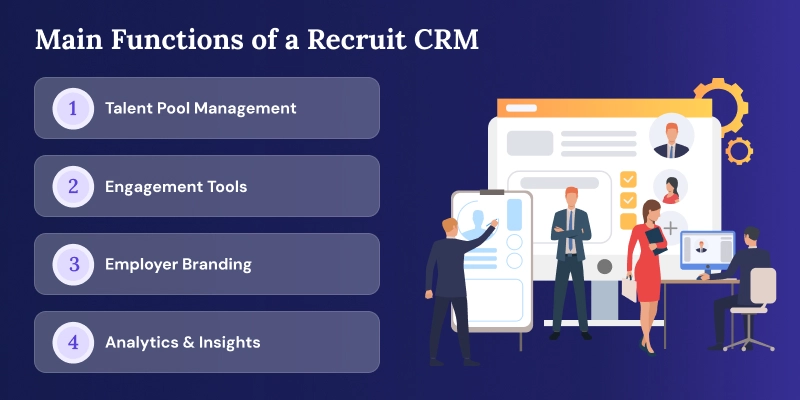
- Talent Pool Management: Groups and manages potential candidates across categories for future job openings.
- Engagement Tools: Enables sending individualised emails, newsletters, and updates of candidate’s engagement.
- Employer Branding: Shows the company’s culture via specific content and messages.
- Analytics & Insights: Tracks how candidates interact to enhance communication strategies.
A Recruiting CRM is ideal for staffing and recruiting agencies needing to build long lasting connections and search potential candidates efficiently.
Feature Based Comparison of ATS vs Recruiting CRM
|
Feature |
APPLICANT TRACKING SYSTEM (ATS) |
CANDIDATE RELATIONSHIP MANAGEMENT (CRM) |
|
Primary Function |
Controls the hiring process and job applications. |
Builds, maintains relationships with prospective candidates. |
|
Focus |
Grouping and tracking applicants who apply for a certain job. |
Engaging passive candidates and retaining a talent pipeline. |
|
Candidate Status |
Deals with active applicants presently in the hiring process. |
Manages both active and passive candidates for future job roles. |
|
Use Case |
Resumes reviewing, interviews scheduling and tracking hiring stages. |
Sending personalised outreach, retaining long-term relationships, and employer branding. |
|
Workflow |
Structured and transactional (follows job application stagewise). |
Proactive and relationship-based (long-term engagement). |
|
Database |
Collects candidate applications and hiring records. |
Preserves talent pools, past applicants, and passive candidates. |
|
Integration |
Always collides with job boards, assessments, and background checking activity. |
Supported with email marketing, sourcing tools, social media. |
|
Best for |
Companies concentrating on immediate hiring needs. |
Companies want to build a long-term talent pool. |
The main differences between Recruiting CRM and ATS are their core purpose and focus:
- Core Focus
Recruiting CRM entrusts on creating strong, long-lasting relationships with candidates. It focuses to connect with and develop a pool of prospective talent, mainly those who are passive job seekers, and keeps them interested until they are ready to apply. On the other hand, ATS is about managing the hiring process smoothly and handling the steps, details involved in recruiting. - User Experience
A. Recruiting CRM: It is built for the easy use, focusing on personalising communication and candidate engagement. It helps you customize your outreach and sort and group candidates by their skills, making it good for staffing and recruiting companies which want to be in touch with the candidates for the more time.
B. ATS: ATS is made for efficient work and have simple workflows for managing job applications. It does task automation like resume parsing and interview scheduling, lowering the need of manual efforts. This confirms that it is good for corporate HR teams managing large-scale recruitments and mass hirings. - Integrations
A. Recruiting CRM: It uses sources – social media, email marketing and CRM systems to improvise communication with candidates. It works mainly on improving outreach and efficiently getting candidates.
B. ATS: ATS uniting with job boards, evaluations platforms, and various HR management systems. It prefers for the automation of tasks like job posting, screening, and tracking of applicants. - Industry and Company Size Considerations
A. Industries
1. Recruiting CRM: Frequently used in fields where strong connections building and employing skilled people is essential, like tech, consulting, education, and companies those needing top executives.
2. ATS: Commonly used in industries needing for high-volume recruitment, like retail, hospitality, healthcare, and manufacturing. These industries based on quick turnaround times and powerful hiring processes to meet instant staffing demands.
B. Company Size
A Recruiting CRM can be a good tool for small companies looking to boost their reputation as an employer and make a pool of potential candidates for future needs.
1. Small Businesses: Small businesses find an ATS much useful, if they wish to automate and streamline their hiring process without any full-time recruitment team to employ.
2. Medium to Large Companies: Normally, both tools- ATS and Recruiting CRM are required. They utilize an ATS to handle tasks very efficiently and a CRM to strategically manage vital relationships.
Big Companies in complex markets mostly combine both systems to achieve the best results in hiring.
Which Is Better for Your Business – ATS and Recruiting CRM?
The right suitable option between a Recruiting CRM and an ATS entirely depends on your business’s hiring strategy, industry type, and size:
Select a Recruiting CRM if:
- You need to make an active pool of potential hires and connect with passive job seekers.
- Employer branding and candidate engagement are prior objectives.
- You are a recruitment or staffing agency working dedicated on grabbing talent for the long time.
Find an ATS if:
- You must handle several job applications fast and effective.
- Compliance and workflow automation are vital.
- You are mate of a company’s HR team handling with urgent, enormous hiring demands.
Combination of both tools mostly gives the best results for businesses with various needs. A Recruiting CRM can manage long-lasting relationships and branding, while an ATS supports for seamless and powerful hiring process.
Do you Require Both – ATS and CRM?
There is no certain answer for this question. Anyhow, if your primary goal is to manage applications and ease the hiring process, an Applicant Tracking System (ATS) designed for recruitment agencies can remarkably improve workflows, automate repetitive tasks, and boost up overall efficiency. But, if building and maintaining strong customer relationships and candidates is equally valuable, you need a CRM.
Interestingly, 45% of recruiters from smaller organizations are eager to embrace new recruitment technology tools over the coming year.
You still think you need both? In case, you’re really in search for an all-in-one recruitment ATS and CRM, solutions like Niyuk offers applicant tracking and client management features inside a single platform.
Choosing the Right ATS Recruiting Solution
- Find Your Requirements: Specifically, display if your focus is on developing the long-term relationships with candidates or you wish a more dedicated hiring process.
- Feature Comparisons: Check if the available tools aligning with your recruitment objectives. Do you want tools for joining with candidates (CRM) or automation of tasks (ATS)?
- Determine Scalability: It is important to check out the tool, which can cover up your business’s future requirements on ever changing hiring.
- Assess Integrations: Check the tool easily integrating with your current HR software, job boards, and marketing tools.
- Check Support: Find out the quality of customer service, training, and support resources given by the vendor.
Why Niyuk is the Best CRM/ATS for Hiring?
Niyuk is a powerful, AI-Driven Application Tracking System (ATS) with a robust Recruitment CRM, assured to search, engage, and hire top talent rapidly.
1. The AI Power for Precision
- AI Resume Screening: Instantly scans resumes, assess skills, and perfectly ranks candidates by relevance, saving unmeasurable hours of manual check.
- AI Interviews: Automated video assessments assess communication, confidence, and role fit condition, taking to 60–70% savings in initial screening time.
2. All-in-One Solution (ATS + CRM):
- Unified Workspace: Manage the full client lifecycle – tracking requirements, handling Billing Management, and managing candidates – all in a place.
- Strategic Growth: The CRM functionality driving business development and coordination, leads to prove outcomes like 26% more placements.
3. Efficiency and Automation
- Time Saving: Line up well redundant tasks, tailor workflows to acquire up to 70% savings in hiring time and drastically reduce associated costs.
- Effective Scheduling: Use latest interview scheduling solutions synchronizing calendars and remove majorly communication exchanges.
- Data-based Decisions: Use the Analytics Dashboard for real-time analytics on candidate pipeline and recruiter performance, changing daily operations into strategic edges.
4. Swift Adoption
Offers quick, hassle-free migration from your current system, making sure for your team can immediately use the platform’s full potential.
Why Niyuk is the Best?
Niyuk is the best because it gives the essential formula for modern recruitment- Powerful ATS + CRM combined into one seamless, AI-driven platform. This combination assures lightning-fast speed, high precision in candidate ranking, and a remarkable decrease in time-to-hire by task automation and removing the risk factor related to human-based processes.
It’s an objective-driven platform made to perfect process management and strengthen your team to get strategic wins, emphasizing only on talent acquisition rather than administrative task’s pressure.
Conclusion
Recruitment CRM and ATS tools have different with supportive roles. A Recruiting CRM supports make lasting connections and communicate with candidates, making it good for staffing agencies. On the other side, an ATS streamlines high-volume hiring and makes sure for compliance, making it suitable for HR teams. Niyuk joins both Recruiting CRM with ATS features, offering a full recruitment solution.
Want to boost your hiring process? Contact Niyuk team on: info@niyuk.ai
Frequently Asked Questions
Q: How do I assess the customer support offered by an ATS and CRM provider?
A: To evaluate customer support for an ATS and CRM provider, focus on three critical factors:
- Speed and efficiency: Prioritize metrics such as first response time (aim for minutes via chat or phone) and a high first contact resolution rate. Check the guaranteed SLA for issue resolution.
- Quality and knowledge: Agents must be well versed in common ATS/CRM issues. Test their skills during your trial by asking about integrations and specific workflows, and assess the clarity of their solutions.
- Accessibility and resources: Make sure they offer 24/7 support if needed, across multiple channels (phone, chat, email). A strong, browsable knowledge base for self-service is also essential.
Q: Do I need both a CRM and an ATS?
A: You may not need both, but most companies benefit from using both an ATS and a CRM, as they serve different but complementary functions. An applicant tracking system (ATS) is needed for managing the hiring process and a high volume of applications, while a customer relationship management (CRM) system is for building long-term relationships with potential candidates.
Q: What happens if I only use an ATS without a CRM?
A: Using only an ATS without a CRM may result in a focus on the process of filling immediate job openings instead of building long-term talent relationships.
Q: What is the difference between a recruiting CRM and an ATS?
A: An ATS is for managing the current hiring process, focusing on active applicants, while a recruiting CRM manages long-term relationships and a pool of passive candidates. The ATS is a workflow and compliance tool for immediate needs, handling job postings and applicant tracking.