Trend of AI in Recruitment: The Future of Talent Acquisition
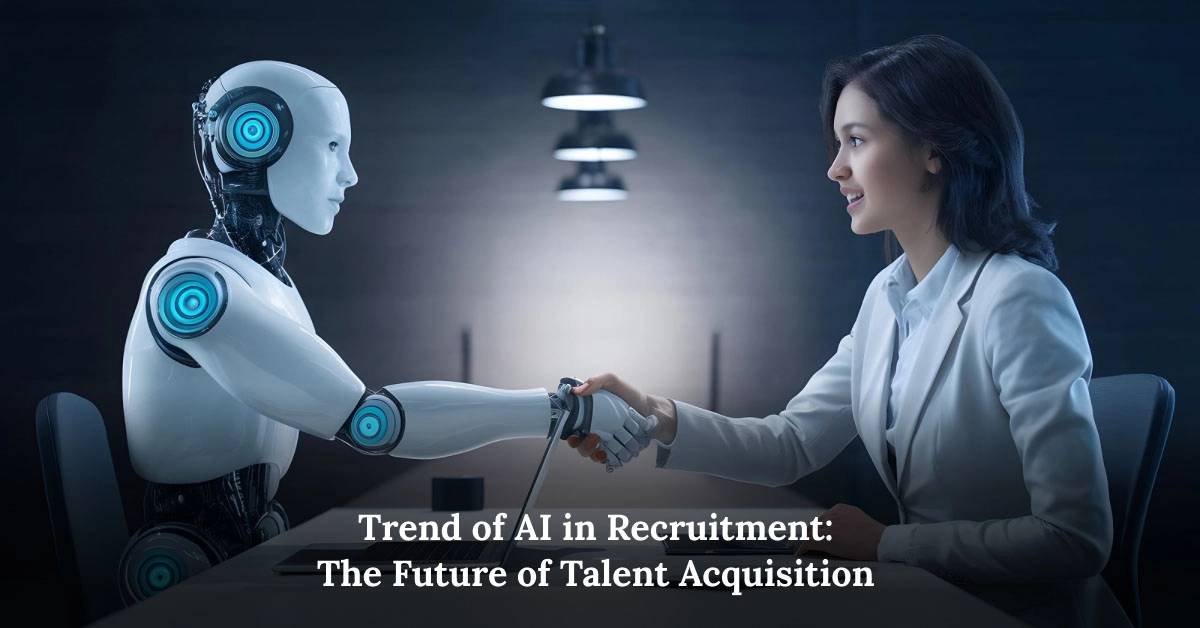
Just imagine many years back, the way HR people were doing a whole some resumes screening and sorting for a particular position, they need to fill up for the organisation. It was a gigantic act in true sense, to get the right one from thousands of applicants. Today, Trend of AI in recruitment has changed the entire game for the betterment.
Artificial intelligence (AI) in recruitment is transforming the industry by simplifying processes and boosting decision-making. AI in recruiting automates tasks like resume screening and initial assessments, reliving HR professionals to focus on more strategic activities’ beneficiary for the organisations.
It also declines time-to-hire by acquiring top talent more efficiently. In actual, 76% of HR leaders believe that, without deploying AI in hiring, in the next 12 to 24 months, they will be failing to gain the pace of the market.
AI has a great potential to change hiring and HR as it evolves.
Statistical Data about Companies Using AI in Recruiting
Artificial intelligence (AI) in HR is useful across all industry verticals. Till 2024, almost 8% of companies have started applying an AI-first approach for their recruitment and hiring, which is automating the full initial recruitment process from application phase to interview scheduling phase.
Apart from full automation, various organizations use AI to improve certain aspects of talent acquisition.
Just have a look on some useful AI use cases and their current market usage:
AI Use Case | Percentage of Companies | Description |
Sourcing and Engaging Talent | 39-40% | AI is used to find and interact with prospective candidates, building talent pipelines via employer-centric matching. |
Content Creation | 27-28% | AI is applied to make social media posts relative to recruitment, improving employer branding and outreach efforts. |
Data Analysis | 27-28% | AI is applied to analyse internal talent acquisition or recruitment data, to improve decision-making and strategy formulation. |
The combination of AI in hiring processes gives many benefits, adding increased efficiency, declined time-to-hire, and improved candidate experience.
For an example to refer, Unilever’s decision to implement (use) AI in recruitment declined their hiring(recruitment) process timeframe from four months to only four weeks. It was a great saving around 50,000 labour (man)hours.
Applying AI in recruitment is not a seamless journey. Queries for human biases, ethical work styles and the urge for transparency are frequent. Amazon removed their AI recruitment tool recently, due to its bias shown for female candidates.
To address such issues, organizations are inspired to implement powerful AI assurance processes and maintain human oversight to handle biases and make sure for the fairness in hiring practices.
Many professionals seek organised or designed ways to deepen their basic understanding of ethical AI and governance, with the use of learning platforms.
As AI’s role in recruitment is increasing with variable degrees of implementation across stages of the hiring process, it is necessary for companies to balance technical efficiency with ethical guidelines to make sure for a fair, effective talent acquisition.
Tips to Use AI in Recruiting
Trend of AI in recruitment is ever rising. Here are some practical tips for deployment of AI in recruitment strategy:
1. Identify Your Needs
- Identify areas of the recruitment process which can be improved by AI.
- Consider time-to-hire, candidate -quality, and cost-effectivity.
- Highlight areas, where big improvement is needed.
2. Select the Right AI Tools
- Research and use AI tools to meet your organisation’s typical requirements.
- Find or identify tools for resume parsing, candidate sourcing and predictive analytics.
- Consider the costing, easy for use, and integration abilities.
3. Train your HR Team
- Guide your HR Division on how to use the AI tools.
- Make sure for the knowing the pros and cons of AI.
- Inspire experiments and continuous learning to get the best AI results.
4. Start Small and Upgrade Slowly or Stagewise
- Begin or initiate with AI in certain areas e.g. resume screening or candidate sourcing.
- Track the results, followed by the required adjustments.
- Slowly improve the use of artificial intelligence for recruitment.
Benefits of Using AI in Recruitment
AI provides many advantages to the recruitment process:
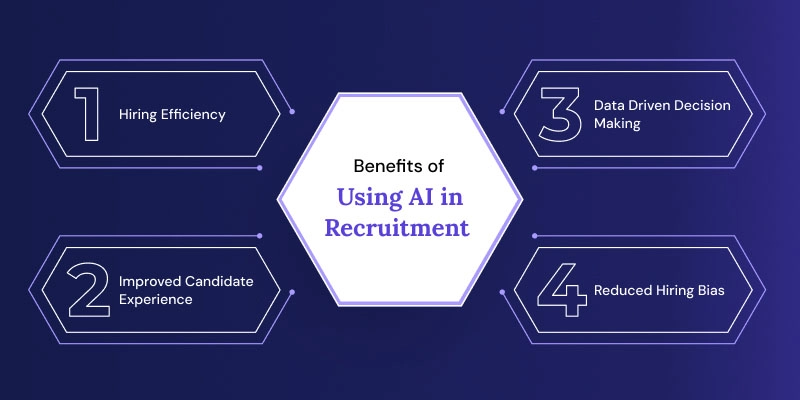
1. Hiring Efficiency
- Integration with AI automates time-taking resume screening and initial candidate filtering.
- AI in recruitment drops down the time to hire by accelerating the hiring process. A report by LinkedIn finds that AI has cut 50% of the time to hire and reduced resourcing costs to 70%.
2. Improved Candidate Experience
- AI can offer key insights, helping recruiters deliver more personalised and engaging candidate experiences.
- AI-powered customer support like can quickly and effectively reply to queries from candidates.
- As per a latest survey from Deloitte, it was found that 94% companies believe AI has a key use in HR. It enhances employee engagement, performance evaluations and hiring.
- It also removes candidate frustration and drop-offs with an easy and engaging application process.
3. Data Driven Decision Making
- AI recruiting tools use data analytics to identify top talent and predict the future performance.
- It offers useful information regarding hiring trends and workforce data analytics.
- Supports in making more valid decisions with fact-based data rather than gut feelings.
4. Reduced Hiring Bias
- It reduces unconscious human biases in the recruitment process.
- AI-based tools can screen applicants on skills and qualifications, and not any more on personal traits.
- It promotes diversification and right inclusion in the workplace.
Challenges for Ethical Use of AI in Recruitment
As AI is use is ever rising in recruitment arena, ethical use is also required.
Some key challenges are:
1. Bias and Discrimination
- AI algorithms can preserve biases in historical data. This takes to discriminatory hiring practices.
- As per a study, AI resume screeners favour men over women if they are same with qualifications. AI companies are trying to fix this issue certainly after the Amazon issue.
2. Transparency and Explainability
- AI based decision-making may hamper trust and accountability in case of no transparency.
- It is important to get well versed with AI algorithms and the way they are getting conclusions. This will help search and remove biases.
3. Data Security and Privacy
- AI-based recruitment tools will gather and process sensitive personal data. This raises concerns for privacy and data misuse.
- There must be powerful data protection parameters to protect candidates’ information.
4. Job Displacement and Economic Impact
- Certain hiring tasks automation is likely to replace or move HR professionals.
- We must polish and upskill the workforce. The AI-based recruitment landscape is changing.
Feel the Real Benefits of AI in Recruitment
Find elite talent before your competitors
Trend of AI in Recruitment Impacting on HR’s Decision Making
AI is changing over the process of talent hiring. Let us discuss here about some major trends those are influencing in making decisions for HR.
1. AI-based Candidate Sourcing
- AI tools can efficiently scan large data of resumes and social media. They find prospective candidates.
- This saves the time and work of HR staff in sourcing the perfect talent, via multiple avenues.
2. Automated Screening and Shortlisting
- AI-powered algorithms can scan thousands of resumes and applications quickly with the use of pre-approved criteria.
- This saves time and offers an unbiased, objective assessment of the candidate. As per the study, 72% of organisations see AI as a key edge in HR.
3. Chatbots or Virtual Assistants
- AI chatbots can handle initial candidate interactions. They can answer questions and offer required information.
- It enhances the candidate experience. It relives HR to focus on strategic tasks.
4. Predictive Analytics
- AI algorithms can analyse historical data. They may predict future trends in the job market and employee transition with ease.
- This assists HR teams to take data-driven decisions for workforce teams and hiring.
5. Ethical AI and Bias Addressal
- Organizations are preferring ethics in AI to conduct fair and transparent hiring.
- AI algorithms can be made less biased by representation of training data and diversification.
How Niyuk Impacts on HR Decision Making?
Niyuk is an AI-first recruitment platform made to liberate HR from the “administrative burden.” Through its platform of smart assessments and AI video interviews, it strengthens hiring managers to pivot from human screening to high-impact strategic decision-making.
Niyuk highly impacts HR decision-making using advantages of AI in recruitment:
1. Data-Driven Precision in Candidate Matching
Niyuk utilizes AI in recruiting to move beyond simple keyword searches. Its matching engine analyses limitless profiles, assessing skills, experience, and behavioural traits to make sure for a high-quality “objective fit.”
This removes the “gut feeling” bias that mainly found in traditional type of hiring, allowing HR to make decisions based on verified data or data insights over subjective resumes.
2. Accelerated Hiring Speed
One of the most remarkable Benefits of AI in Recruitment given by Niyuk is the drastic reduction in “time-to-hire.”
- Efficient Screening: Shortlists candidates within 24 seconds.
- Auto Logistics: Tracks interview scheduling and alerts, reducing the initial interview time by 60%.
- Faster Shortlisting: With the automation of up to 70% of the initial screening workloads, HR teams could focus fully on interviewing the top talent i.e. 5%.
3. Enhancing the Interview Lifecycle
Niyuk’s AI in hiring and recruiting tools include an AI Interviewer that conducts two-way conversations. Unlike static chatbots, asking follow-up questions based on candidate replies.
This offers HR managers with complete reports and technical scores before they meet the candidate, making sure that each human-led interview is a productive use of time.
4. Process Optimization
With real-time analytics dashboard, Niyuk gives visibility to the entire recruitment process. Therefore, HR leaders can track candidate drop-off points, review or check recruiter performance, and filter their hiring strategies, based on actual conversion data.
Comparison: Traditional Hiring Vs Niyuk (AI-based) Hiring
Find here a feature wise comparison between the regular-traditional hiring process and Niyuk’s Ai-based hiring process.
Check out as follows:
Feature | Traditional Manual Process | Niyuk AI-Driven Process |
Resume Screening | Manual review taking 1–3 mins for a CV; prone to fatigue and bias. | Niyuk.AI scans more than 500 resumes in 20 seconds with almost 95% accuracy. |
Candidate- Engagement | Delayed replies or “ghosting” due to recruiter workload. | 24/7 instant interaction via chatbots; automated status updates. |
Interviewing | Logistical “headache” of back-and-forth emails for scheduling. | Automated scheduling and asynchronous AI video interviews. |
Decision Basis | Mostly based on “gut feeling” or subjective interview notes. | Evidence-based scoring of technical and behavioural skills. |
Cost and Scalability | Costs increase linearly with volume (more hires mean more recruiters). | Flat-rate range; cost-per-hire lowers as volume raises. |
Key Advantages of Niyuk
- Bias Mitigation: One of the core Benefits of AI in Recruitment is the removal of human bias. Niyuk evaluates candidates strictly on skills and objective fit, ensures a fair recruitment process.
- Parallel Processing: In traditional hiring, candidates move in “batches” (screen all, then interview all). Niyuk allows for parallel evaluation, means a qualified candidate can move from application to an AI interview in minutes.
- Beyond the Hire: Unlike a standard ATS, Niyuk’s AI in hiring impact extends to employee management, helping HR track performance reviews and job roles within a secure dashboard.
- Global Reach: With multiple lingual support (more than15 languages), Niyuk allows AI in recruiting on a global scale, breaking down geographical and language hurdles that slow down traditional HR teams in normal situation.
Conclusion
The uses of AI have transformed the recruitment area. AI supports HR professionals make better decisions. It automates regular tasks, analyses bigger data, and makes insights from it. Anyhow, this approach must be hired with a human-centric perspective. Only after this, organisations can use AI’s power.
They must create diverse, high-performance teams based on ethics. As AI changes, we must find its potential and fix its limitations. We can then make a fair and more efficient recruitment process. By 2025, 60% of organisations will get a responsible AI framework for their HR technology, as per the Gartner Inc. report is saying.
It will enhance employee experience and trust in the organization. For more details and project requirements in AI in recruiting, you can mail your enquiry at: sales@niyuk.ai
Frequently Asked Questions
1. How is AI transforming HR decision-making?
AI is shifting over HR decision-making from subjective, intuition-based processes to data-driven strategies by automating daily tasks, predicting workforce trends, and reducing hiring bias. Key impacts are AI-driven talent acquisition, personalized employee development, proactive retention modelling and increased efficiency. It is allowing HR to focus on more strategic, people-centric initiatives.
2. What are the key benefits of using AI in recruitment?
AI in recruitment delivers fast hiring, improved candidate quality, and lower costs by automating redundant tasks like resume screening, sourcing, and interview scheduling. It improves the candidate experience with 24/7 chatbot support, eliminates human bias via objective data analysis, and gives predictive insights to improve workforce planning.
3. How does AI improve candidate screening and shortlisting?
AI improves candidate screening and shortlisting by using machine learning and Natural Language Processing (NLP) to analyse large applicant pools in seconds, dropping manual effort, improving efficiency, and cutting down on hiring bias. These tools instantly rank candidates based on their skills, experience, and cultural fit level.