How to Stop Cheating in Skills Assessment with Fair AI
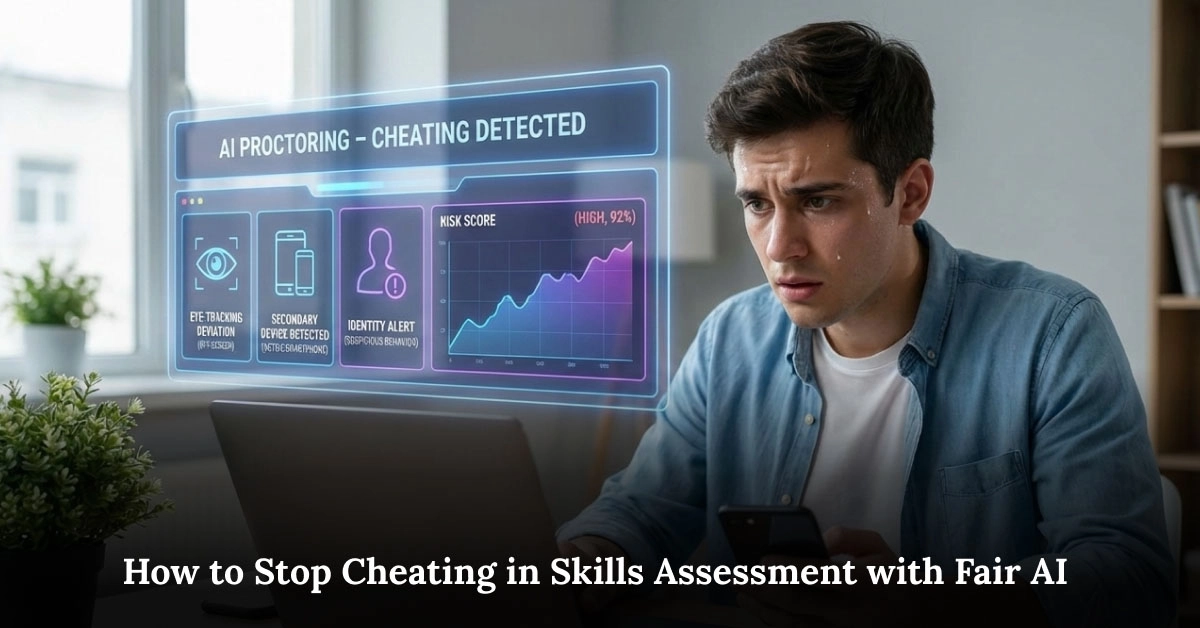
AI in HR has allotted many traits which are helpful to today’s HR people across all sectors going for hiring. Skills assessments with AI are one of them and it’s most important in the automated HR process for hiring and recruitment now.
Many recruiters prefer to conduct online skills assessments for candidates to save the time. But this also attracts dishonest behaviour of the candidate on his side. A false picture is offered to the recruiter by the candidate during this assessment activity, which he may not worthy of. ‘Honesty has become a personal virtue.’
So, to maintain the fairness in AI hiring, an effective method of conducting these skills Assessments is a must. This will help in the right hiring in the long run with trustworthy resourcing.
In this blog article, we are going to discuss the precise methods which will deliver fairness in AI hiring by conducting faired assessment practices.
At first, we will briefly elaborate about fairness in AI hiring.
Experience the Ace of Smart AI Hiring
Find your next top performer today!
What is Fairness in AI Hiring?
Assessment of candidates solely by their skills, performance and abilities is called fairness in AI hiring. It makes sure for the protection of personal information, demographics, background, or other biases don’t affect the candidate assessment.
Sustaining of a fair skills assessment process asks for transparency and equality during the actual testing. This shows that hiring mechanism will strictly work for all candidates for checking their standard and described criteria’s- if they are matching or not.
Every candidate needs to have the same platform. There is not a single chance for any candidate to do any malfunctioning or dishonesty during the skill assessment in remote. In fact, all candidates are given same conditions with same challenge to test the best one across them.
Any breach of trust by anyone of them, shows error in the mechanism. As a result, this will lead to the wrong hiring on false views or results shown.
Ways of Cheating in Online Assessments
There are 5 ways of cheating normally carried out by candidates during their online skills assessments. According to them, recruiters can put on the security checks to get fairness results.
Find them as follows:
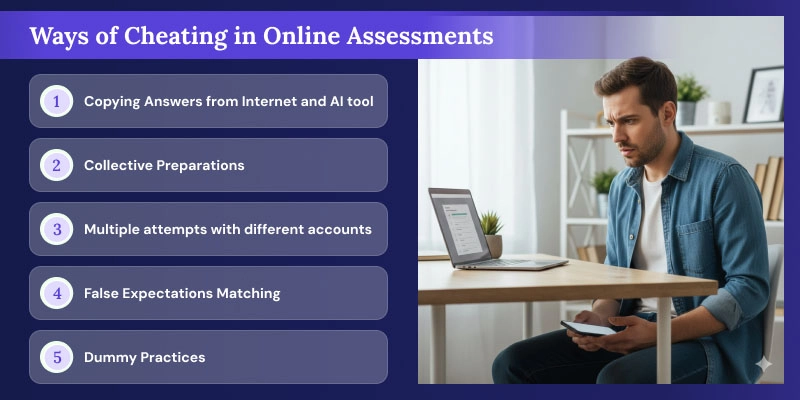
1. Copying Answers from Internet and AI Tool
Almost 22% of candidates giving online assessments have committed that they have cheated by using internet. Some of them used, almost 37% ChatGPT and remaining 71% used Google search results.
Search queries are the easiest way for them to cheat or rather copy the questions and get the answers from ChatGPT. This brings great results in less time. One can use the second device to do so.
Such answers seem too much right or technically perfect as an Identical answer to given question. The scenario becomes denser, when all candidates deliver the same answer, where an individual thoughtfulness is required while answering.
2. Collective Preparations
Candidates contact others with questions and get shared answers or find answers from earlier made answer banks. Candidates share questions upon giving test to their groups, communities or drives. These becomes standard sets of questions after certain time. This impacts on future tests whenever these questions come across, the candidates can perform far better than their earlier performance. This is also one kind of cheating for online skills assessments.
3. Multiple Attempts with Different Accounts
Candidates try to attain the test with multiple accounts for multiple times. For the first attempt they copy or try to get these questions. After that, they get answers for these questions.
After getting answers ready or well-studied, they try to attain the same test with different user account and try to outperform the test to make a successful performance. This breaches the fairness in hiring. This also leads to bad hires due to cheated performance holders getting the opportunity only because of wrongly achieved performances during hiring process.
4. False Expectations Matching
In this method, Candidates studies thoroughly the job descriptions about those job profiles they want to get placed. They also study the old, selected candidates’ data, information and other required details about the same. Then they manage the answers which recruiters normally pick or recommend as expected one. Any preparation in the right direction may not be called as wrong practice, still it becomes artificial all the times due to candidates’ style of responses.
Normally, such performances fail to show the required calibre or problem-solving. Even though they are delivering the perfect answers matching to the company’s expectations, they are not the right choice to hire for regular challenges and situations to handle for the prescribed JD.
5. Dummy Practices
This is an important and direct fraud method in today’s age of AI based skills assessments. A candidate can hire a person, close friend or any talented third party to appear for the test with his name or identity. This person normally cracks the ai assessment criteria. But they refuse to show their identity visually. This is really a bad professional practise leading for the cheating and doing injustice to the fairness hiring approach and strategies of any organisation.
End Effects of Cheating on Hiring Results
More than 60% of hiring managers have confirmed that many candidates are using Gen AI to give online assessments. This kind of cheating directly affects the quality of hiring. Below are the 3 effects recruiters see due to cheating by candidates during assessments online, leading to bad hiring, affecting fair hiring.
1. Inaccurate Results
This is direct result of hiring a bad resource who is not having accurate skill sets described in the JD. The candidate has hired wrong practices to pass the assessment online, not showing his real capabilities and even do not getting the information about whether he can handle the desired job or not. Wrong hires lead to hiring errors. This also gives early exits as well as declining the team performance. The wrong hires also build up recruitment costing due to frequent or uneven turnovers. These all are long term bad effects.
2. Breach of Trust and Candidate Experience
As cheating becomes the regular exercise, the candidate gets lost in mid of the process or so as well as recruiters also start losing interest. They feel like losing confidence on their data reliability leading to more chances for hiring with compromises on candidate qualities and skills. Candidates feel stressed due to competition with wrong practices doing candidates. This more takes up to tarnish the employer brand image as well as loose of faith on transparency and merit acclamation or appreciation. The genuine candidates stop applying for such brands.
3. Waste of Resources and Hiring Time
Due to more dishonest candidates keeps incoming in the process, leads to consuming more recruiting time, lowering time-to-hire, more time on checking results, interviews, many times rehiring happens. This leads to a complete wastage on resourcing due to wrong hires and increasing hiring time, as well. This also fails the use of AI based tools for hiring.
Upgrade your Recruitment Stack.
AI-powered assessments that reduce hiring risk.
How to Stop Cheating During Online Assessments?
You can always prevent cheating and wrong hiring due to it; by implementing AI tools like Niyuk and anti-cheating system features with working on fairness principles. This can reinstate bias-free hiring with quality and merit-oriented placements for organisations.
Here we are discussing certain ways to avoid cheating as per given them below:
1. Randomized Questions
Similar sequence of questions brings the predictability of certain answers. This makes easy path for candidates. This may result in copying of questions for further attempts as well as sharing for their solutions.
This leads to systematic fraud during online assessments by some candidates.
This is possible to remove by randomizing.
Randomizing means randomly arranging the question order, rotating answer options, or making little variations in scenarios making sure that no two candidates get the same version of an assessment. With this action, rehearsed answers become useless for further tests.
2. Assessment Variety
Mixing question formats like multiple-choice questions, text, presentation, or spreadsheet fails predictions or make search queries much more difficult.
Variety in skills assessments types expect for multiple skills from candidates to demonstrate in many ways. And this is tough to copy or search for solutions. This encourages recruiters to test all abilities of all candidates, and for candidates, to show their logical thinking in every question’s solution.
3. Monitoring Tools
Proctoring suspicious behaviours during the online assessments by candidates is possible now. With latest AI hiring tools like Niyuk, proctoring features track candidates without being invasive with checking tab switches, their unexpected movements, or imitated answers.
Common examples add light monitoring via occasional screenshots without intimation or AI-driven plagiarism detection.
The screenshots give you a complete view of candidates’ screens, inserting any tabs with Google or Generative AI searches. On the other side, plagiarism detection scans all responses across thousands and raises flags for any copy of answers.
4. Creative Assessments
Real, job-driven tests skip any possibilities for shortcuts. Task based activities will show the real skills for each candidate, easy to assess the real talent. Avoid check box styling or easy options answers.
For example, a sales candidate could write an outreach email, or a developer could debug short code. These creative, scenario-based tests will decline cheating opportunities, also will make the process engaging for candidates.
5. Using Fair, Bias-Free Software
Software’s allowing hiring bias, poor transparency, and unreliable features makes a foundation for cheating manipulated results. Smarter AI hiring tools must possess functional anti-cheating measures like automated plagiarism checks, geolocation tracking, and one-attempt limits.
Also, it must integrate these features with complete assessments and performance-based grading system to assure precise, bias-free hiring results forever.
How to Select Fair, Cheating - Less AI Hiring Software?
With many AI hiring tools available in the recruitment market, it can be tough to highlight exactly what you need from it. To select a fair AI hiring software, transparency, non-cheating and with proctoring features, you can consider below factors discussed herewith:
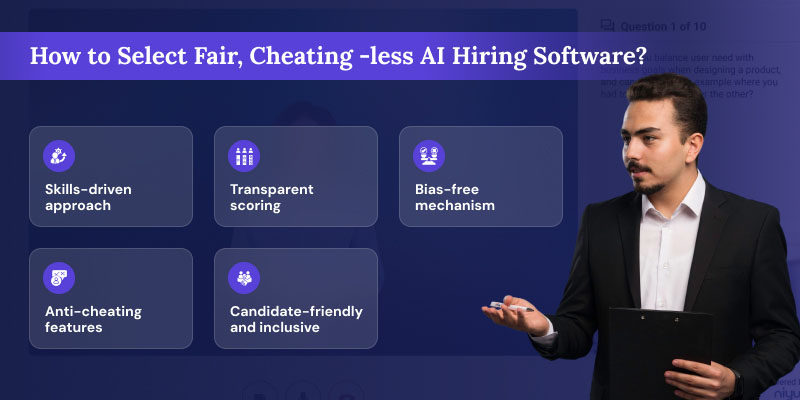
1. Skills-Driven Approach
The core principle in fair hiring is pure ability testing. Irrespective of resumes or academic backgrounds, skills-first software prefers to assess candidates purely on their performance in job-suited tasks reflecting real scenarios.
By selecting software with this approach, you offer a fair playing field for all candidates, regardless of their history, education, or connections.
Because of this, you can prefer hiring for true potential candidates, and those who demonstrate they can do, over what their resumes or credentials are telling. Over the period, this makes strong, more diversified teams with fair performances.
2. Transparent Scoring
Transparency in the scoring gives a quality result among all deserving candidates. You can set the right scoring criteria in fair ways. The clarity in scoring criteria improves the standard of hiring overall.
This clarity makes sure that hiring managers and candidates may view the link between performance and result. When candidates understand your assessment parameters, fairness becomes calculative and justified.
Transparent scoring helps in driving data-driven decisions with past decisions review in hiring for the future, giving directions to recruitment managers about right assessment standards and hiring quality. This inspires them for a healthy and quality recruitment strategy.
3. Bias-Free Mechanism
AI may also give biased decisions if it is not trained and tested properly. A truly fair hiring platform like Niyuk emphasis more on performance data only over demographic or background details.
The algorithm must regularly fine tune its selection patterns for aligning with your defined success profiles, making sure for the relevant and accurate recommendations. No candidate should be discriminated because of attributes like age, gender etc. And this must be taken care of.
4. Anti-Cheating Features
Security and fairness go together always. The perfect AI hiring systems takes care of both- talent picking approach with proper level of surveillance of all candidates. This includes features like time limits, randomization, locations tracking and plagiarism detection.
Balance is highly required. Fair AI must retain the assessment integrity along with overall candidate experience.
With effective but invisible security arrangements, the system becomes popular for both where sincere applicants feel confident, assured and recruiters can trust that each result shows genuine effort for the same.
5. Candidate-Friendly and Inclusive
In a fair hiring process, each candidate can comfortably access and do assessments. This practically converts to mobile-friendly platforms, intuitive interfaces, with accessibility oriented and designed assessments.
Specific instructions, comfortable timing, and compatibility with supportive technologies together creates a great candidate experience. Also, you must take note of how the platform check on assessments to make sure for inclusivity.
When tasks cover different styles and variable communication, candidates feel engaged and honoured. This takes up for the authentic participation, more perfect insights, and strong long-term hiring results building on trust and equity.
Smarter Assessments. Better Hires.
Evaluate skills, aptitude, and job fit instantly.
Conclusion
Cheating in online skills assessments gives inaccurate results, shakes trust, and spoils precious hiring time. To assure that you make each decision solely on skill, and for a fair assessment, you need a fair, safeguard assessment platform.
Niyuk.AI features a decent, multi-layered AI Proctoring suite designed to remove cheating and makes sure for the integrity of each hire. It moves beyond simple recording by use of active, real-time intelligence to track candidate behaviour.
Niyuk.AI’s proctoring suite serves as a robust cover for remote hiring, mixing real-time AI surveillance with deep behavioural analytics to assure assessment integrity. By automating identity verification and instantly flagging suspicious activities like tab-switching or unauthorized assistance, it changes high-volume screening into a safe and hands-off process. This makes sure that each candidate is assessed on their real merits, protecting your company’s standards while always improving your recruitment ROI.
For more clarifications and utilising of anti-cheating features with Niyuk implementation, you can catch our teammates by writing a mail on: info@niyuk.ai
Frequently Asked Questions
1. Can AI detect cheating in online assessments?
Certainly. AI can smartly detect cheating in online assessments by monitoring behaviour, technical signals, and anomalies content, using tools like webcam proctoring. Platforms like Niyuk.AI adds a robust, multi-layered proctoring system specifically designed to detect and avoid cheating during online assessments. It uses a combination of visual, audio, and environmental controls to make sure for the integrity of the hiring process.
2. How does biased AI affect hiring decisions?
Biased AI in hiring preserves discrimination by learning from historical, biased data, leading it to unfairly filter out multiskilled, qualified candidates on the basis of gender, race, or background, making systemic inequities, damaging reputations, going for legal issues, and ultimately declining talent pools, also causing human recruiters to reflect the AI’s skewed choices.
3. Can AI assessments replace interviews?
No, AI based skills assessments are not at all replacing human interviews; Rather, they are transforming the process by handling initial screening, offering objective data, and automating tasks, enabling human recruiters to entrust on deep cultural fit, empathy, complex problem-solving, and relationship-building.