A Complete Guide on AI in HR (2026)
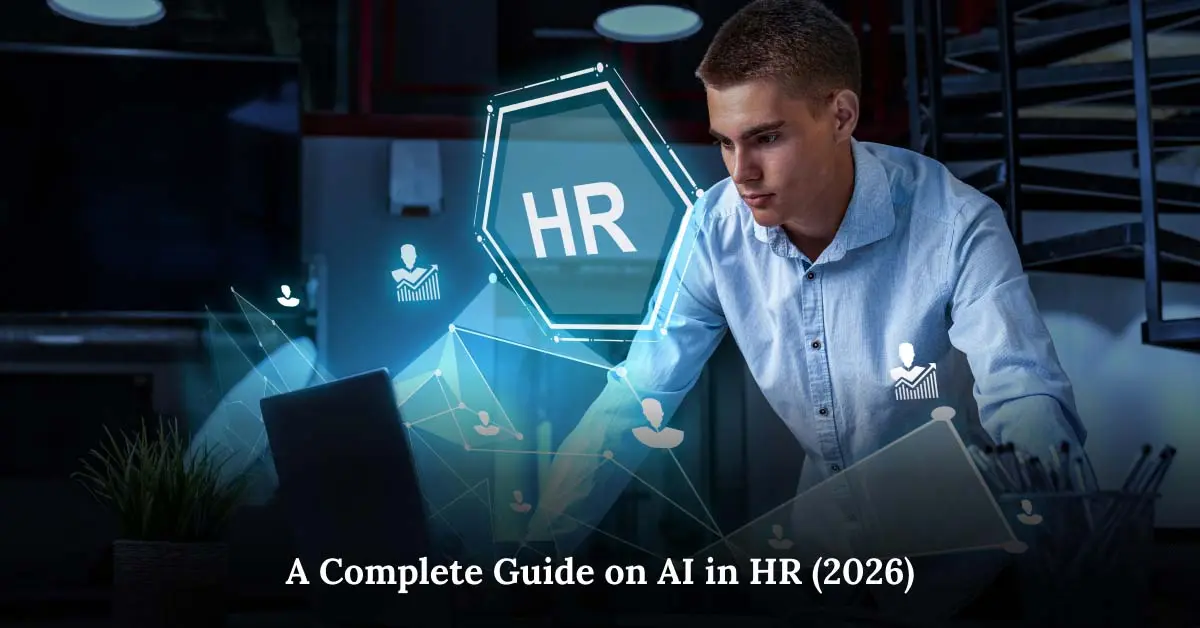
AI automation is the new buzzword in today’s corporate recruitment arena. AI is not an instant result giving object or process, but the concern organisations must set an environment for the same and must adept it as per the requirement and suitability in due time. AI in HR has developed in recent months from Application Tracking System and resume screening solution to Advanced solution covering the entire process of recruitment –from screening to final selection without any human bias.
As AI keeps on changing, it comes up with new challenges and opportunities also. The skills updating is a vital part to adept it.
Artificial intelligence (AI) in HR is referring to the use of technologies like machine learning (ML) natural language processing (NLP) as well as predictive analytics to help automate and do HR tasks which need a human decision, in specific.
AI in HR also allows data-driven decision-making for training, retention, and manpower planning while helping to lower bias and enhance the experience for both candidates and employees.
AI used in HR can be applied on various levels, with individuals, the HR team, and the organization, with various benefits and risk levels.
For instance, at the individual level, AI helps to save time and improve quality with low risk. At the team level, AI complements current skills, joining to improve workflows and processes with highly complex but calculating risks. At the enterprise level, AI helps large-scale decision-making affecting the business strategy. The stakes and potential risks are much higher in this.
Artificial intelligence (AI) in HR simply means the technological usage of machine learning (ML), predictive analytics, and natural language processing (NLP) to support automation, conduct HR tasks typically improving human decisions / judgment.
HR practitioners and teams can use AI to ease recruitment, payroll, and benefits administration, write policy documents and contracts, and offer real-time HR support to employees.
It also allows data-driven decision-making for training, retention, and workforce planning while assisting to drop the human bias and improve the experience for – candidates and employees.
AI can be applied on various levels, with individuals, the HR team, and the organization, with multiple benefits and risk levels.
For example, at the personal level, AI supports to save time and improve quality with low risk. At the team level, AI complements current skills, collaborating to improve workflows and processes with more complex but manageable risks.
At the enterprise level, AI supports large-scale decision-making that impacting business strategy, but the stakes and potential risks are much higher.
AI has different subsets and types, each with varying purposes, and can be used to complete or support a range of tasks.
Various Types of AI in HR
Find here several types of AI in HR and for what they’re used for.
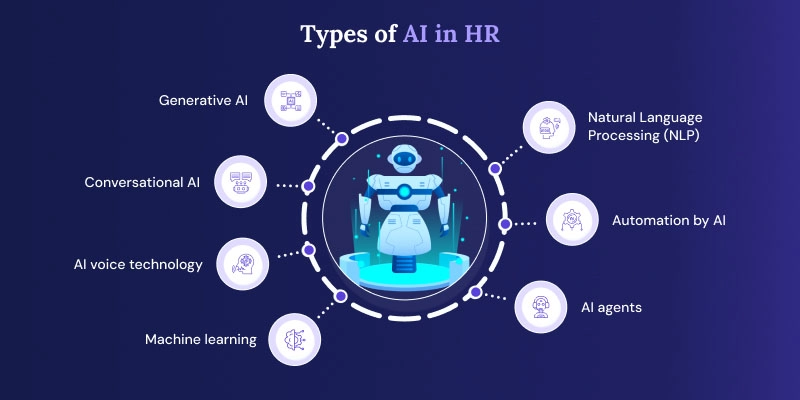
1. Generative AI
Generative AI applies large datasets to create a new content, like text, images, and video. HR practitioners may use it to make personalized candidate outreach, craft job descriptions, create learning materials, and assist with workforce planning by giving insights into tedious data sets. Some extensively used generative AI tools are ChatGPT, Copilot, and Perplexity.
2. Conversational AI
HR chatbots and virtual assistants based mainly on Natural Language Processing (NLP) helping HR teams to cater instant, 24/7 support for employees and candidates. These AI tools can answer HR policy questions, guide employees via benefits enrolment, offer individualised learning references, and engagement boost by making HR more accessible.
3. AI Voice Technology
Virtual HR assistants like Grace use AI voice technology to give or access 24/7 support, control inquiries, and escalate more concern issues to a real person, improving the complete rely to timings and accessibility.
4. Machine Learning
Machine learning enables AI to learn from data and improve by time. In HR, it can offer information update about employees who might be leaving, matching candidates to jobs, and recommending right salary ranges.
Some machine learning models are trained with certain examples (supervised learning) to make predictions, like whether a candidate is a good fit for a role. Others find patterns in big datasets without any prior instructions (unsupervised learning), helping HR reveal trends like why certain teams has got high turnover.
5. Natural Language Processing (NLP)
A type of AI helping written and spoken languages and may be helpful in HR to monitor employee surveys and sentiment in feedback, performance reviews, and interview workouts. Searching trends in employee sentiment allowing HR teams to address workplace issues reactively.
6. Automation by AI
Automation by AI helps HR teams outsource redundant, administrative tasks, like screening resumes, processing payroll, and tracking compliance. This drops the human error risks and improves accuracy and efficiency.
7. AI Agents
An emerging type of AI where autonomous systems can also act, making decisions, and do HR tasks with minimum human roles.
In HR, AI agents may proactively track employee performances, suggests career development prospects, plan learning programs, guiding new hires via onboarding processes.
AI is reshaping HR by making processes smart and fast. From analysing manpower data trends to improve talent management and employee development, AI is helping HR teams work smartly while improving the employee experience.
Either It’s automating routine tasks or supporting business decisions, AI is becoming an important tool across the employee life cycle.
Let us check out how HR departments are applying AI in practice.
Stop Wasting Time on Manual Screening
Best AI tools for HR revolutionize your hiring
Simplifying Recruitment and Hiring Practices with Intelligent Automation
Recruitment and hiring were certain areas where AI was used to improve processes. Also, AI has been incorporated into many parts of the recruitment process, from sourcing and pre-selection to interview and develop fair compensation.
For example, AI-driven applicant tracking systems (ATS) can be used to scan resumes to find key qualifications and match candidates to job descriptions.
Some AI tools or platforms like Niyuk is useful in recruitment function. HR professionals may use ChatGPT or AI for several tasks of the hiring process stagewise, including:
- Job descriptions (JD’s) writing and job postings
- Boolean string generation
- LinkedIn posts
- Providing pre-interview briefings to candidates
- And much more.
AI’s Role in Recruiting: Prompts for Every Stage of the Hiring Process
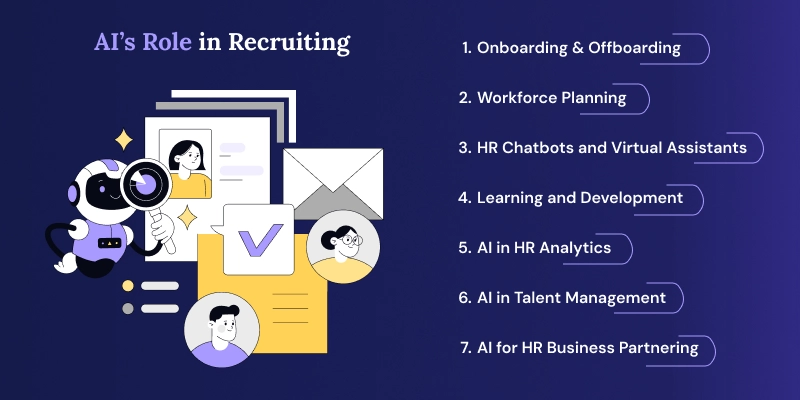
1. Onboarding & Offboarding
Efficient employee onboarding can improve retention with 82%. AI-driven onboarding platforms can support organizations and their HR’s in making an engaging experience for their employees by assuring the required forms are filled in, right policies are shared, and training sessions are scheduled.
Offboarding is no different. When an employee departs from the company, an AI-driven solution can, for instance, send out an exit survey, documents related to the return of company assets, and emails to revoke the employee’s access to many systems. Some software’s do provide notifications of employee leaving company, exit interviews etc.
2. Workforce Planning
AI can also be useful in workforce planning. Analytics platforms driven with AI can use vast amounts of employee data to unzip trends, predict turnover, and show potential skills gaps. In turn, this allows HR professionals to make targeted training programs and solid succession plans, so that their workforce is ready to meet future business needs.
For example, has created an AI-powered forecasting and automation solution letting companies analyse thousands of data points to anticipate peak and down periods in demand and automatically plan the exact number of employees they need.
3. HR Chatbots and Virtual Assistants
Chatbots and virtual assistants are including in the more commonly known types of artificial intelligence in HR. A chatbot serving as an HR assistant can reply 24/7 to employee queries about, for instance, leave policies and benefits.
These easy tools may improve an organization’s entire employee experience while saving HR teams from answering frequently asked questions or offering commonly requested information.
Some companies have developed chat, AI-driven agents supporting HR teams with many processes, adding recruitment and onboarding, compensation & benefits, and admin tasks.
4. Learning and Development
There are various applications of AI in learning and development. For example, AI can permit personalized learning experiences for an employee. AI tools can measure or track the learner’s performance and use the curriculum or content to their needs and preferences.
Other examples are automated learning content creation, predictive analytics, and smart systems for teaching. It has developed an AI system that can individualise the learning experience for teams. It indicates learners’ profiles, preferences, and activities and gives employees customized course recommendations to map their unique needs and interests. The tool has AI-driven chatbots offering learning support.
Use Niyuk for AI Automation in HR Processes
Transform your HR department with the best AI tools for HR professionals
5. AI in HR Analytics
AI in HR analytics giving facilities to organizations to collect and analyse large data sets for employee performance, engagement, turnover, and culture, searching for the key improvement areas. This gives businesses way to make more informed data-driven decisions for the management of their workforce.
For example, AI can support HR predict turnover by analysing earlier exits, performance trends, and data sentiment. If patterns indicating employees lacking mentorship are more likely to leave, HR can filter out its retention strategy by starting planned mentorship programs or career growth plans.
AI can also help with compensation benchmarking by analysing industry salary data and internal pay structures to make sure competitive and equitable salaries. That way, HR teams may address, pay gaps and improve retention by offering best compensation packages.
ChatGPT has also emerged as a utility AI tool for people analytics, allowing HR teams to process data, summarize trends, and suggest key insights without needing coding or latest technical skills. Several generative AI tools, HR professionals can identify patterns and make decisions based on data, all without depending on data scientists or tough analytics tools.
6. AI in Talent Management
AI is enhancing talent management by creating performance tracking, career development, succession planning, and retention strategies more accurate and data driven.
For instance, AI-powered performance reviews are becoming popular. These tools help to decline bias by finding patterns in feedback, track progress against real-time KPIs, and create clear, objective summaries from various sources. Managers benefit from prompts and insights improving the quality, consistency, and fairness of their feedback.
Career growth and internal shifting / mobility are also AI in HR use cases. Some Platforms prefer internal job opportunities, mentorship pairings, or upskilling programs because of an individual’s experience and aspirations.
This supports HR in matching the employees with growth opportunities colliding with personal career goals and company needs.
HR departments can monitor performance with real-time data, personalize career development, find future leaders, and addressing retention risks reactively – all leading to a more engaged, strategically managed workforce with the integration of AI in HR.
- AI-Based Coaching
AI-based coaching is a technology-driven coaching process uses artificial intelligence to offer individualised feedback, guidance, and development support to employees. - AI-Supported Coaching
It uses AI- assessments to test skills and knowledge and AI-driven tools providing information to the real-life coach to improve the mentoring relationship. This creates the coach more effective and quality improvement of the coaching sessions. - AI-Augmented Coaching
This type allows coaches to use AI-based tools between sessions with their human coach, promoting further development, offering continuous coaching, and making the coaching process more scalable than traditional models. - AI-as-the-coach
This makes students only engage with AI, and they have limited or no interaction with a human coach. This process makes coaching more accessible and scalable.
7. AI for HR Business Partnering
As generative AI evolves, it will enable HR professionals to successfully join HR objectives with the strategic objectives of the business.AI has mainly been used to automate redundant, routine HR tasks, its quality expands far beyond basic automation to support more tough, strategic HR functions.
To maximise AI’s impact, HR professionals must develop analytical and digital skills to interpret AI-based insights and integrate them into business discussions. AI boosts decision-making, but HR remains crucial in making sure that strategies are public-centred and joined with organizational goals. Smartly using of AI enables HR to become a real business partner, directly making workforce strategies driving success.
AI in HR: Challenges
AI’s prospect to transform HR is undeniable. It comes with notable challenges. Knowing these challenges is key to use AI wisely and smartly at the workplace.
Let’s take a deep look here.
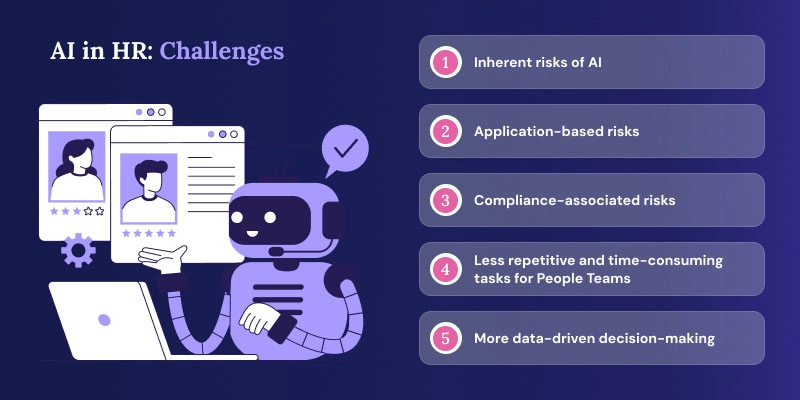
1. Inherent Risks of AI
AI technology comes with direct risks stemming from how it functions, its abilities, and its limitations. These include bias, fairness risks, if the technology has been trained on biased data. This may lead to non-fair decisions in the hiring process and performance evaluations, getting to legal risks and a less added workplace.
Some AI systems cannot have transparency related to decision-making, which can make a lack of trust between candidates, employees, and HR, and decisions become toughest to get in legal contexts. When left to function independently, AI technology may behave unpredictably, which resulting in uneven hiring decisions and talent mismanagement.
2. Application-Based Risks
Application-based risks are arising from the use and application of artificial intelligence systems. In other words, how the technology is applied and controlled by humans using AI. This sums up when AI makes options aligning with your company’s values / ethics, which can negatively impact your company culture and lower down morale and trust.
In actual, there is a proper coordination to be found between AI-driven tools use and using human insights, empathy, and emotional quotient. AI dependence in HR can damage business relations with its manpower and makes bad decisions.
3. Compliance-Associated Risks
Compliance-associated risks arriving from the legal standards companies are needed to sticked to, specifically with data protection and employment laws. AI shows several risks, involving data privacy violations when sensitive employee data is being collected, used and stored, discriminatory results and upholding some laws requiring organizations to document how their AI systems function and how they take fair and legal decisions.
Failed to manage these risks resulting in legal fines and challenges, reputational damage, and the breach of trust between candidates, employees, and the organization.
4. Less Repetitive and Time-Consuming Tasks for People Teams
AI may be served as a smart digital assistant doing automation of manual, time-taking HR tasks (desk support, scheduling meetings, creating documents, etc.), releasing their precious time for important work driving the business ahead.
HR professionals could focus on making much more positive, welcoming workplace where each one feeling appreciated, leads to greater efficiency and growing the culture with powerful human connection.
5. More Data-Driven Decision-Making
AI aids HR identifying top talent in their workforce, remove skills gaps, anticipate turnover risks, and smartly manage talent for the future. With this knowledge, HR may prepare and plan for most outcomes and adjust talent management strategies based on the organization’s current requirements and long-term objectives.
There are many AI based tool available today for generating text and other content formats.
Go through below mentioned examples of how personal HR workers can use various AI tools in their routine work:
- Handling Routine HR Questions: HR teams get the same questions again from workers about rules, perks, time off, and pay checks. Tools like Google Gemini also handles each one fast, skipping slow manual notes. They draft routine replies with it or build an inside bot for quick answers to usual HR asks.
- Writing of HR Documents: Well, AI automation speeds up HR paperwork. It aids pros in crafting job ads, offer letters, review forms, policy tweaks, and memos quicker. For instance, share key facts with AI tool. It creates a clear job ad draft. They check it and adjust with little effort.
- Supporting Process of Hiring: HR people or system users can use some AI tools like Niyuk to analyse job descriptions for any biased language, to prepare interview questions based on role requirements, and summarizing candidate resumes to excel screening process. This could help recruiters to focus on talent assessment over consuming more time on administrative tasks.
- Simplifying HR Data Analysis: HR professionals may use AI platforms like Niyuk to summarize from employee surveys, performance reviews, or exit interviews from larger volumes of text. Suppose in place of reading several exit interview transcripts, HR can get common causes for turnover and suggest major improvements to display from some leading AI platforms or tools.
- Communication Improvement with Employee Engagement: HR professionals can utilise AI tool or platform to make clear, engaging emails specially for company initiatives, policy changes, or engagement programs. It can also help in innovating new ways to improvise employee satisfaction, suggesting ideas for a recognition program or preparing pulse survey questions for collecting feedback.
AI Takes Over the HR
61% of business drivers believe that HR will be taken over by AI in the future as per the research report of Personio. Many of the employees in such roles share their doubts. Does it attract facts or it is just a confusion on HR teams’ side, as they are not clear about the role of AI in HR still?
As per discussed, HR is transforming already and will continue. AI tools really develop, and they are also used in a finest way across HR processes. With out any doubt, AI will be a vital asset that reduces repetitive tasks, but it will not be capable of retaining the real relationships and personal connections which HR team’s do normally.
Jobs mainly of remarkable, easy, repetitive, administrative tasks are likely to be automated. But roles needing more issues-resolving and human interactional – which are HR roles, are not much likely to be automated.
Find here some of the most common HR roles nailed down into 3 major categories from high-risk to low risk:
- High-Risk: HR Administrators, DEIB Consultants, and Payroll Team Leads.
- Moderate Risk: L&D Specialists, HRIS Analysts, and HRBPs.
- Low Risk: Senior HRBPs, HR Specialists, and Data Scientists.
*Remark-Can not change these 3 points.
For HR professionals possessing the high-risk category, there are a few of steps you can take to prepare yourself a more valued asset, with upgrading of yours or broadening your skills, learning for applying your skills in many contexts, and consider moving into a role needing more critical thinking and problem-solving skills.
Change your Recruitment Game with niyuk.ai
From recruiting to retention, see how AI tools used in HR
The Future Scenario: HR Job Automation After 10 Years
HR is going to become more vital to the business, even though adoption grows in coming years. The fact is 73% of business leaders believe in this. The reason is, as the repetitive, low-value tasks are taken care of, HR teams will be available for focussing on more business-critical matters, making a great workplace culture, increasing employee retention, and working with business leaders directly to meet long-term company goals.
So, it’s important that HR teams start showing their worth to the business leaders, and equally it becomes necessary that business leaders invest time in knowing the value HR offers. Every organization is driven by its workforce, this indicates that people are your highest valued asset, and HR’s prime focus is on building and developing relationships with these people.
Merits and De-Merits of Using AI in HR
Merits | De-Merits |
Productivity improvement | High initial cost |
AI automates redundant tasks, freeing HR staff to work on strategic activities. | AI systems can be expensive at start for companies |
Boosted candidate screening | Data quality dependency |
AI can quickly sift via resumes and find the best candidates. | AI effectiveness relies on the data quality on which it is trained. |
Well-structured processes | No human touch |
AI simplifies processes like onboarding and offboarding. | Over-dependence on AI can drop personal interaction in HR processes. |
Companies may make data-driven decision-making | Bias prone |
AI gives insights & recommendations on data analysis base. | AI can perpetuate current biases in data. |
Bias reduction | Tedious in implementation |
Drop unconscious bias in hiring decisions. | Using AI solutions can be tough and requires expertise. |
Personalize employee experiences | Security & Privacy concerns |
AI leads to high candidate (employee) engagement. | Handling of sensitive employee data by AI can cause privacy concerns |
Niyuk: AI Tool in HR
Niyuk is an AI-based recruitment platform for HR teams created to automate the hiring process for them and recruitment agencies and companies. Prime features are around intelligent automation, AI Resume Screening automatically scans, ranks, and matches candidates to job requirements, saving of recruiter time significantly.
It offers Automated Video Interviews and AI Assessments (adding over 100 curated role-specific tests) that objectively assess a candidate’s communication, technical skills, and complete fit, supporting to drop bias and improve the hiring quality.
Apart from screening and assessment, Niyuk possess an Applicant Tracking System (ATS) / Recruitment CRM to centralise job openings, track candidate pools, and automate communication like sending updates, interview invites, and feedback automatically. The platform’s core benefits include a heavy decline in Time-to-Hire and Cost-to-Hire, improved accuracy level in selection, and the ability to make data-driven hiring decisions via customizable real-time analytical dashboards.
Additionally, the tool automates screening and evaluation, HR professionals must assure that human oversight remains for final hiring decisions. Use of AI as an informed advisory tool and not as a replacement to human judgment.
Regular training and monitoring are necessary to guarantee for the data feeding by AI is clean, current, and used responsibly to maintain the high quality and fairness of the hiring process.
Why to Use niyuk.ai in HR?
- Automation by AI: Automates resume screening, shortlisting, and interview scheduling processes of HR.
- Time Savings: Niyuk .AI Reduces70% of time spent on human screening and administrative tasks.
- Improved Quality: niyuk.ai uses AI and predictive analytics for the most accurate candidate matching.
- Human Bias Reduction: niyuk.ai offers objective, fair assessment in initial screening.
- Fast Hiring: It remarkably reduces the time and cost-to-hire.
- Data Insights: Gives data-driven dashboards for hiring performance.
- Improved Experience: niyuk.ai assures for a smooth, automated candidate journey with timely communication.
Conclusion
AI in HR goes beyond a passing trend. It changes the core way HR operates. AI boosts automation and improves tasks. This lets HR staff drop routine admin work – like scanning resumes, booking meetings, and basic policy questions. They turn to key strategic roles with real human touch.
HR AI tools deliver top speed and smart data insights across the full employee journey. That covers hiring, talent care, and staff planning.
This transition positions HR as a true strategical partner with the organization, smartly using deep data insights to make direct and informed decisions impacting business results.
For more details and automation in HR related queries, ask us on: info@niyuk.ai
Frequently Asked Questions
1. How is AI used in human resources?
AI in HR automates repetitive tasks (like screening, scheduling, payroll) and offers data insights, enhancing efficiency and strategy by individualising employee experiences, boosting recruitment via AI-driven matching, improving onboarding, analysing development performance, and maximising workforce planning, relieving HR to focus on human interaction and strategy.
2. What are the key benefits of AI in HR?
AI in HR improve efficiency by automation of tasks like recruiting, onboarding, payroll improves strategic focus for HR professionals, boosts talent management via data-driven insights for turnover prediction, skills gaps, individualizes employee experience like training, feedback. Also, declines bias in hiring, leading to best decisions, engagement, and overall business results.
3. How does AI improve recruitment and hiring?
AI improves recruitment by automating complex tasks (sourcing, screening, scheduling) via chatbots and algorithms, remarkably cutting time-to-hire, enhancing candidate experience with instant support, and reducing bias by focusing on skills, taking to better-matched, more diversified hires and freeing recruiters for strategic work.