AI Interview: How They Work and Why Recruiters Rely on Them
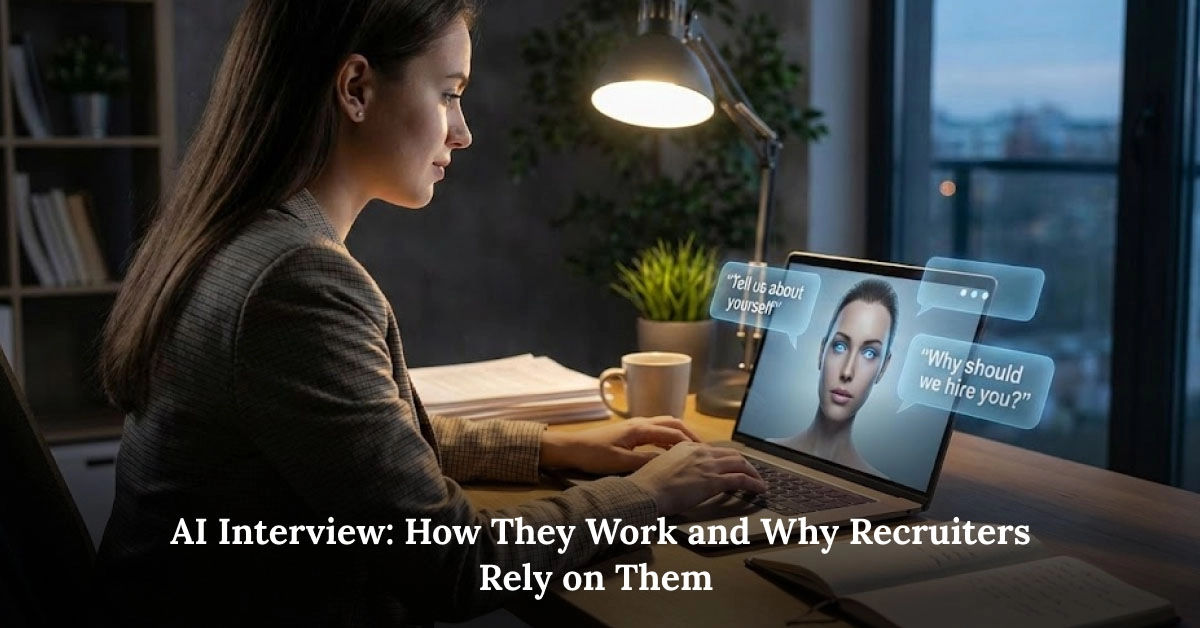
Artificial Intelligence has entered in every walk of human life today. In every domain, AI can outperform the given tasks in record time, saving optimum human efforts and time for those tasks. Especially, AI interview is a prospective story to share. Tasks like candidate evaluation, assessment along with AI interview can be automated with AI based softwares or platforms.
This not only reduces human bias, task redundancy and massive human resources with their dedicated time to accomplish these tasks but also offers quality hiring without any natural human bias.
A real top talent can be hired in a record time without wasting measurable time with zero human bias for any technical or non-technical domain for the AI using HR team.
In this blog, we will disclose all vital aspects about AI for interview in details.
Let us start with the core concept of AI interview i.e. what exactly it means?
AI Interview: A Core Concept
It is nothing but Interview taken with Artificial Intelligence technology or using AI for interview. Such interviews are arranged on real time and may be pre-recorded mostly based on conveniences or comfort of the candidate by automating the interview schedule.
This reduces the to and fro communication required before the actual interview. Also, AI can analyse speech, behaviour, language and tone of the candidate.
It can pre-evaluate the required eligibility criteria for the role in terms of qualification, skills and background verification check. AI helps in initial candidate screening. This reduces the natural human bias making the decision more consistent, best for the businesses.
The streamlining of entire HR process makes AI interview, an ideal tool for remote as well as bulk hiring for businesses using the same.
Why to Go for AI Interviews?
Today, as per latest data, almost 92% of the businesses are going for AI implementation. That may be for the overall processes of the business, which may lead to more time and slow ROI for it.
At the same time, going with interview AI in HR’s recruitment process takes care for the entire operations. Right from initial screening to the final onboarding process AI automates majority of the tasks. It also reduces the human bias, which is an issue in conventional or human based hiring process.
AI takes care for the skill assessments, candidate screening etc. And takes a lion’s role in saving the ultimate recruitment time. This is not all. It also helps in quality-of-hire by reducing time-to-hire. From goals setting to final selection of a right deserving talent is done by AI.
So, the AI Interview implementation has got fast and optimum ROI for those companies who have initialised it.
AI for interviews is the need of an hour.
Many businesses have realised this and have started implementing the same to faster their bulk and quality recruitment drives with minimum human intervention. The output possesses quality with ultimate money saving in the long run.
AI Interview Types
1. AI-Led Interviews
AI-led interviews are interviews fully run by artificial intelligence. This type of interview has human intervention free conversation.
It is interesting to check out how it goes:
- You need to join an interview link or app.
- An AI system asks questions to you. These could be text-type based or loudly spoken by an AI chatbot or a digital avatar selected.
The AI analyses your replies in real-time or after the submission, looking at:
- What have you said? (keywords, content)
- How did you say it? (tone, confidence level, clarity)
Sometimes it also catches your facial expressions or body language (if video-based).
After this, the system generates a report or scores that recruiters or hiring managers may utilise to decide your next step – or, in some cases, the AI itself moves you forward towards the next step of your recruitment journey or reject you automatically.
2. AI-Assisted Interviews
AI-assisted interviews are job interviews those are improved by artificial intelligence tools that support and not replace the human decision-making throughout the candidate assessment process. These systems are designed to simplify interviews, boost objectivity, and enhance efficiency without doing any sort of compromise with the human touch, which is equally important in hiring.
The process normally looks like this:
- AI acts as a co-pilot, helping the interviewer during the session. It tracks the interview in real time, recommends follow up questions, checks the interviewer’s performance and suggests ways to improve the same. Simultaneously, it checks candidate performance and helps generate “interview summaries”.
- Across both formats, AI analyses candidate replies – looking at oral content, tone, clarity, body language, and more. Then the system creates scores or recommendations to help hiring decisions.
- Additionally, AI can proctor interviews to make sure for the fairness and integrity via the process.
How AI Interview Works?
1. JD Indulgence (Job Description Indulgence)
The AI system starts by “reading” the job description offered by hiring manager or the recruiter. It applies natural language processing (NLP) to know what the role really needs:
- Which skills are required?
- What experience is recommended?
- What type of questions must be asked to assess a certain skill?
2. Skills Mapping
After job description indulgence, the AI takes out a list of must-have and nice-to-have skills. These skills would be technical (like “Python,” “SQL”) or soft skills (like “leadership” or “communication”).
This forms the baseline for which every candidate will be evaluated.
3. Question Generation (Q Gen)
At this stage, the AI prepares the interview questions.
Fixed Questions: These are standard questions (or set of questions) asked to all candidates. They are used for regularity and benchmarking – so everyone gets a fair opportunity to perform.
Example: “Explain a time you handled a tough stakeholder.”
Dynamic Questions: These are fully personalized based on the candidate’s resume. If the resume mentions project management, the AI will raise a question, “Tell us about a project you have led from scratch to finish.”
This mixture of static and personalized questions makes sure for both fairness and relevance.
4. Interview (Proctoring and Monitoring)
When the candidate takes the AI interview (mostly recorded video or audio):
The AI proctors the session to find out cheating or uneven behaviour (like someone else prompting or helping off camera).
It tracks the tone, speech clarity, eye movement, facial expressions, manual pauses, and confidence levels to collect behavioural signals.
It’s like having a “robot interviewer” watching and listening – without human availability.
5. Evaluation / Check
Once the interview is over, the AI reviews of the content of the candidate’s answers and the way they were added i.e. tone, pacing, and clarity. It interprets the data for the job requirements.
Recruiters get this structured output and can decide who to move further – without any need to see each interview from start to finish.
The same conversational AI is used in AI call center companies in India, where businesses emplace intelligent systems to handle support exchanges at scale.
Tired with First-Round Stress?
AI for interview conserves energy for best matches.
Benefits from AI Interviews
Let us enlist the entire benefits of AI interview. The entire HR process becomes fast and result driven. AI leads the HR automation with goal-oriented approach.
- Declined resume screening time: Recruiters can save numerous amounts of time in resume screening with the use of AI. The regular hiring process takes days or even months to do it. Because of this, the process remains inconsistent.
- Rapid time to hire: With AI, companies have declined average hiring timelines from 44 days to 11 days.
- Per candidate cost: Companies using AI you can quickly lower down the cost per candidate which is the hiring costs. This is screening cost.
- Bias handling: AI works on skills, keywords, not subconscious human biases supporting to promote fair evaluations and diversified hiring.
- Fast feedback: Chatbots and systems may promptly acknowledge applications or pre-screen results, enhancing communication and transparency.
- Hiring depth: Candidates may start or attain interviews anytime, anywhere making the process more accessible and handling many time zones.
- Cost saving: Organizations reports saving up to 87% of recruiter screening time, cutting agency fees, and dropping down vacancy-related losses.
- Boost in hiring quality: AI aligns candidate skills, experience more precisely.
It takes the best hiring results and reduced turnover.
- Standardization and consistency: Each candidate is scored using the same criteria. No personal feelings of HR person to mix.
- Global recruitment depth: Systems handle thousands of applicants globally with ease, making them best for bulk-volume or international hiring.
- Candidate experience: Quick scheduling and real-time updates lead to smooth, more respectful interactions – improving satisfaction and completion rates.
- Employer brand improvement: A latest, responsive hiring process reflects on your business attracting high-class applicants.
- Experience for recruiters and hiring managers: AI can assist recruiters by automation of regular routine tasks, lowering their administrative friction, and boosting the screening process. This simply means hiring managers incur less time in the earlier recruitment stages and able to concentrate on high-value decisions.
The full process becomes more simplified, allowing quick and more accurate hiring decisions.
Real-Time Use Cases of AI Interviews
AI interview is no more just future development. It reforms how companies assess talent across each stage of the hiring funnel. But the way AI is used is not suitable or common to all. Relying on the industry type, position, and hiring goals, AI interviews adhere to assess many skills and simulate real on-the-job scenarios.
1. Tech Developers
In modern engineering workflows, developers are not coding in remote position, but they are working with AI. That’s why today’s companies are using AI interviews reflecting this reality.
Candidates are asked to resolve live coding problems when using tools like GitHub Copilot or Claude.
The AI interviewer checks not just the accuracy of their code, but how they debug, structure, and iterate in alignment with these AI tools.
There is a focus on system design, edge-base thinking, and the ability to convince decisions.
2. Sales & Customer - Centric Roles
For roles those based on communication such as sales, marketing, business development and customer success – AI interviews are more than scripted answers.
Some tools simulate customer calls or expected scenarios, helping to gauge how easily a candidate accepts in real time.
After-interview, AI can also offer coaching recommendations based on speech patterns and behavioural cues.
3. Campus Hiring
Screening large pools of freshers are tough to recruit, but AI creates it scalable and maintaining the depth. These systems don’t just screen resumes and schedule interviews – they also analyse video replies to assess communication skills, presentation style, knowing potential, and adaptability. AI helps lower hiring bias by focusing on real performance rather than just credentials or backgrounds, while also measuring intellectual ability and cultural fit.
4. GCCs & BPOs: Speed, Quality in High-Volume Hiring
For call centres and service centre operations, the balance between fast hiring and candidate quality is required. AI-powered chatbots and voice assistants help rapidly evaluate candidates’ language skills, speech clarity, and ability to reply effectively under stress.
5. Executive & Leadership Roles
Also, executive hiring benefits from AI’s insights. By analysis of video interviews, written answers, and voice tone, AI assess leadership qualities like decision-making, strategic thinking and influence. It supports with mixing of feedback across many interviewers and uses psychometric tools to find out candidates whose leadership style and emotional intelligence aligning well with the organization’s values.
Let Interview AI do the Smart Work
Stop losing great talent in endless scheduling
Preconceptions about AI Interviews
1. AI Interviews are Tough to Use
Most AI interview platforms are developed to be simple and intuitive. Recruiters can apply them without requiring technical expertise, and they mostly easily integrate with present systems.
2. AI Interviews Miss Human Touch
While AI cannot fully replace human touch, it can be designed to show your brand’s personality – including tone, language and communication style. By handling redundant tasks and retaining consistency, AI enables recruiters to concentrate more on meaningful dialogues and minimum on administrative tasks.
Some AI tools can identify tone, facial expression, and language patterns to best understanding candidate behaviour. AI systems don’t carry unequal biases and are not judgemental at any stage, which many candidates find latest.
3. AI Interviews Can be Manipulated
These systems track how regularly candidates reply, how engaged they are and rest behavioural signals. This makes it tough to cheat or give rehearsed answers.
4. AI Interviews are Only Suitable for Bulk Hiring
While supportive for processing large applicant volumes, AI interviews also work in tiny hiring processes, where accuracy and fairness are equally important.
5. AI Raises Bias in Hiring
AI systems which are carefully developed and monitored can help decline bias by focusing on objective factors like skills and qualifications, over names or backgrounds.
AI Interviews by Using Niyuk
There are many Ai platforms available today in the market of HR Automation. Most platforms give “one-way” recordings fills like speaking with a dead wall. Niyuk breaks this concept easily. Niyuk’s AI platform makes it a two-way, adaptive dialogue. If a candidate gives a brief answer, the AI can sense the gap and raise a dynamic follow-up to uncover their real expertise. It’s the difference between a static questionnaire and a real dynamic conversation.
- It’s a “Live” Experience, Always and Anytime: Candidates can attain their interview at midnight or mid-day without any recruiter needing to be available for the same, and they get a responsive experience reacting to their certain answers.
- Catching the “Unspoken”: The AI is trained to get on enthusiasm, confidence, and clarity – signalling may be an issue during a standard text-based screening.
- Fair Chance for Everyone: Each candidate is met with the same energy level and the same objective standards, making sure that a “bad day” for a recruiter does not mean a “bad chance” for an applicant.
AI Interview by Niyuk: Not Just a Video Call!
Standout Features of Niyuk AI Interviews
- Dynamic Follow-up Logic: The AI questions deeply expecting good answers, like a professional human interviewer would.
- Role-Driven Scenarios: It may pivot from a behavioural chat to a technical simulation. It tests “on-the-job” in real-time.
- Proctoring: Sophisticated technical runs in the background to find out tab-switching, screensharing, or any external help, making sure for the person you see is the same facing the interview, doing technical assessments for self.
- Prompt Clarity Reports: Minutes after the “hang up,” recruiters get a highlight reel and a score breakup mapping directly with the job requirements.
- Multiple Language Feature: It may chat in multiple languages, making it a power hub for diverse, global talent pools.
- 24/7 Virtual Support: Zero scheduling back-and-forth; the “room” is always open whenever the candidate is ready to shine.
How Niyuk AI Interview Works?
By understanding the above-mentioned special features of Niyuk AI Interview, let us see how AI Interview works for Niyuk step wise here. We need to refer below major steps for the same:
Step 1: Create Interview Link
- Click on the Link: https://app.niyuk.ai/login for your login to niyuk.
- Login with your Company official email id and password / one can also Login with Gmail account.
- You will divert immediately to the Niyuk main Dashboard.
- Click on “Ai Interviews” from the left-hand side panel / menu bar.
- You will be diverted to Main Interview page, (will be also showing active Interviews in the Interview Box of under the same login use). Click on the Create Interviews Menu button on the page.
- It will take you to the Create interview Link Form page. Fill up all the details, those are required fields to be filled to make a job description – for which you need to conduct an AI interview.
- Upon filling all required details, click on your required type of interview. You can select your required one option from 2 below options-
“ My Custom Question” or “AI Question” and click on the “Next” button.
Step 2: Share Interview Link
- Further, you can set Interview timing in given Minutes ranges.
- Now, you can select the mode of notification to be sent to the candidates of the interview link. You can select any one option from – Email and WhatsApp.
- Also, you can set the validity of the interview by Set date option or click on “No expiry” for the limit less occurrences of the same job interview link created.
- Click on the Save button.
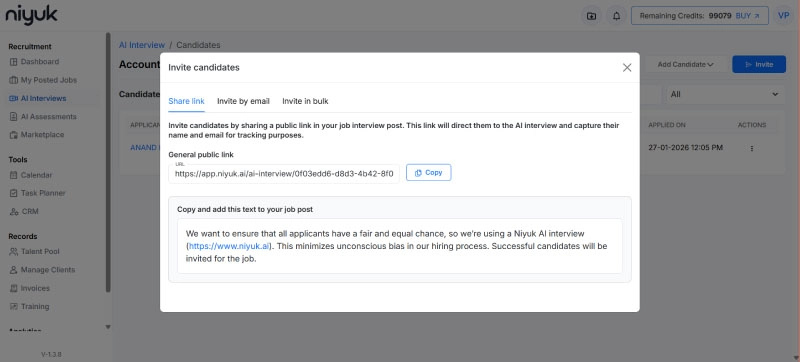
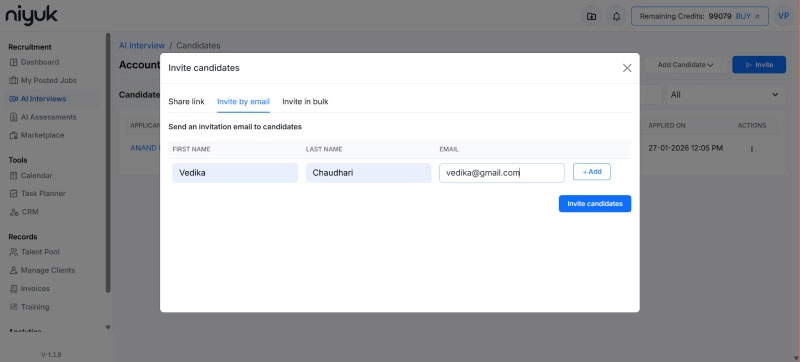
- It will take you to the Invite Candidates window. You will be on the Share the link menu option. Another two options you can browse are – “Invite by email” and “Invite in bulk”. A message for ‘Interview Created Successfully’ will be displayed.
- Then, you can click on Generate Public Link, where the generated link is available for the interview. Copy the same to send candidates the invitation link by any given mode.
Step 3: AI Takes the Interview
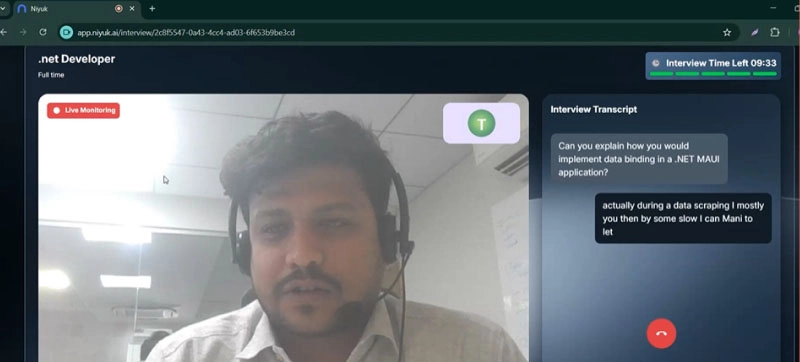
- Upon receiving the link, any candidate can click on the link as per his schedule or time zone convenience and start the AI interview.
Step 4: Detailed Report
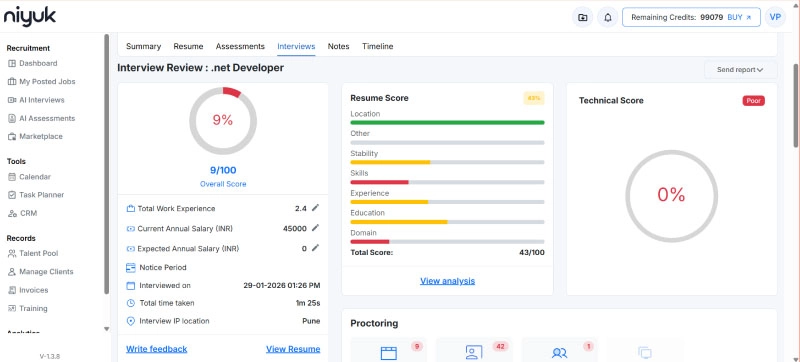
- Upon giving the AI interview, questioned one by One by AI, the Assessment review with Resume matching scores is displayed at the end of it. Also, A video clip is attached for reference with it.
Future of AI interviews
1. AI Job Posts
This AI tool is made to support make and maintain job posts that are regular, compliant, and matched with a company’s brand. It checks both live and draft job posts to make sure that they add up-to-date information, meet compliance requirements, and are well engaging.
The AI understands from hiring head’s discussions and interview feedback to give custom updates to job posts. It works dynamically with users, adapting based on their input to skip common recommendations. Above all, it regularly monitors job posts for their accuracy and relevancy.
2. AI Based Career Site
An AI-powered career site helps brands improve their job portals by giving candidates an individualised job search experience. Using AI, the site recommends jobs which are best matching every candidate’s skill, interests and location. It makes easy for candidates to find suitable opportunities faster.
3. AI Note Taking for Recruiters
AI note taking tools use artificial intelligence and advanced speech recognition to automatically record, transcribe, and organize notes in-between or after the interviews. These tools can grab interviews directly or work on uploaded audio or video files, then transcribe the dialogue, summarize key points, and well develop the content into organized notes. The output can be shared with hiring teams and integrated into ATS or other platforms like CRM.
4. AI Panel Feedback Automation
AI panel feedback tools are to simplify and improve the way, hiring teams gathers, analyse, and synthesize feedback from panel interviews. By using AI (artificial intelligence), these tools transcribe the conversations, extract meaningful data, score candidates objectively, and generate well – structured reports, helping teams in making fast, fair hiring decisions.
Save Human Efforts and Time of your HR Team
Run smooth ai interviews 24/7 to grab top talent
AI Interview: Global Statistics for 2026
Find here some interesting global statistical data for 2026 on businesses consuming AI interview feature in their HR Automation process. Let us see the brief breakdown given here:
Future-Ready Metric | The Winning Figure | Strategic Insight |
Global AI Integration Rate | 87 – 88% | Many global businesses have now moved away from humanised legacy systems. |
Fortune 500 Industry Standard | 99% | AI screening is almost universal among the world’s most successful corporates. |
AI- Interview Adoption | 45% | Nearly half market has already swapped starting human calls for AI-based screening. |
Projected HR Evolution (2026) | 80% | Within a year, AI will be the basic driving engine for all HR functions. |
Recruiter Industry Confidence | 75% | The manpower is preparing for a total transfer towards automated and bias free interviewing. |
Conclusion
AI interviews are suitable for teams hiring at bulk, across various geographies and is in many languages. If you’re looking to lower down your recruiter’s workload, boost candidate experience, and maintain regular candidate assessment without any bias, AI can help. AI not only saves the workload and time but also to and fro communication cost and human efforts. AI tools are very useful for remote, high-volume, or multilingual recruitment needs. In case you need, AI features to implement within your HR team for recruitment and hiring objectives, you can drop an email to our Niyuk team at: sales@niyuk.ai
Frequently Asked Questions
1. Can an AI Interviewer Hire Better Than a Human?
AI interviewers can hire much better than humans in terms of efficiency, consistency, and volume. Studies reveal that, 90% reduction in time-to-hire and about 17-18% higher early retention rates. They excel at data-driven, objective and scalable screening.
2. How is AI Used to Analyse Interviews?
AI interviews are used to analyse by automation of transcription, doing summaries of key insights, and checking candidate replies via natural language processing (NLP) and behavioural analysis.
These systems like Dovetail, Looppanel, ChatGPT analyse video, audio, and text to identify patterns, sentiment, and real-time skills or post-interview, dropping down the hiring time up to 60% and making sure for objective assessments.
3. Can AI Create Interview Questions?
AI can effectively make customized, job-based interview questions, lowering down the preparation time for recruiters and hiring heads. By analysis of job descriptions and resumes, AI tools can make behavioural, technical, and company-related questions customised to evaluate key skills.
4. What Skills Do AI Interviews Assess?
AI interviews, with video, voice and text formats, also evaluate a blend of technical competency, soft skills, and behavioural traits, use of natural language processing (NLP) mainly and computer vision to analyse communication patterns, tone and facial expressions. They are designed to track communication proficiency, emotional intelligence, problem-solving abilities, cultural fit and technical skills.