

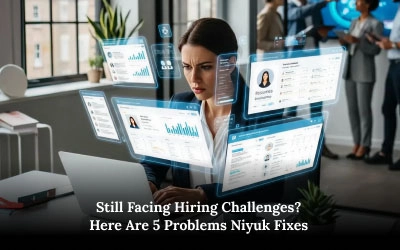
Hiring professionals in 2026, are operating in an increasingly tough environment where conventional recruitment methods juggle to maintain required speed with business demands. From uneven expectations among the stakeholders to pressure- driven admin tasks, recruiters get stucked unnecessarily sometimes, between giving quick results and maintaining quality. Such challenges faced by modern recruiters are not just incidents. But they represent system issues affecting recruitment efficiency across global industries.
The latest recruiter’s day often involves handling of endless email chains, manually screening thousands of applications, expecting feedback from very busy hiring managers, and struggling to show strategic value while drowning in operational tasks.
These kinds of bottlenecks make a cascading effect which affects time-to-hire, candidate experience, and business results.
What’s frustrating is that many such issues are generated out of very old processes and backword technology used for talent acquisition.
Anyhow, forward-thinking companies are changing these recruitment bottlenecks into competitive advantages via strategic process improvements and smart automation.
By mitigating five critical areas professionally, recruitment teams can transform from reactive order-taking to strategic business partnership, delivering measurable value while making exceptional experiences for candidates and hiring stakeholders both.
Solutions e.g. AI screening offered by platforms like niyuk.ai reducing administrative cost up to 60-75%, while improving candidate experience and hiring results. Uneven role expectations raise time-to-hire by 40% and responsible for 30% turnover rates in the first year.
Recruiters spend up to 40% of their valued time on communication instead of searching quality candidates. Popular positions now receive 200-300 applications needing 20-40 hours of manual screening time role wise.
Delays in giving feedback more than72 hours result in candidate drop-off rates ahead of 25%.
AI-based screening platforms get a 75% drop in time-to-shortlist while maintaining assessment standards. Organizations with 48-hour screening reply time experience 35% higher candidate acceptance rates.
Automated recruitment solutions drop administrative tasks by 60-75% while improving quality of the process. The transformation from tactical recruitment function to strategic business partnership needs systematic attention to these interconnected challenges.
Successful organizations deploy complete approaches aligning process improvements with smart technology adoption, allowing recruitment teams to focus on relationship building, strategic workforce planning, and market intelligence delivering genuine strategic value to business’s success.
Let us elaborate on challenges faced by recruiters.
Automate your Busy Work to Focus on the Talent
Switch to latest recruitment methods saving your daily hours
1. Mismatched Role Expectations from Stakeholders
This is very long-term challenge for recruitment professionals is the mismatch between different stakeholder’s expectations to meet for the role.
Hiring managers mostly have some expectations or requirements regarding an ideal candidate for the post. HR teams have requirements based on company policies and budget limits. But the executives may have fully different expectations based on strategic objectives.
This mismatch makes a domino effect via the recruitment process. This leads to waste of time, frustrated candidates, and in actual, failed placements damaging both efficiency parameters and professional relations.

1. The Loss of Mismatched Job Requirements
The basic cause of this misalignment stemming from less upfront collaboration during role definition phases. Placement managers focus on prompt tactical needs without thinking about any broad organisational context. As HR professionals may focus on compliance and cultural fit over certain technical requirements.
Meanwhile, executives mostly introduce sudden changes based on market conditions or strategic moves, making moving targets that creates regular candidate evaluation mostly impossible.
2. Filling up the Gap of Communication
This alignment gap becomes certainly hassle when recruitment teams invest remarkable time sourcing and candidates screening who really do not match stakeholder expectations which were not communicated or documented.
How Niyuk Fixes This:
- Creates a single, shared role definition for hiring managers, HR, and leadership, so that they can easily align among them for the best fit.
- Documents and prioritises expectations upfront (must-haves vs flexible criteria). This will ease the exact expectation for the role from a candidate.
- Applies consistent, role-based screening rules for all candidates, so fair chance to each one of them will be given by the employer to prove their skills.
- Makes expectation changes visible to all stakeholders in real time, to avoid further confusions before final shortlisting.
- Prevents wasted shortlisting and late-stage candidate rejections with AI driven processes of sorting in time.
- Keeps hiring aligned, faster, and fair throughout the process by all process’s automation.
2. Continuous Two-end Communication Cycles
As per the research, poor job requirements increase time-to-hire by an average of 40% and support to turnover rates more than 30% in the first year of employment. When stakeholders are not happy with the basic role expectations, recruitment teams mostly find themselves starting the process for many times with various candidate profiles.
This makes a cascading effect where prospective candidates lose interest due to prolonged timelines, quality candidates are lost based on shifting criteria, and recruitment teams also lose credibility with both internal stakeholders and external talent pools.
The financial impact extends apart from the immediate recruitment costs to include lost productivity from unfilled positions, extra workload for existing team members, and the hidden costs of re-recruiting when mis-hired employees inevitably quit.
Organisations with clear and aligned job requirements normally see 60% fast placement rates and remarkably grow in new hire satisfaction scores, displaying the tangible benefits of time investment in proper role definition upfront.
Good organisations implement well-designed requirement-gathering processes which bring all stakeholders on a common page before hiring.
This consists of conducting workshops where recruitment managers, HR representatives, and executives join to define required and preferred qualifications, discuss and analyse real- market availability for expected skill combinations, and to set clear decision-making criteria guiding the actual candidate evaluation.
These activities could produce documented job profiles that all parties duly sign on, creating accountability for maintaining consistent expectations via the hiring process.
Latest recruitment mostly becomes ineffective by communication overheads, with recruiters incurring up to 40% of their time only in management of email chains, coordinating schedules, and offering repetitive status updates over identifying and engagement of quality candidates.
These communication cycles typically involve multiple stakeholders who need different information at different frequencies, making a tedious web of human coordination becoming increasingly tough to manage as hiring volume improves.
The challenge intensifies when considering the global type of many organisations, where stakeholders operate across various time zones and have variable communication preferences.
A single recruitment process might involve hiring managers in multiple locations, interview panels with challenging schedules, and executives needing regular updates with limited availability for complete discussions.
This develops a situation where recruitment progress slowdowns to accommodate the lowest common denominator of communication efficiency, mostly results in top candidates accepting other offers while internal coordination goes on.
How Niyuk Fixes This:
- Brings all hiring communication into one shared platform to avoid any hassle among them to provide ultimate synchronisation.
- Keeps role requirements, updates, and feedback visible to all stakeholders to offer a uniform level of transparency throughout the process.
- Enables structured, stage-wise feedback instead of ad-hoc discussions to offer clear communication to candidates and stakeholders.
- Reduces coordination effort and speeds up hiring decisions so that right candidates can be acquired in timeline.

1. Emailing Stress and Scheduling Hassles
As per research data, hiring professionals send an average of 73 emails for an open position, with scheduling-related communications making almost 45% of this volume.
The human process of coordinating interviews between many parties creates exponential tedious situations – a simple three-person interview panel needs managing six different schedule matches, while making sure for the sufficient timeframe for preparation and feedback gathering.
This administrative burden increases remarkably when dealing with candidate databases involving many applicants across multiple roles at a time.
The time cost becomes particularly proof when considering that each scheduling exchange typically needs 2-3 communication rounds. With an average 8-hour delay between replies due to competing priorities.
This means a straight interview scheduling process can consume 3-4 days of calendar working time and many hours of actual coordination effort, during which competitive candidates can accept offers from more attentive organisations.
How Niyuk Fixes This:
- To automate interview scheduling by syncing calendars and finding common availability of both to occur it smoothly.
- Centralises interview communication to reduce email back-and-forth and saving much time at all levels.
- Speeds up interviews so candidates don’t drop off due to delays in the recruitment process.
2. Automated Communication Solutions
Intelligent screening platforms like Niyuk address volume level challenges via automated resume parsing and candidate matching that can simply process hundreds of applications in some minutes rather than hours.
Niyuk. Ai’s Resume Screening solution highlights this capability, using AI algorithms to score and rank candidates in real-time based on their work experience, education, and skills aligned with job requirements. These systems give a 75% reduction in time-to-shortlist while improving the quality of candidate identification process compared to regular manual processes.
Candidates report significantly high satisfaction / experience with recruitment processes that offering fast responses to queries and self-service scheduling options, while recruitment teams may deflect their time from administrative communications to strategic candidate assessment and relation building.
3. Making Simplified Feedback Channels
Feedback management expects setting up of clear protocols for various possible sources, the valuable input will be collected during the recruitment process. Analogous challenges live in client support operations, which is why numerous businesses are now espousing AI call center solutions to give moment and scalable client support.
These covers deploying joint assessment platforms where stakeholders can offer designed or crafted feedback against certain criteria, automated alert systems that promptly replies without any need of manual follow-up, and centralized dashboards dedicating visibility into assessment status for all active candidates.
By standardizing these processes, organisations remove the ad-hoc communication loops or channels that typically incurs major recruiter time while making sure for the entire assessment of all candidates.
How Niyuk Fixes This:
- Uses AI to quickly screen and rank resumes based on role requirements to avoid many delays for these processes along with high accuracy level.
- Reduces shortlisting time by handling large volumes automatically with the help of AI based screening and sorting processes.
- Improves candidate experience with fast responses and smoother communication without any stop gaps of communication upon interviews.
Stop Manual Tracking & Start Recruiting with Speed
Scale faster with end-to-end hiring automation
3. Time Lost in Manual Resume Screening and Sorting
Too many applications for any job position exceeds tremendous workload for HR teams for resume screening and assessment work. As per the available industry data, every position attracts 200-300 applicants in a week upon job posting, and more than 1000 applicants are there in a week for a favourite or hot job position post.
Manual screening process long last 6 to 8 minutes per resume for screening. So, almost 20 to 40 hours are required for the overall screening of CVs of candidates for a post published. This leads to final shortlisting of a deserving or suitable candidate for the position.
But this sort of a biggest challenge makes hiring quality versus speed issue where hiring teams must select from candidate evaluation and responsive hiring timelines.
Manual screening done in speed causes mismatched or misaligned candidate selection with possible overlooking of qualified candidates. A complete screening process takes much time delay making deserving and suitable candidates to runaway to competitors due to much time lost.
The situation becomes specifically intense during high-volume hiring times or for organizations functioning in competitive talent markets where speed-to-contact remarkably affects conversion rates of candidates.
Apart from this time consumption in manual screening process, it faces a challenge of inconsistency. At the same time, competitors do the selection of same level of candidates by using variable criteria’s and achieves their placement goals.
Such inconsistency scenarios hamper objective evaluation of HR teams and making unnecessary legal compliances due to irregular selection criteria.
Organizations require vast screening solutions which will maintain the uniform evaluation quality at the same time will lower down the invested time from hiring professionals or teams.
How Niyuk Fixes This:
- Automatically screens and ranks resumes in minutes to avoid manpower efforts, time and give an accuracy in results.
- Applies the same criteria to every candidate for consistency to avoid any manual bias. Bias free selection.
- Speeds up shortlisting so good candidates aren’t lost due to process delays and communicational gaps.

1. The Volumetric Challenge in Today’s Recruitment
As per the latest market data, hiring teams are processing 40% more applications per role as compared to pre-2023 levels, while available recruiter capacity has remained static. This creates a mathematical imperfection where deep level of manual evaluation remains unachievable within reasonable time limits.
Organizations trying to maintain manual screening, tells that recruiters spend 65% of their time on initial review of resume, leaving insufficient space for candidate engagement, stakeholder management, and strategic hiring actions driving good hiring results.
The prolonged initial screening process gives overall compound effect on the entire recruitment process. This causes getting delayed communication and confirmation to selected candidates, disinterest shown by the candidates due to delays and frustrating experience for recruitment professionals at the end of the day for not following their recruitment timelines given.
This may also attract improper placement choices from their sides creating more mess for the future.
As per the industry benchmark or standard, a 48- hour initial screening process completion will gain 35% more candidate acceptance rates for the position.
To get it done with speed and accuracy, niyuk.ai is the preferred platform in this.
How Niyuk Fixes This:
- Handles high application volumes with AI screening, reducing manual resume review time as well as efforts and manual biases.
- Helps recruiters complete initial screening, improving candidate acceptance rates due to fast processes and accuracy and transparency.
- Frees recruiters to focus on candidate engagement and decision-making instead of resume filtering, as this is done accurately by AI based process.
2. AI-Powered Screening Technologies
Intelligent screening platforms address volume challenges with automated resume parsing and candidate matching. These features are Ai driven. They can process hundreds of applications in minutes. Niyuk’s Resume Screening solution exemplifies this capability, using proprietary AI algorithms to score and rank candidates in real-time based on work experience, education, and skills alignment with job requirements.
These systems get a 75% reduction in time-to-shortlist while retaining or improving the quality of candidate identification process compared to manual processes.
Advanced screening technologies go above the simple keyword matching to know contextual relevance and transferable skills that human reviewers might miss during manual evaluation.
The platform’s intelligent assistants arrange automated screening interviews. They evaluate candidates based on their responses to role-specific questions. Also creating completed candidate profiles enabling data-driven shortlisting’s rather than subjective resume interpretation.
How Niyuk Fixes This:
- Uses AI to screen and rank hundreds of resumes in minutes to avoid human intervention and efforts with time delays.
- Reduces time-to-shortlist by up to 75% without losing quality with AI technology use for maintaining accuracy in results.
- Goes beyond keywords to understand skills and role fit to offer an accuracy and precision in decisions.
- Uses automated screening questions to build complete candidate profiles and remove human biases as well as giving fair chance for skill presentations or performance.
4. Following up for Feedback from Busy Hiring Managers
One of the most stressful aspects of latest recruitment adding the constant follow-up for intime feedback from hiring managers who are also managing their primary business duties. This makes a cycle where recruitment momentum waits while waiting for evaluation details, candidates become impatient with delayed communication, and competitive offers initiates during extended decision-making periods.
The challenge becomes intense in senior-level recruitment where hiring managers are busy executives with planned schedules and going through priorities mostly take precedence over recruitment evaluation tasks.
The conventional feedback collection process depends heavily on human follow-up, informal communication channels, and personal relationship management, which doesn’t scale effectively across multiple equally working recruitment processes.
Recruiters find themselves in a challenging position, as they must keep healthy relations with hiring managers, at the same time push the speed of the entire recruitment process.
This can strain professional relations and gear ups tension between recruitment teams and the business stakeholders they’re trying to support, ultimately weakening the collaboration with hiring heads essential for sound talent acquisition.

1. Delayed Decisions- Hidden Costing
Research shows that feedback beyond 72 hours result in candidate drop-off rates more than 25%, with top-class candidates are likely to withdraw themselves from the active consideration when they experience and feel slow decision-making due to the organizational inefficiency.
In competitive talent markets, the top performing candidates normally manage many opportunities simultaneously. It makes prompt evaluation and feedback crucial for retaining their interest within the entire recruitment processes which naturally extend over many weeks.
The cascading effects of late feedback extend far ahead with sudden candidate loss, adds up employer brand damaged perception, prolonged time-to-fill metrics that hamper business operations, and raised up recruitment costs as processes again restart with new candidate pools.
On the other side, companies achieving average feedback turnaround times below 48 hours report for 60% high offer acceptance rates and mention ably short overall hiring cycles. This shows the tangible business benefits of prompt feedback management.
Successful organizations implement standardized assessment criteria and scoring frameworks that allow regular, efficient feedback collection from hiring managers.
These frameworks provide clear rubrics for assessing candidates against predetermined competencies, reducing the time and effort needed for hiring managers to offer meaningful input while making sure for the complete evaluation process. Well planned approaches also make accountability via defined timelines and escalation processes when feedback collection exceeds established timeframes.
Digital assessment platforms facilitate this process by giving hiring managers user-friendly interfaces for recording candidate assessments, automated prompts and alerts for pending evaluations. They also offer the consolidated views of candidate performance across multiple assessors.
This systematization drops down the administrative burden on recruiters and hiring managers while maintaining in-depth candidate evaluation standards.
How Niyuk Fixes This:
- Quick feedback forms for hiring managers to avoid much documentation and time spending on such tasks.
- Automated reminders instead of manual follow-ups to save time and prevent gap in any communication on human level.
- Clear visibility on pending decisions due to data insights or analytical data shows accuracy in results to take right decisions.
- Calendar integration to schedule interview meetings on time.
2. Feedback Management Technology Solutions
Latest recruitment platforms incorporate sophisticated feedback management capabilities automating collection, tracking, and follow-up processes. They offer full visibility to evaluation status across all active candidates.
niyuk.ai’s collaborative scoring and feedback mechanisms exemplify this approach, allowing multiple stakeholders to record structured evaluations against predefined criteria while automatically aggregating diverse perspectives into comprehensive candidate assessments that reduce individual bias and make sure for the objective hiring decisions.
These solutions typically include automated reminder systems that prompt timely feedback without manual recruiter intervention, mobile-optimized interfaces enabling evaluation input from any device or location, and analytics dashboards tracking feedback turnaround times and to identify bottlenecks in evaluation processes.
By systematizing these earlier manual processes, organizations can maintain recruitment momentum while ensuring thorough candidate evaluation from all relevant stakeholders.
How Niyuk Fixes This:
- Automated feedback collection and tracking of each candidate to save time and documentation work.
- Shared scoring to all stakeholders in one place to take next decisions effectively and faster.
- Structured evaluations reduce bias and confusion to get equal opportunity to all the candidates.
- Smart reminders remove manual follow-ups to skip any possible communication gap and delay.
Make Atomised Candidate Matching
Stop referring bad resumes, let AI screening find top 1%
5. Proving Strategic Value Amid Administrative Burdens
Perhaps the most significant challenge facing modern recruitment professionals is showing or displaying strategic business value while being loaded heavily by operational tasks which really drains their work time and energy.
Traditional recruitment parameters like time-to-fill and cost-per-hire fail to acquire the strategic contributions which recruitment can make to organizational success. But administrative workload prevents recruiters from engaging in the relation building, market intelligence collection, and strategic workforce planning which enlightens genuine business effect.
This challenge becomes particularly more intensive as organizations growingly expect recruitment teams to function as strategic business partners over just order-taking service providers.
Anyhow, when 70% of recruiter time is incurred in administrative coordination, manual screening, and process management, there’s insufficient limit for the strategic activities which would display this higher value proposition.
The result is a cycle where recruitment team juggle to prove their strategic worth while being failed to invest time in strategic activities due to multiple operational demands.

1. Measuring Recruitment Impact Over Basic Parameters
Strategic recruitment value needs measurement frameworks which extend beyond traditional operational parameters to grab business impact dimensions like quality of hire assessments, diversity and inclusion improvements, new hire time-to-productivity rates, and long-term retention stats corelating with recruitment usefulness. These advanced KPIs show how recruitment activities support to organizational performance over simply measuring process efficiency.
Leading organizations now track metrics like new hire performance ratings at 6 and 12-month intervals, cultural fit assessments that predict long-term success, and diversity pipeline development supporting organizational inclusion objectives.
niyuk.ai’s analytics capabilities support this strategic measurement approach via real-time reporting that provides insights into candidate funnel performance and recruitment KPI tracking. This enables data-driven optimization of recruitment processes.
2. Automating Administrative Tasks
Technology automation reflects the highly effective pathway for the removal of routine administrative work, which prevents recruiters from focusing on highly strategic, value-added activities.
Entire recruitment platforms like niyuk.ai is quite capable to automate candidate communication, screening process, automate interview scheduling, feedback gathering and status reporting.
They typically reduce administrative overhead by 60-75% while improving process quality and candidate experience.
niyuk.ai’s automation capabilities exemplify this shift, with features like AI-based screening which removes manual resume review, automated scheduling systems that coordinate interviews without any human recruiter’s intervention, and intelligent candidate matching identifying qualified applicants without extensive manual search. By automating these routine tasks, recruitment professionals can redirect their time towards relationship building with hiring heads, strategic workforce planning, market intelligence development, and candidate experience improvement that deliver genuine strategic value to their businesses.
The shift over of recruitment from a tactical function stressed by administrative tasks to a strategic business partner needs planned attention to these five critical challenge areas.
Organizations addressing stakeholder alignment, communication efficiency, screening automation, feedback management, and strategic measurement position their HR teams for success. They create competitive advantages in talent acquisition.
How Niyuk Fixes This Challenge:
- AI screens resume instantly, so no manual shortlisting is required. Accuracy is more.
- Automated scheduling and follow-ups avoid back-and-forth emails much more and removes process delays further.
- Structured feedback gets faster, bias-free decisions and avoids time spending on it.
- Real-time analytics provides clear visibility into hiring impact.
- Less admin works due to repetitive tasks and follow ups are done automatically with AI, more time is allotted to the recruiters for strategic hiring.
Conclusion
The key lies in finding that, these challenges faced by modern recruiters are interconnected – resolving them needs complete approach combining process improvements with intelligent technology adoption.
Rather than accepting these challenges as unavoidable aspects of modern recruitment, forward-thinking organizations are using solutions that eliminate operational friction while enhancing recruitment’s strategic contribution to business success. Modern recruitment methods are need of the hour.
The recruitment teams that grow in 2026 and beyond will be those, that transform these long-lasting pain points into systematic competitive edges through strategic process design and smart automation amplifying manual capability rather than replacing it. Recruitment automation is the real solution.
For more details on these challenges and their handling, you can contact Niyuk team on: sales@niyuk.ai
Frequently Asked Questions
Q: What are practical ways to reduce endless email chains and back-and-forth scheduling during recruitment?
A: To reduce email chains and scheduling friction in recruitment, use automated booking tools (e.g., Calendly, Doodle), embed booking links in email signatures, and use pre-written email templates for common communications. Consolidate information, set clear subject lines, limit options to 4–6, and use group polls for internal alignment.
Q: Why does manual resume screening take so much recruiter time, and how can it be improved?
A: Manual resume screening is time-intensive, often taking 24+ hours per hire, due to high application volumes (averaging 250+ per job), the need to manually parse varied formats, and the cognitive fatigue of reviewing resumes in bulk. It causes bottlenecks, increases costs, and invites bias. Improvements include AI-powered tools, ATS optimization, and well-designed pre-screening assessments.
Q: Can Niyuk help reduce recruitment costs?
A: Yes. Niyuk can significantly lower recruitment costs by using AI to automate time-consuming tasks such as resume screening, candidate assessments, and scheduling. It reduces dependency on external agencies and cuts manual recruiter effort by up to 70%, resulting in lower cost-per-hire, faster turnaround times, and fewer hiring mistakes.